All species › Passerines › Sparrows › Socotra Sparrow
Socotra Sparrow | Passer insularis
Socotramus | Gorrión de Socotora
The sparrow of Socotra: an endemic of the Socotra archipelago found wherever there is a bush, a village or a well, from the coastal plain high into the Hajhir mountains. With an estimated more than 200,000 birds on the main island it is one of the most numerous land birds of the archipelago.
Voice
A typical sparrow chilp and cheep, somewhat fuller and more metallic than in House Sparrow, and a soft twittering in flocks; in alarm a fast, dry rattle.
Recording: Mischa Keijmel — CC BY-NC-SA 4.0 · shortened to the first 60 s, mono · xeno-canto
Identification
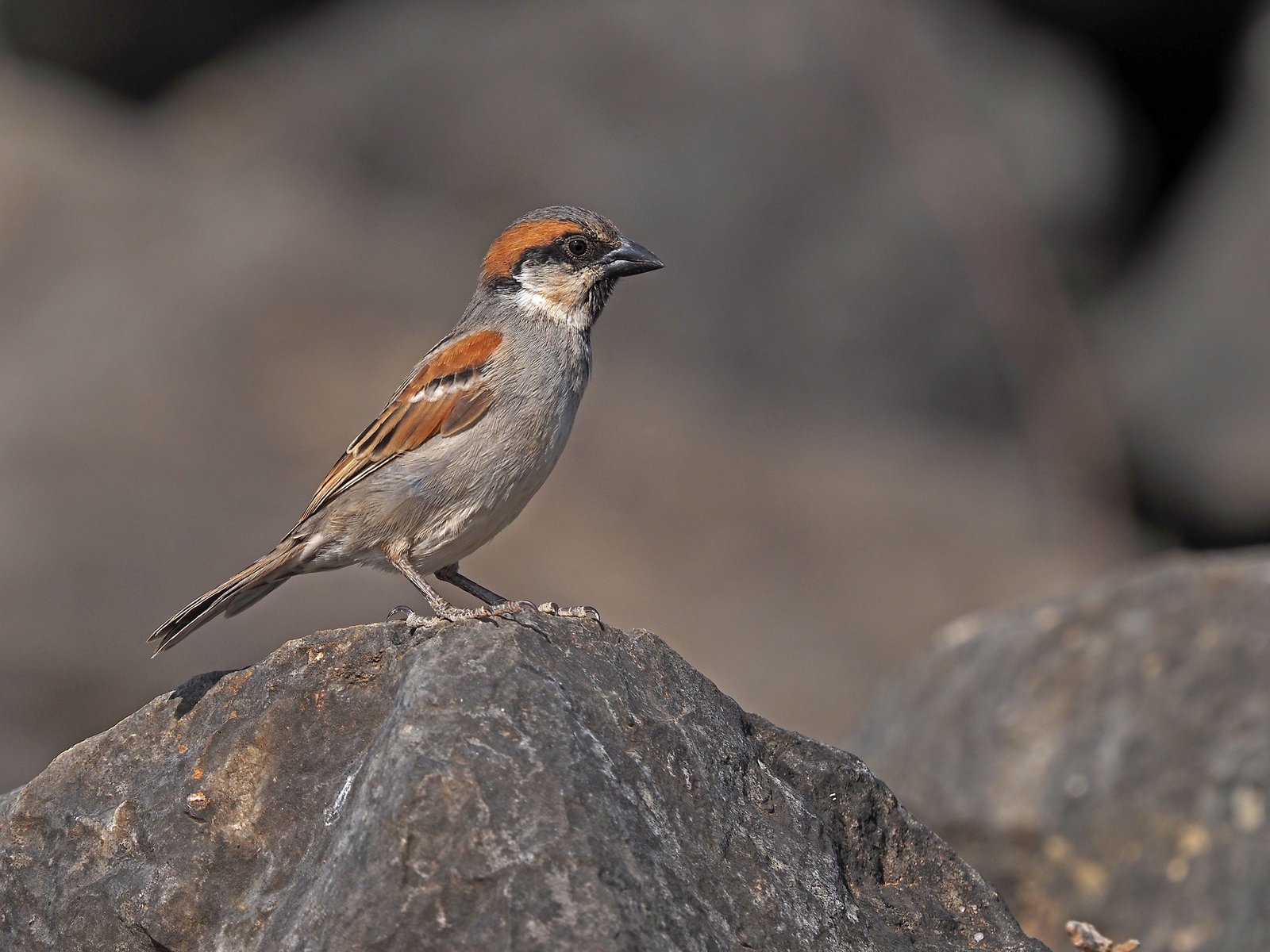
About 14–15 cm, the size of a House Sparrow, with a fairly heavy black or dark bill. The male has a grey crown and nape, a broad, rich chestnut band from behind the eye along the head-side to the nape, black lores, extensive black around the ear-coverts, a white cheek and a black bib extending onto the upper breast. The mantle is brown with heavy black streaks, the rump grey, the underparts pale grey, and the wing shows a narrow white bar. The female is plain grey-brown with a pale, buffish supercilium, streaked back and dirty white underparts; juveniles resemble the female. Birds on Samha and Darsa are clearly smaller.
Confusion species
There is little to confuse on Socotra. The Abd al-Kuri Sparrow (Passer hemileucus), of Abd al-Kuri island in the same archipelago, is smaller and paler, with sandy rufous rather than chestnut head-sides, sandy buff underparts, less black on the ear-coverts and a bib confined to the throat. A House Sparrow (Passer domesticus) has a chestnut band from behind the eye to the nape bordering a grey crown, but a greyish cheek and a narrower head pattern. Females may recall a female Socotra Golden-winged Grosbeak (Rhynchostruthus socotranus), but that has a much heavier bill and yellow wing patches.
Habitat
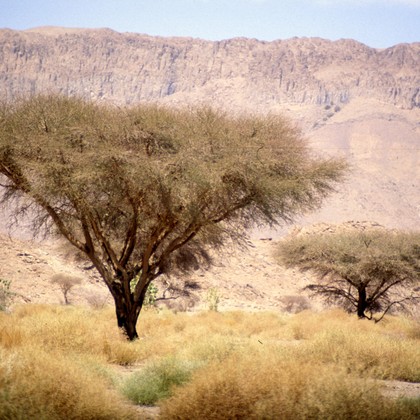
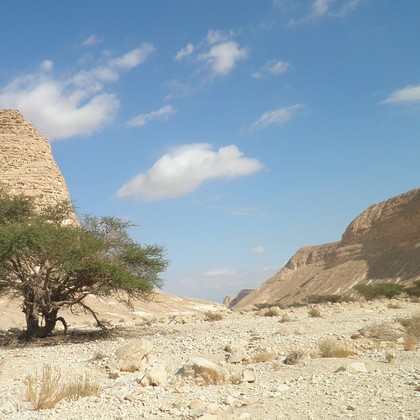
Almost any open or semi-open ground with shrubs and trees: croton scrub and acacia country on the coastal plain, dry riverbeds with scattered trees, rocky slopes with dragon's blood and frankincense trees, up to the plateaus of the Hajhir mountains. Also common in and around villages, yards and wells, where it feeds on scraps and grain. It nests in tree holes, rock crevices, walls and eaves, and sometimes builds free-standing nests in bushes.
Where the bird is most at home, classified by the habitats of North Africa and the Middle East.

Range and movements
Only in the Socotra archipelago (Yemen): common on the main island of Socotra, with smaller populations on Samha and Darsa, where the birds are smaller and may form a separate subspecies. On Abd al-Kuri it is replaced by the Abd al-Kuri Sparrow. Not known outside the archipelago.
- Winter visitor (c. Oct–Mar)
- Passage (Mar–Apr, Oct–Nov)
- dark = core range, pale = thinly spread
How and when to look
On Socotra it cannot be missed: at every village, campsite and well in the Dixam and Homhil areas small groups come for crumbs and water. A breeding-plumaged male with the chestnut head band is best seen at sunrise on a boulder or a dragon's blood tree.
Conservation status
Not threatened. Widespread and common on Socotra; the small populations on Samha and Darsa are vulnerable because of their size. Longer-term threats are overgrazing by goats and the possible establishment of introduced species such as the House Crow, which was eradicated from Socotra in 2009.
Scientific name
Passer insularis | Sclater & Hartlaub, 1881
Sclater & Hartlaub described the species in 1881 and placed it straight away in the genus where it still stands. The genus Passer was introduced in 1760 by Brisson. Passer is the Latin word for 'sparrow'. insularis is Latin for 'of an island', after Socotra. The specimen the first description was based on came from Socotra, Yemen.