All species › Passerines › Cisticolas › Socotra Warbler
Socotra Warbler | Incana incana
Incanagraszanger | Prinia de Socotora
The Socotra Warbler is a grey, long-tailed songbird found only on Socotra and the sole member of its own genus. It is widespread and common there, from the coastal plain high into the Hajhir mountains, and gives itself away by its lively song and its habit of cocking its tail.

Voice
A lively, fairly loud song of rapid, clear whistles and trills, often in duet; the call is a sharp chik and a grating chatter when alarmed.
Recording: Mischa Keijmel — CC BY-NC-SA 4.0 · converted to mono · xeno-canto
Identification
12–13 cm. Prinia-like, but sturdier and with a shorter, less strongly graduated tail. Upperparts plain grey to grey-brown, unstreaked; underparts off-white with a grey or soft buff wash on the breast and flanks. Pale lores and an indistinct pale supercilium, dark eye-stripe weak. Tail dark grey with pale tips, often cocked and swung sideways. Bill fairly long and pointed. Sexes alike.
Confusion species
On Socotra the only confusion species is Socotra Cisticola (Cisticola haesitatus): it is smaller, heavily streaked above, with a short tail and a rusty rump, and lives in low coastal scrub. Migrant Curruca warblers have a shorter, straighter tail and different head and wing markings.
Habitat
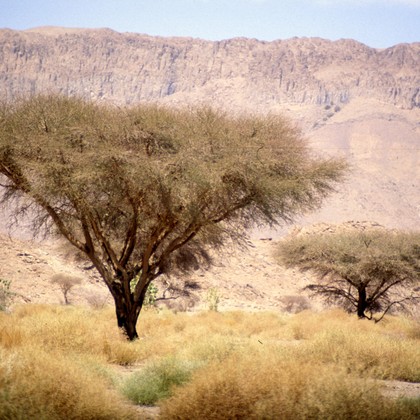
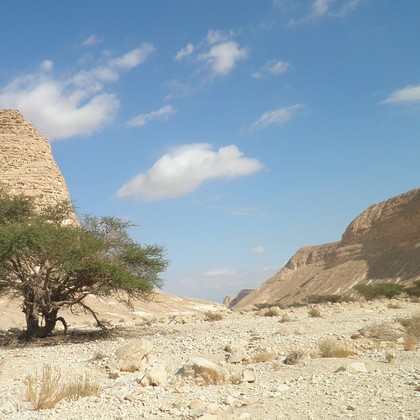
Scrub and rank vegetation of almost every type on the island: Croton scrub and dragon's blood trees on the limestone plateau, vegetated wadis and gardens, grassy slopes and dense vegetation in the Hajhir mountains, from sea level to about 1,400 m. Forages low in bushes, in pairs or family parties. Eats insects.
Where the bird is most at home, classified by the habitats of North Africa and the Middle East.

Range and movements
Endemic to the island of Socotra (Yemen), where it occurs over almost the whole island; not known from the other islands of the archipelago. Found nowhere else in the world.
- Winter visitor (c. Oct–Mar)
- dark = core range, pale = thinly spread
How and when to look
Easily seen in the bushes around Hadibu, in the wadis near Ayhaft and on the Diksam plateau; walk quietly along a scrub edge and wait for the inquisitive birds to pop up with their cocked tails.
Conservation status
Not globally threatened; common within its small range. Potential threats are overgrazing by goats, road building and development, and climate change on the island.
Scientific name
Incana incana | (Sclater & Hartlaub, 1881)
Sclater & Hartlaub described the species in 1881 as Cisticola incana; because it was later moved to another genus, the author and year stand in brackets. The genus Incana was introduced in 1930 by Lynes. Incana is Latin for 'grey' or 'hoary'; the genus name was taken from the species name incana. incana is Latin for 'grey' or 'hoary'. The specimen the first description was based on came from Socotra, Yemen.