All species › Passerines › Chats and flycatchers › Spotted Flycatcher
Spotted Flycatcher | Muscicapa striata
Grauwe vliegenvanger | Papamoscas gris
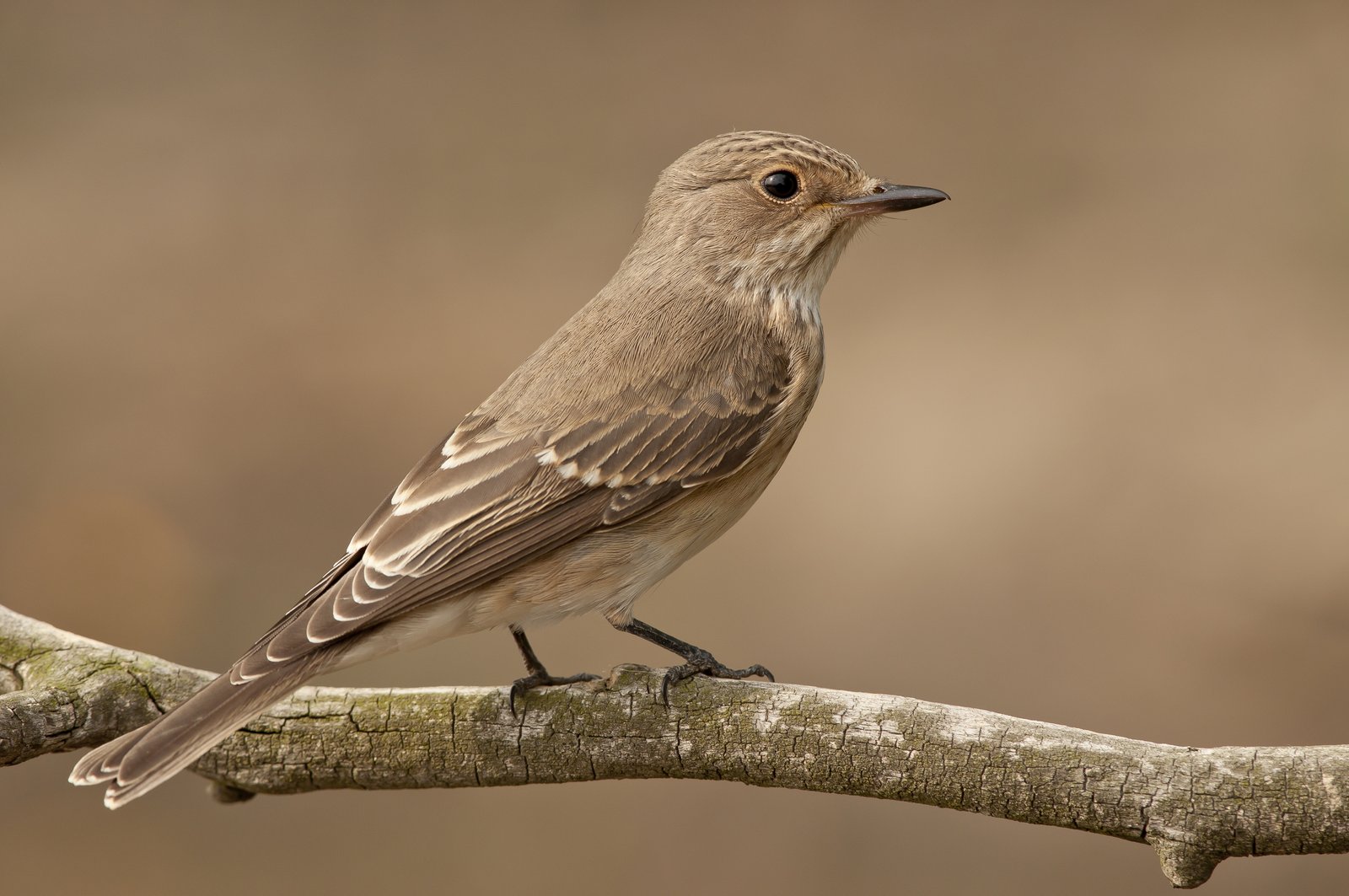
The Spotted Flycatcher is an inconspicuous grey-brown songbird that catches insects in the air from a fixed perch and then returns to the same branch. In this region it breeds in the woodland and gardens of the Maghreb and the Levant and passes through the whole region in large numbers to sub-Saharan Africa.
Voice
Little song: a soft, scratchy series of high squeaks. The call is a sharp, high tseeep, and when alarmed tsee-tek-tek.
Recording: Philippe Grange — CC0 · converted to mono · xeno-canto
Identification
13.5–15 cm. Upperparts grey-brown, the crown finely streaked dark, throat and breast off-white with diffuse grey-brown streaks, belly white. Wings with pale fringes to the tertials and a narrow pale wing-bar. Fairly long wings with a clear primary projection. The bill is black and broad-based, the legs short and black. Sexes are alike; juveniles are spotted pale above. Sits very upright, sallies out in a short loop after an insect and often returns to the same perch, with a characteristic flick of wings and tail.
Confusion species
Gambaga Flycatcher (Muscicapa gambagae) of south-western Arabia is smaller, with a shorter wing point, an unstreaked plain crown and fainter, more blotchy breast markings. Females and juveniles of European Pied Flycatcher (Ficedula hypoleuca), Collared Flycatcher (Ficedula albicollis) and Semicollared Flycatcher (Ficedula semitorquata) have a white wing patch and an unstreaked breast.
Habitat
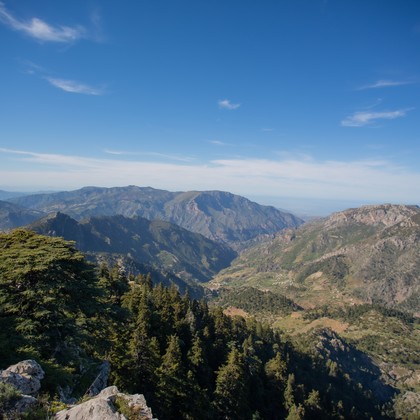
In the breeding season open woodland with old trees, woodland edges, parks, olive groves, orchards and villages; in the Atlas up into the cedar forest. On passage any place with trees or bushes: oases, date-palm gardens, wadis with acacias, city parks and gardens even in the middle of the desert. Feeds on flying insects.
Where the bird is most at home, classified by the habitats of North Africa and the Middle East.


Range and movements
Breeds in Morocco, northern Algeria and Tunisia and in north-western and north-eastern Libya (Jebel Akhdar), and in the Levant: Israel (scarce), Lebanon, Syria and northern Jordan, also in northern Iraq. On passage common throughout the region, including the Sahara, Egypt, Sinai, Saudi Arabia, Yemen (including Socotra), Oman and the Gulf states; in autumn often the commonest migrant flycatcher. Winters in sub-Saharan Africa, south to South Africa. Beyond the region it breeds across Europe and western Asia to central Siberia and Mongolia.
- Summer visitor (c. Apr–Sep)
- Winter visitor (c. Oct–Mar)
- Passage (Mar–Apr, Oct–Nov)
- dark = core range, pale = thinly spread
How and when to look
On autumn passage in September in any city park or hotel grounds in the Gulf states, Egypt or Eilat: look for a grey-brown bird sallying from a low branch and returning. In the breeding season in the cedar forests of the Middle Atlas around Ifrane and Azrou.
Conservation status
Not globally threatened, but it has declined steeply in much of Europe, possibly because of deteriorating conditions in the African wintering grounds and fewer insects. On passage it is locally caught with nets or lime sticks in the region.
Scientific name
Muscicapa striata | (Pallas, 1764)
Pallas described the species in 1764 as Motacilla striata; because it was later moved to another genus, the author and year stand in brackets. The genus Muscicapa was introduced in 1760 by Brisson. Muscicapa is Latin, from musca 'fly' and capere 'to catch'. striata is Latin for 'striated', from striatus, after the streaking on crown and breast. The specimen the first description was based on came from Holland.