All species › Passerines › Weavers › Streaked Weaver
Streaked Weaver | Ploceus manyar
Gestreepte wever | Tejedor listado
The Streaked Weaver is a South Asian reed weaver that has taken to breeding in the Gulf states as an escaped cage bird. The reedbeds and parks of the UAE now hold the largest population on the Arabian Peninsula.

Voice
A soft, whistling and creaking song ending in a drawn-out, high trill, roughly tsi-tsi-tsi-tsiiiiii, plus harsh grating notes; the call is a short chit or chirt.
Recording: Peter Ericsson — CC BY-NC-SA 4.0 · converted to mono · xeno-canto
Identification
14 cm, a compact weaver with a heavy, conical bill and a short tail. The breeding male has a bright yellow crown, a blackish-brown face and ear coverts, a pale throat and a black bill; the buffy breast and flanks are heavily streaked dark, the upperparts brown with dark streaks. The female and non-breeding male have a brown crown, a yellow or yellowish-white supercilium, a yellow patch on the side of the neck behind the ear coverts and a horn-coloured bill; the breast streaking remains visible. Juveniles resemble the female, with finer streaking.
Confusion species
Baya Weaver (Ploceus philippinus), also known as a cage bird, has a plain, unstreaked or barely streaked breast; the male has a yellow breast. Black-Breasted Weaver (Ploceus benghalensis) has a black breast band instead of streaks. Rüppell's Weaver (Ploceus galbula) is yellow below with a chestnut mask. Female sparrows and Scaly-breasted Munia (Lonchura punctulata) lack the combination of yellow supercilium, yellow neck patch and heavy bill.
Habitat
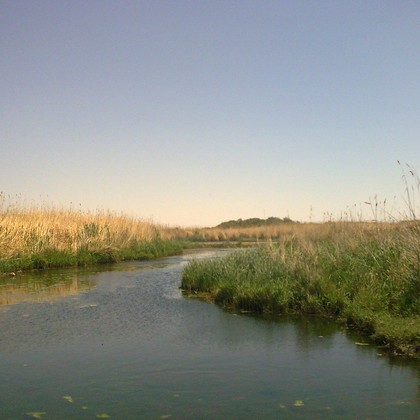
Reedbeds, bulrushes, tall grass and wet rank vegetation by ponds, sewage works and canals, and adjacent fields, parks and gardens. Breeds in small colonies in reeds: the nest is a ball of reed strips with a short entrance tube, woven onto a few stems, often with lumps of mud in the wall. Eats grass and reed seeds, grain and insects, in small flocks outside the breeding season.
Where the bird is most at home, classified by the habitats of North Africa and the Middle East.


Range and movements
Introduced only; the species does not originate from the region. United Arab Emirates: established and most numerous, mainly in Dubai, Ajman, Abu Dhabi and Ras al-Khaimah. Saudi Arabia: since 1989 in the Eastern Province (Dhahran, Qatif) and also near Riyadh, a scarce breeder. Also small numbers in Qatar, Kuwait, Bahrain and northern Oman, and a few records in Egypt since 2017. The native range lies in Pakistan, India, Nepal, Bangladesh and Sri Lanka, east to South-East Asia, Java and Bali.
- Resident
- Summer visitor (c. Apr–Sep)
- Winter visitor (c. Oct–Mar)
- Passage (Mar–Apr, Oct–Nov)
- dark = core range, pale = thinly spread
How and when to look
In the UAE, check reedbeds and sewage works for males singing with their yellow crowns from a reed plume. Note whether nests are present at any site outside the known ones: the species' distribution in the Gulf states is still changing.
Conservation status
Not globally threatened. In the region an introduced species derived from escaped cage birds, with established breeding populations in the UAE and the Eastern Province of Saudi Arabia; irregular elsewhere.
Scientific name
Ploceus manyar | (Horsfield, 1821)
Horsfield described the species in 1821 as Fringilla manyar; because it was later moved to another genus, the author and year stand in brackets. The genus Ploceus was introduced in 1816 by Cuvier, GLCFD. Ploceus is Greek, from plokeus 'braider', from plekō 'to plait', after the woven nests. manyar is the Javanese name of this weaver. The specimen the first description was based on came from Java, Indonesia.