All species › Passerines › Weavers › Yellow-Crowned Bishop
Yellow-Crowned Bishop | Euplectes afer
Napoleonwever | Obispo coronigualdo
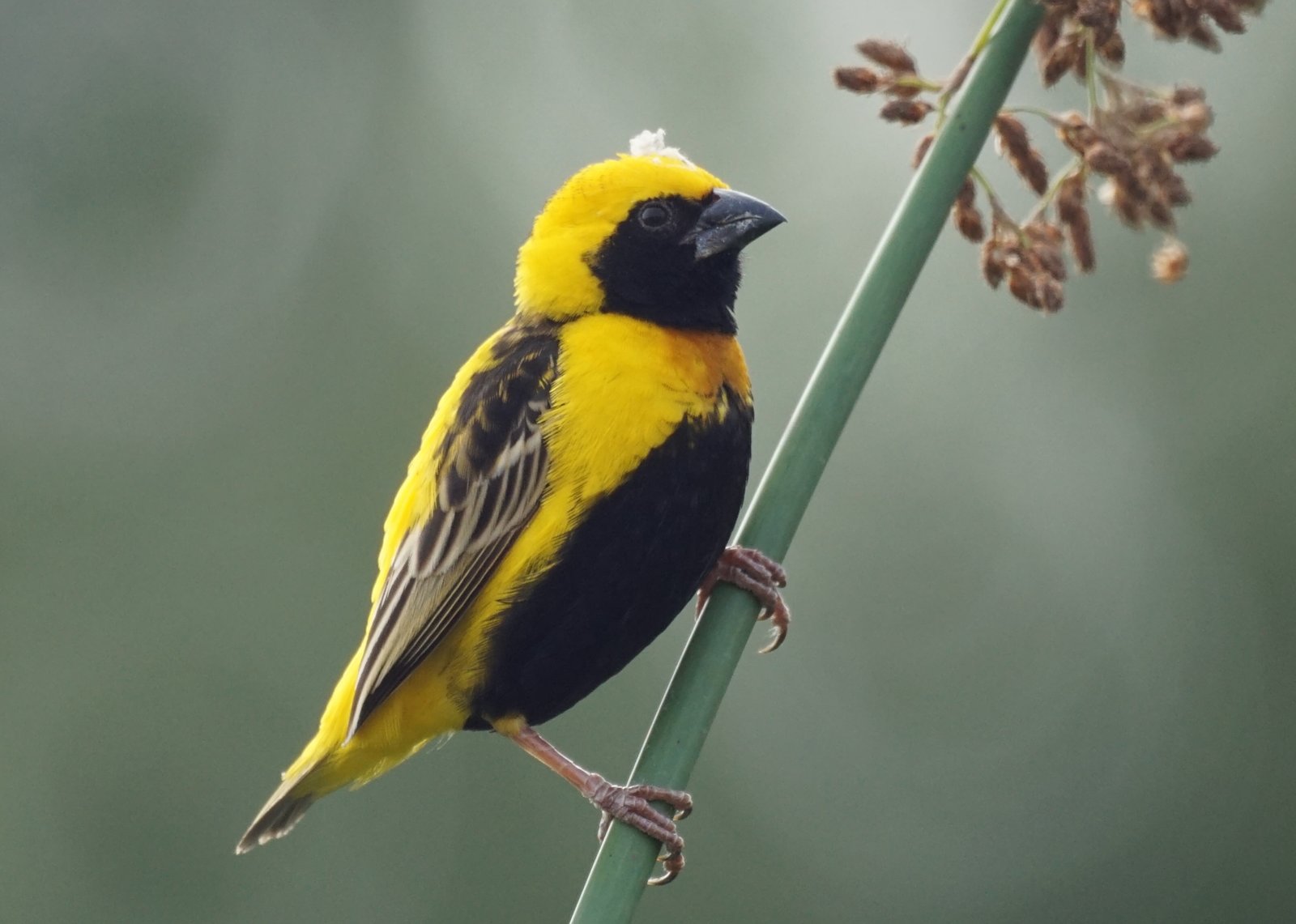
The Yellow-crowned Bishop is a small yellow-and-black bishop of wet grasslands in Africa, widely kept as a cage bird. In the Gulf states it has turned up at reedbeds and sewage works for twenty years, but unlike in Portugal and Spain it has not clearly become established here.
Voice
A high, sizzling and buzzing song, zit-zit-zzzzzz, in display flight or from a grass stem, the male puffing out his yellow back and rump feathers. In flocks a dry, crackling chip.
Recording: Jorge Leitão — CC BY-NC-SA 4.0 · converted to mono · xeno-canto
Identification
9–11 cm, small and compact, with a short tail and a conical black bill. The breeding male has a bright yellow crown and yellow nape, back and rump, set against a black face, black throat and wholly black underparts; the wings are brown. The female and non-breeding male are buffy brown with heavy dark streaking, a striking broad, yellowish supercilium, a dark eye-stripe and a pale, finely streaked breast; the bill is then horn-coloured. Juveniles resemble the female.
Confusion species
No other small bird in the region combines a yellow crown and back with wholly black underparts. Females of Southern Red Bishop (Euplectes orix) are larger with a less sharply marked head; in Yellow-crowned Bishop the broad, bright supercilium is the best feature. Streaked Weaver (Ploceus manyar) also has a yellow crown but is larger, with streaked rather than black underparts.
Habitat
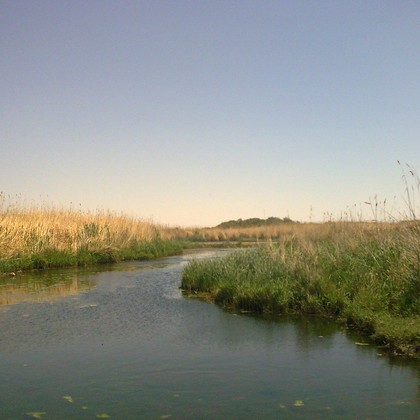
Reedbeds, wet rank vegetation and tall grass at wetlands, sewage works and ponds, and adjacent irrigated fields and lawns. In the breeding season the male holds a territory in tall vegetation and builds small, globular grass nests there; outside the breeding season the species forages in small flocks on the ground and in fields, often with other seedeaters.
Where the bird is most at home, classified by the habitats of North Africa and the Middle East.

Range and movements
Introduced only; the species does not originate from the region. United Arab Emirates: escaped birds regularly since about 2005, at first mainly in Dubai, later also in Ajman, Sharjah and Abu Dhabi; males sometimes hold territories, but a self-sustaining population has not been shown. Kuwait: a small group at Jahra between 2018 and 2021. Also single birds in Qatar, Oman, Bahrain and Israel. The native range covers sub-Saharan Africa from West Africa to the Horn of Africa and southern Africa; in Portugal and Spain the species is established from cage birds.
- Resident
- Summer visitor (c. Apr–Sep)
- Winter visitor (c. Oct–Mar)
- Passage (Mar–Apr, Oct–Nov)
- dark = core range, pale = thinly spread
How and when to look
At reedbeds and sewage works in the UAE and Kuwait, look for a yellow-and-black puffball fluttering and buzzing over the reeds. Report breeding-plumaged males with nests: this shows whether the species is becoming established in the Gulf after all.
Conservation status
Not globally threatened. In the region an introduced species derived from escaped cage birds, without a definitely established population.
Scientific name
Euplectes afer | (Gmelin, 1789)
Gmelin described the species in 1789 as Loxia afra; because it was later moved to another genus, the author and year stand in brackets. The genus Euplectes was introduced in 1829 by Swainson. Euplectes joins Greek eu 'fine, good' to New Latin plectes 'weaver'. afer is Latin for 'African'. The specimen the first description was based on came from Senegal.