All species › Passerines › Weavers › Southern Red Bishop
Southern Red Bishop | Euplectes orix
Grenadierwever | Obispo rojo
The Southern Red Bishop is a fiery red bishop from southern Africa brought to the Gulf as a cage bird. In the UAE it has been seen increasingly often since about 2020, with a feral population in the reedbeds and irrigated fields around Abu Dhabi.

Voice
A fast, sizzling, buzzing song, roughly zik-zik-zik-zizizizizi, from a reed stem or during the bumblebee-like display flight with puffed-out plumage; also a sharp chik call.
Recording: African Bioacoustics Community — CC BY-NC-SA 4.0 · converted to mono · xeno-canto
Identification
10–11 cm, stocky, with a short tail and a conical bill. The breeding male is scarlet to orange-red with a black forehead, face and chin, a red crown, throat and upper breast and a black lower breast and belly; the long red undertail coverts largely cover the short brown tail. Wings brown, bill black. The female is streaky brown above and buff below with fine streaks on breast and flanks, a pale supercilium and a horn-coloured bill. The non-breeding male resembles the female but is slightly larger and more heavily streaked.
Confusion species
Northern Red Bishop (Euplectes franciscanus), from the Sahel and also reported as a cage bird in the Gulf, has a wholly black crown and even longer undertail coverts that cover the tail completely; in non-breeding plumage and as females the two are barely separable in the field, and not every red bishop in Arabia has been identified to species with certainty. Yellow-crowned Bishop (Euplectes afer) is yellow and black; its females are smaller, with a broader, brighter supercilium. Red Avadavat (Amandava amandava) is much smaller, with a red bill and white spots.
Habitat
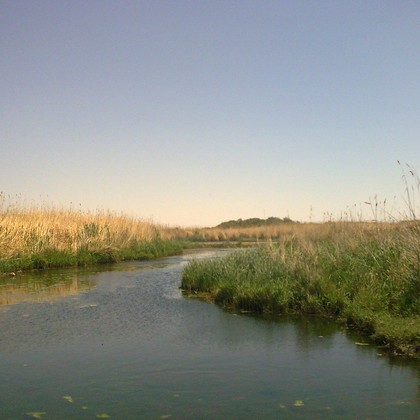
Reedbeds and bulrushes at sewage works and wetlands, tall grass and wet rank vegetation, and adjacent irrigated fields and lawns. The male is polygynous: he defends a small territory in the reeds and builds several nests there, oval balls of grass with a side entrance, for different females. Outside the breeding season it forages in flocks on fields and grassland, often with other seedeaters.
Where the bird is most at home, classified by the habitats of North Africa and the Middle East.

Range and movements
Introduced only; the species does not originate from the region. United Arab Emirates: regular and increasing since about 2020, mainly around Abu Dhabi (including Al Wathba) and also in Sharjah, Dubai and Ajman, where males in breeding plumage hold territories and the species appears to be becoming established. Single escaped birds in Kuwait, Qatar, Bahrain and Oman. The native range lies in Africa from South Africa north to Angola, Tanzania, Kenya, Uganda and eastern DR Congo.
- Resident
- Summer visitor (c. Apr–Sep)
- Passage (Mar–Apr, Oct–Nov)
- dark = core range, pale = thinly spread
How and when to look
In summer, check reed fringes around Abu Dhabi for red males fluttering and buzzing over the reeds. Check the crown: red with a black forehead is Southern Red Bishop, wholly black is Northern Red Bishop. A photograph of the male helps clarify the distribution of both species in the Gulf.
Conservation status
Not globally threatened. In the region an introduced species derived from escaped cage birds; possibly established in the UAE, elsewhere only single birds.
Scientific name
Euplectes orix | (Linnaeus, 1758)
Linnaeus described the species in 1758 as Emberiza orix; because it was later moved to another genus, the author and year stand in brackets. The genus Euplectes was introduced in 1829 by Swainson. Euplectes joins Greek eu 'fine, good' to New Latin plectes 'weaver'. orix comes from the Latin oryza, 'rice' — for a seed-eating bird of grain fields. The specimen the first description was based on came from interior of Africa (Angola).