All species › Passerines › Weavers › Vitelline Masked Weaver
Vitelline Masked Weaver | Ploceus vitellinus
Dottergele wever | Tejedor vitelino
The Vitelline Masked Weaver is a small masked weaver of the dry acacia savanna of the Sahel. On the southern edge of the Algerian Sahara it was seen in numbers and found breeding in 2022, as one of the Sahel species that have recently turned up northwards in the region.

Voice
A fast, sizzling, scraping song of squeaky and rattling notes, roughly chee-chee-zzzzzrrr, often given hanging beneath the nest with quivering wings; the call is a short chuk.
Recording: Julien Birard — CC BY-NC-SA 4.0 · shortened to the first 60 s, mono · xeno-canto
Identification
12–13 cm, a small, slim masked weaver with a fairly fine black bill. The breeding male is bright egg-yolk yellow with a black mask that forms only a narrow band across the forehead and otherwise covers cheeks and throat; between the mask and the yellow crown runs a chestnut border, and the edge of the throat is also somewhat rusty. The eye is red, the legs pink. The back is yellowish green with fine streaking. The female and non-breeding male are olive-yellow above, pale yellowish white below, with a yellow supercilium and a pink to horn-coloured bill. Juveniles resemble the female.
Confusion species
Village Weaver (Ploceus cucullatus) is larger and heavier, with a black mask extending over the whole forecrown and a black-spotted back. Rüppell's Weaver (Ploceus galbula) has a chestnut instead of black mask and in the region occurs only in south-west Arabia and as a feral cage bird. Sudan Golden Sparrow (Passer luteus) has a chestnut back and no mask. Female weavers are difficult to separate; go by the males in the flock wherever possible.
Habitat
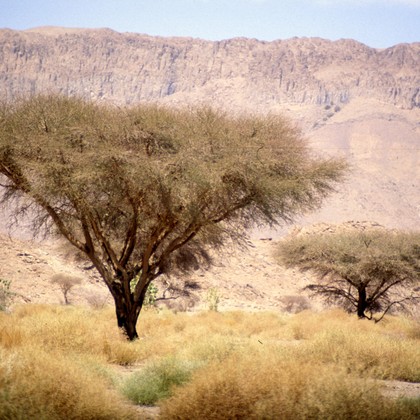
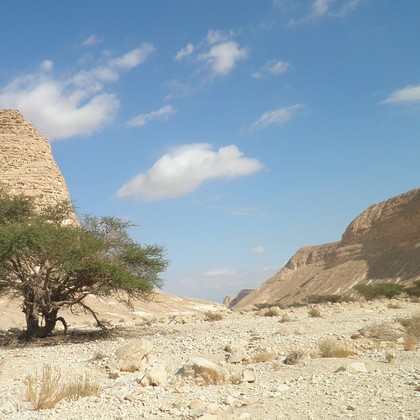
Dry acacia savanna and thorn scrub; in the Sahara only in vegetated wadis and at oases with acacias and water. Breeds singly or in small scattered groups: the male weaves a globular nest with a short entrance tube underneath, often at the tip of a thin acacia branch and not infrequently next to a wasp nest. Eats seeds and insects; escaped birds in the Gulf states keep to parks and gardens.
Where the bird is most at home, classified by the habitats of North Africa and the Middle East.
Range and movements
Algeria: a notable influx in 2022 in the far south, in the Tamanrasset–In Guezzam area on the border with Mali and Niger, with the first breeding records for the country; a few further records in 2024 and 2025. United Arab Emirates: single escaped cage birds in Dubai, Abu Dhabi and Ras al-Khaimah between 2008 and 2015. No certain records elsewhere in the region. Beyond, in the Sahel and dry savanna from Senegal and Mauritania east to Sudan, Ethiopia and Somalia, and south to Kenya and Tanzania.
- Resident
- Summer visitor (c. Apr–Sep)
- Winter visitor (c. Oct–Mar)
- Passage (Mar–Apr, Oct–Nov)
- dark = core range, pale = thinly spread
How and when to look
In southern Algeria, vegetated wadis with acacias south of Tamanrasset are the places to look for Sahel species; a small yellow weaver with a narrow black forehead band and a chestnut crown border is this species. Report every sighting with a photograph to the national rarities committee.
Conservation status
Not globally threatened. In the region a scarce visitor from the Sahel, with a first breeding record in southern Algeria in 2022; whether it will persist there is unknown. The birds in the UAE were escaped cage birds.
Scientific name
Ploceus vitellinus | (Lichtenstein, 1823)
Lichtenstein described the species in 1823 as Fringilla vitellina; because it was later moved to another genus, the author and year stand in brackets. The genus Ploceus was introduced in 1816 by Cuvier, GLCFD. Ploceus is Greek, from plokeus 'braider', from plekō 'to plait', after the woven nests. vitellinus is Latin for 'yolk-yellow', from vitellus 'egg yolk'. The specimen the first description was based on came from Senegambia, West Africa.