All species › Passerines › Weavers › Rüppell's Weaver
Rüppell's Weaver | Ploceus galbula
Rüppells wever | Tejedor de Rüppell
Rüppell's Weaver is the common yellow weaver of south-west Arabia: in the Tihama, the wadis of Asir and Yemen and the gardens of Dhofar its colonies hang like bunches of green balls from acacias and palms. It is the only weaver that breeds naturally in the region.
Voice
A continuous sizzling, rattling chatter at the colony, with rasping and squeaky notes, roughly chuk-chuk-zzzzizizi, often given with quivering wings beneath the nest; the call is a dry chuk or chet.
Recording: Stanislas Wroza — CC BY-NC-SA 4.0 · shortened to the first 60 s, mono · xeno-canto
Identification
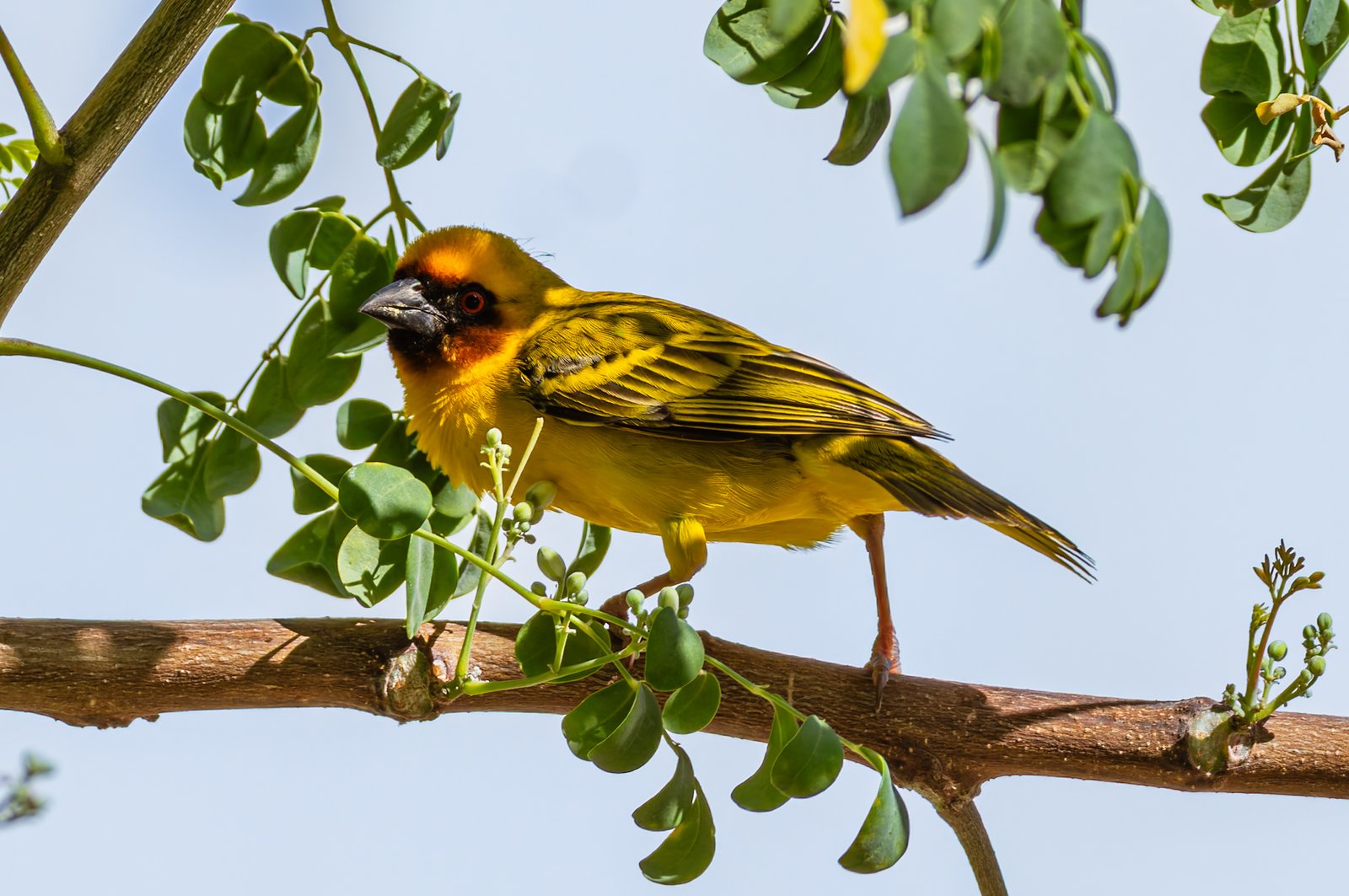
14 cm, a medium-sized, stocky weaver with a heavy, conical black bill. The breeding male is bright yellow with a chestnut mask over forehead, cheeks and throat that grades into orange towards the breast; the back is yellowish green with faint dark streaks, the wings dark with yellow edges. The eye is reddish brown, the legs flesh-coloured. The female and non-breeding male are dull olive-yellow above with light streaking, pale yellowish to off-white below, with a yellow supercilium and a horn-coloured bill; the chestnut mask is then absent. Juveniles resemble the female.
Confusion species
Arabian Golden Sparrow (Passer euchlorus) is smaller and plain yellow without a mask and without streaks on the back; the female is plain pale brown. Vitelline Masked Weaver (Ploceus vitellinus) and Village Weaver (Ploceus cucullatus), both at most escaped cage birds here, have a black mask. Streaked Weaver (Ploceus manyar) has a yellow crown, a dark face and a heavily streaked breast. Females are harder: look at structure, the heavy bill and accompanying males.
Habitat
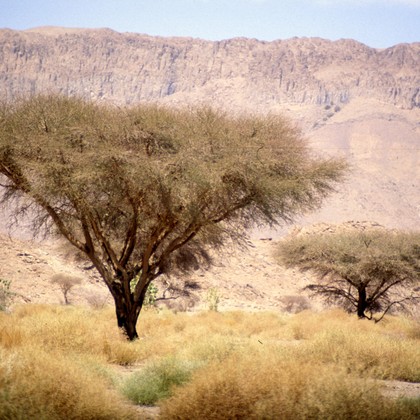
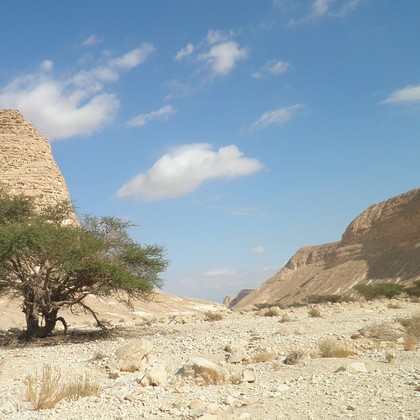
Acacia savanna and thorn scrub of the coastal plain, vegetated wadis and terraced valleys in the mountains, as well as gardens, palm groves, fields and trees at wells and villages; in the highlands to about 2500 m. Breeds in colonies: the male weaves a green, globular ball of grass with the entrance underneath, often on an overhanging branch above water or a track, and tears down nests that fail to attract a female. Eats seeds, nectar and insects, and outside the breeding season joins flocks of sparrows and other seedeaters.
Where the bird is most at home, classified by the habitats of North Africa and the Middle East.

Range and movements
Saudi Arabia: common in the Tihama and the western mountains of Asir and Hejaz, north to beyond Jeddah; in the mountains mainly a summer visitor, lower down in winter. Yemen: widespread in the coastal plain, the highlands and the wadis of the south. Oman: common in Dhofar, including around Salalah. Elsewhere there are feral populations derived from escaped cage birds: around Riyadh, where the species breeds, and in Kuwait, where it has occurred in gardens and parks since about 2010; single birds in the Eastern Province of Saudi Arabia, Bahrain and the UAE. Outside the region in north-east Africa: Sudan, Eritrea, Djibouti, Ethiopia, Somalia and northern Kenya.
- Resident
- Summer visitor (c. Oct–Mar)
- Winter visitor (c. Apr–Sep)
- Passage (Mar–Apr, Oct–Nov)
- dark = core range, pale = thinly spread
How and when to look
In Dhofar the species is hard to miss in the parks and coconut gardens of Salalah; in Asir and Yemen colonies are easiest to find in acacias beside irrigation channels and wells. A yellow weaver outside south-west Arabia and Dhofar is almost always an escaped cage bird: photograph it and check the species.
Conservation status
Not globally threatened. In south-west Arabia and Dhofar a common native resident; the populations around Riyadh and in Kuwait derive from escaped or released cage birds.
Scientific name
Ploceus galbula | Rüppell, 1840
Rüppell described the species in 1840 and placed it straight away in the genus where it still stands. The genus Ploceus was introduced in 1816 by Cuvier, GLCFD. Ploceus is Greek, from plokeus 'braider', from plekō 'to plait', after the woven nests. galbula is the Latin name of a small yellow bird, probably the golden oriole. The specimen the first description was based on came from Modat valley, Eritrea.