All species › Passerines › Sunbirds › Pygmy Sunbird
Pygmy Sunbird | Hedydipna platura
Kleine honingzuiger | Suimanga pigmeo
The Pygmy Sunbird is a Sahel species of the acacia savannas south of the Sahara. In the region it has been recorded only as a vagrant, in the far south of Algeria on the border with Mali.

Voice
A high, thin tseep and a dry tchit; the song is a fast, high, rather husky twittering phrase.
Recording: Andrew Spencer — CC BY-NC-SA 4.0 · converted to mono · xeno-canto
Identification
9–10 cm, the breeding male 15–17 cm owing to the two greatly elongated, narrow central tail feathers. Short, slightly curved bill. The male is glossy metallic green on head, throat, breast and back, with a bronzy to purplish-green rump and bright yellow underparts, without a breast band; wings and tail blackish. The non-breeding male resembles the female but keeps dark wings and often the streamers. The female is grey-brown above and pale yellow below, with a pale supercilium and a short dark tail with white edges.
Confusion species
Nile Valley Sunbird (Hedydipna metallica), in the Nile Valley and south-west Arabia, is the only real confusion species: the male has a violet-blue breast band and a violet rump. Females of the two are hardly separable in the field; location (Sahel versus the Nile and Arabia) is then decisive. Palestine Sunbird (Cinnyris osea) has a longer, more strongly curved bill and no yellow.
Habitat
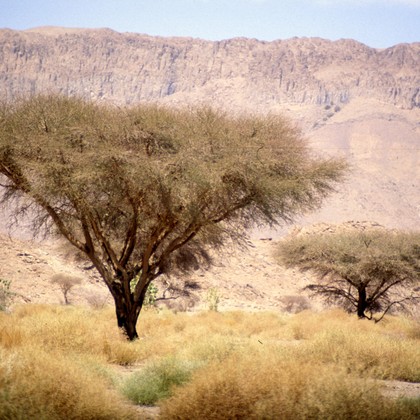
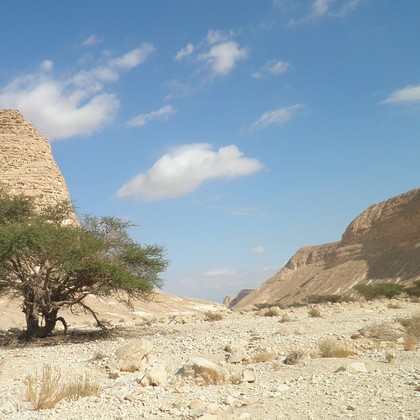
Dry acacia savanna, thorn scrub and vegetated wadis in the Sahel and on the southern fringe of the Sahara; in the breeding season often at flowering acacias and Loranthus mistletoes.
Where the bird is most at home, classified by the habitats of North Africa and the Middle East.
Range and movements
In the region only in Algeria: a male and a female in October 2023 near Timiaouine in the wilaya of Bordj Badji Mokhtar, the first record for the country. Beyond the region it breeds across the Sahel from Senegal and Mauritania east through Mali, Niger (including the Aïr Mountains) and Chad to Sudan, South Sudan and northern Uganda; in the dry season it moves north to the southern edge of the Sahara.
How and when to look
There is only a chance of this species in the extreme south of Algeria, in vegetated wadis with flowering acacias after the rains. Any sunbird with tail streamers west of the Nile is worth photographing; report the sighting.
Conservation status
Not globally threatened (IUCN: Least Concern). Common in the Sahel. In the region a vagrant at the northern edge of its range; possibly more regular in the barely visited south of Algeria.
Scientific name
Hedydipna platura | (Vieillot, 1819)
Vieillot described the species in 1819 as Cinnyris platurus; because it was later moved to another genus, the author and year stand in brackets. The genus Hedydipna was introduced in 1851 by Cabanis. Hedydipna comes from the Greek hēdudeipnos, 'dainty-supping, sweet-eating', from hēdus, 'sweet', and deipneō, 'to dine' — for the nectar-rich diet of these sunbirds. platura is Greek for 'broad-tailed', from platus 'broad' and oura 'tail'. The specimen the first description was based on came from Senegal.