All species › Passerines › Sunbirds › Abyssinian Sunbird
Abyssinian Sunbird | Cinnyris habessinicus
Glanshoningzuiger | Suimanga brillante
The Abyssinian Sunbird is a sunbird of the dry acacia country of the Horn of Africa. In the region it is known only from Egypt's border area with Sudan; the Arabian birds are now treated as a separate species, Arabian Sunbird.

Voice
The call is a hard, sharp tchik; the song is a loud, fast series of clear, metallic notes and trills.
Recording: David Darrell-Lambert — CC BY-NC-SA 4.0 · converted to mono · xeno-canto
Identification
13–14 cm. Fairly large for a sunbird, with a long, curved bill. The male is glossy metallic green on head, throat and back, with a violet-blue rump; a broad scarlet band crosses the breast, bordered violet-blue above, and the belly is black, with yellow pectoral tufts at the breast sides. Wings and tail are black. The female is grey-brown above and drab greyish-white below, with a faint pale supercilium and a dark tail.
Confusion species
Arabian Sunbird (Cinnyris hellmayri) is smaller and shorter-billed with a narrower red breast band; in the field location is decisive, as the two do not overlap. Nile Valley Sunbird (Hedydipna metallica), which also occurs in southern Egypt, is smaller, short-billed, yellow-bellied and the male has tail streamers. Palestine Sunbird (Cinnyris osea) lacks the red breast band and the green gloss.
Habitat
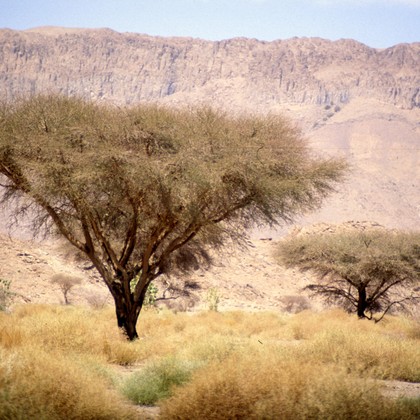
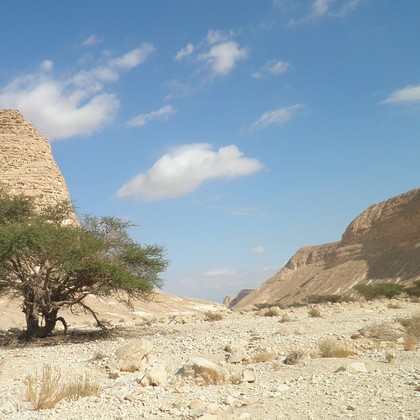
Dry acacia savanna, thorn scrub and vegetated wadis in hill country, often at flowering acacias, Aloe and mistletoes; also village gardens.
Where the bird is most at home, classified by the habitats of North Africa and the Middle East.
Range and movements
In Egypt only in the Gebel Elba area on the Sudanese border, with a few records; possibly a small peripheral population of the Sudanese coastal mountains. Beyond the region in north-east Sudan, Eritrea, Ethiopia, Djibouti, Somalia, South Sudan, northern Kenya and north-east Uganda.
How and when to look
Only in remote Gebel Elba (in the Halaib area, with a permit) is there a small chance, in vegetated wadis with flowering acacias after rain. Any large sunbird with a red breast band in Egypt deserves a careful description and photographs.
Conservation status
Not globally threatened (IUCN: Least Concern). Common in the Horn of Africa. In the region an extremely rare bird; its status in little-studied Gebel Elba is uncertain.
Scientific name
Cinnyris habessinicus | (Hemprich & Ehrenberg, 1828)
Hemprich & Ehrenberg described the species in 1828 as Nectarinia (Cinnyris) habessinica; because it was later moved to another genus, the author and year stand in brackets. The genus Cinnyris was introduced in 1816 by Cuvier, GLCFD. Cinnyris is from the Ancient Greek kinnuris, an unidentified small bird mentioned by Hesychius of Alexandria. habessinicus means 'Abyssinian', from Habesh, the Arabic name for Abyssinia (Ethiopia). The specimen the first description was based on came from Eilet, Eritrea.