All species › Passerines › Sparrows › Sudan Golden Sparrow
Sudan Golden Sparrow | Passer luteus
Soedanese goudmus | Gorrión dorado
The Sudan Golden Sparrow is a small, nomadic sparrow of the Sahel, the male bright golden yellow with chestnut back and wings. At the northern edge of its range it penetrates the Sahara in wet years and has in recent years become established in the far south of Algeria and in Western Sahara.

Voice
A simple chilp or chirrup and a fast, rhythmic che-che-che; flocks keep up a continuous chirping.
Recording: Stanislas Wroza — CC BY-NC-SA 4.0 · converted to mono · xeno-canto
Identification
12–13 cm. Small and compact, with a short conical bill. The male has a bright lemon to golden-yellow head and underparts, a chestnut mantle and scapulars and dark wings with two pale wing bars; the bill is horn to blackish in the breeding season, pale otherwise. The female is dull sandy brown above and pale yellowish to off-white below, with a hint of yellow on head and breast, and no streaking. Juveniles resemble the female.
Confusion species
Arabian Golden Sparrow (Passer euchlorus), across the Red Sea in south-west Arabia, has in the male an all-yellow back without chestnut. Females may recall a female Desert Sparrow (Passer simplex), but that is larger, greyer and lacks yellow; African Silverbill (Euodice cantans) has a silvery-grey bill and a black, pointed tail.
Habitat
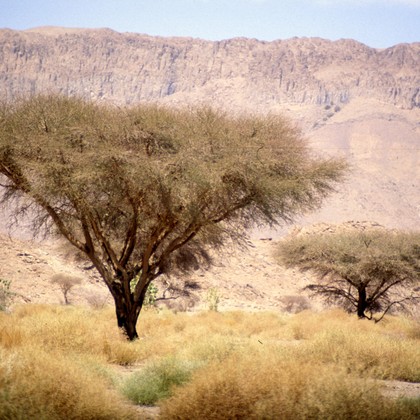
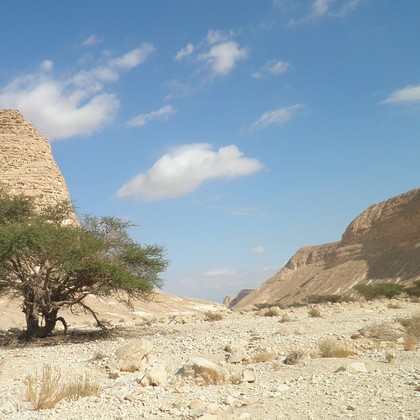
Acacia savanna and dry thorn scrub, wadis with acacias and grasses, and the edges of oases and fields; in the desert mainly where grasses are seeding after rain. Breeds in loose colonies in acacias. Outside the breeding season lives in flocks, sometimes of hundreds of birds, that travel long distances depending on rainfall.
Where the bird is most at home, classified by the habitats of North Africa and the Middle East.

Range and movements
In the region mainly in the far south of Algeria: around In Guezzam since 2017 flocks of over a hundred birds year-round, with juveniles; also seen at Djanet (January 2017) and Tin Zaouatine (July 2018). In southern Western Sahara, in the Aousserd and Oued Dahab region, irregular since 2009, with the first confirmed breeding for Morocco in October 2024. No certain records from Libya or Egypt. Beyond the region in the Sahel from Mauritania and Senegal to Sudan, Eritrea and Ethiopia.
- Resident
- Winter visitor (c. Apr–Sep)
- Passage (Mar–Apr, Oct–Nov)
- dark = core range, pale = thinly spread
How and when to look
Around In Guezzam and in the wadis of southern Algeria, or in the acacia wadis around Aousserd after a rainy spell; search at drinking spots early in the morning, where flocks come down.
Conservation status
Not globally threatened and locally common in the Sahel, though trapped for the cage-bird trade. Recently established or expanding in the region: now resident in the far south of Algeria and breeding in Western Sahara since 2024.
Scientific name
Passer luteus | (Lichtenstein, 1823)
Lichtenstein described the species in 1823 as Fringilla luteus; because it was later moved to another genus, the author and year stand in brackets. The genus Passer was introduced in 1760 by Brisson. Passer is the Latin word for 'sparrow'. luteus is Latin for 'yellow'. The specimen the first description was based on came from Dongola, Sudan.