All species › Passerines › Sparrows › Dead Sea Sparrow
Dead Sea Sparrow | Passer moabiticus
Moabmus | Gorrión del Mar muerto
The Dead Sea Sparrow is the smallest sparrow in the region, a finely built bird of tamarisk thickets by water in the deep rift of the Jordan Valley and the Dead Sea and in Mesopotamia. With his grey head, black bib and yellow neck patch, the male is one of the most boldly marked sparrows of the Middle East.

Voice
Softer, higher and more musical than other sparrows: a series of fine, thin chirps from the top of a tamarisk, and in flight a high chi-wit. A colony produces a soft, continuous tinkling.
Recording: GABRIEL LEITE — CC BY-NC-SA 4.0 · converted to mono · xeno-canto
Identification
12–13 cm. Clearly smaller than House Sparrow, with a short, pointed bill and a rounded head. The male has a grey crown and cheek, a small black bib, a pale supercilium that turns ochre behind and merges into a lemon-yellow patch on the neck side, a rufous back streaked black with a chestnut shoulder patch, and plain greyish-white underparts. The female resembles a small, pale female House Sparrow, sometimes with a hint of yellow on the neck side. Juveniles resemble the female.
Confusion species
Male House Sparrow (Passer domesticus) and Spanish Sparrow (Passer hispaniolensis) are larger, with a bigger bib and no yellow. The female is best identified by its small size, fine bill and pale tone, and by the company of males. Yellow-throated Sparrow (Gymnoris xanthocollis) has a completely plain head and white wing bars.
Habitat
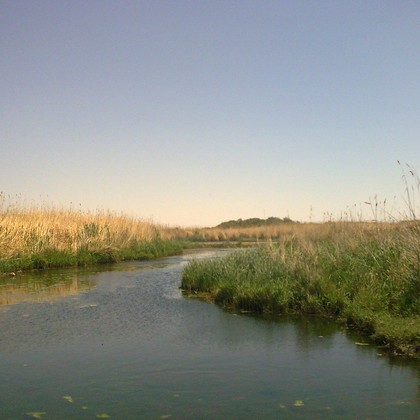
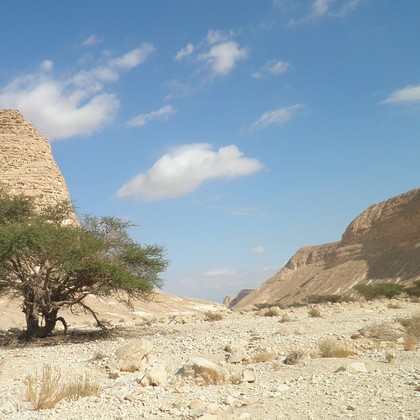
Tamarisk thickets, reed fringes and riverine woodland along rivers, streams and springs, also around salt marshes, fishponds and irrigation canals in a dry setting; in Mesopotamia also poplar woods and palm groves. Builds large, domed twig nests in tamarisks, sometimes in loose colonies. Outside the breeding season in flocks on fields and fallow land near water.
Where the bird is most at home, classified by the habitats of North Africa and the Middle East.

Range and movements
In the Jordan Valley on both sides of the river, from the Sea of Galilee and Bet She'an to the Dead Sea, and further south locally in the Arava and Wadi Araba; also in Jordan at Azraq. Scattered and local in Syria, and with its own subspecies (mesopotamicus) in the river valleys of Iraq. In winter wanders in flocks, also away from the breeding areas, as far as Kuwait; rare in Sinai and the rest of Arabia. Beyond the region in south-east Turkey, Iran and Afghanistan; rarely on Cyprus.
- Resident
- Summer visitor (c. Apr–Sep)
- Winter visitor (c. Oct–Mar)
- Passage (Mar–Apr, Oct–Nov)
- dark = core range, pale = thinly spread
How and when to look
In spring, search the tamarisk thickets along the northern Dead Sea, at Ein Gedi or in the Jordan Valley near Bet She'an, and listen for the fine tinkling of a colony. The domed nests give away a breeding site from a distance.
Conservation status
Not globally threatened. Dependent on tamarisk thickets by water, which in the dry Middle East are vulnerable to drainage, clearance and the falling level of the Dead Sea.
Scientific name
Passer moabiticus | Tristram, 1864
Tristram described the species in 1864 and placed it straight away in the genus where it still stands. The genus Passer was introduced in 1760 by Brisson. Passer is the Latin word for 'sparrow'. moabiticus is Latin for 'Moabite', after Moab, the biblical land by the Dead Sea where the species was first found breeding. The specimen the first description was based on came from En Gedi, Israel.