All species › Passerines › Reed warblers › Sykes's Warbler
Sykes's Warbler | Iduna rama
Sykes' spotvogel | Zarcero de Sykes
Sykes's Warbler is a pale, long-tailed Iduna warbler that breeds from Iran to Central Asia and winters in India. In the region it breeds locally along the Persian Gulf, mainly in coastal mangroves and scrub in the Emirates and eastern Saudi Arabia. It was long treated as a subspecies of Booted Warbler; in Arabia it is by far the more often recorded of the two.

Voice
The call is a hard, dry chek, often in a short series, and a short clicking tk-tk, not separable from Booted Warbler. The song is slower, lower and much more monotonous than Booted Warbler's: a sustained, nasal and grating babble of short repeated phrases, closer to Eastern Olivaceous Warbler. It sings from a mangrove, tamarisk or garden tree, also in the middle of the day.
Recording: Mats Rellmar — CC BY-NC-SA 4.0 · converted to mono · xeno-canto
Identification
12–13.5 cm. Slightly larger and much longer-looking than Booted Warbler, with a long tail and a short, blunt wing. Cool and dull: sandy grey above, white to off-white below with at most a faint buff wash on the flanks. The bill is long and straight, with a lower mandible orange-pink to the tip. The face is plain: a short, faint pale supercilium barely reaching behind the eye, without a dark lateral crown-stripe. Primary projection very short, about half the tertials. The slightly rounded tail has little white on the outer feather and is almost constantly pumped downwards and flicked sideways. Legs pale grey-brown. Sexes alike.
Confusion species
Booted Warbler (Iduna caligata) is smaller, rounder and shorter-tailed, warmer brown, with a short, dark-tipped bill, a supercilium reaching clearly behind the eye with a dark stripe above it, and a longer primary projection; it does not pump its tail constantly. Eastern Olivaceous Warbler (Iduna pallida) is the real trap: larger, with a longer and broader bill and the same tail action; check size, bill width and the flat-headed look of Sykes's. Upcher's Warbler (Hippolais languida) is much larger, with a dark, white-edged tail.
Habitat
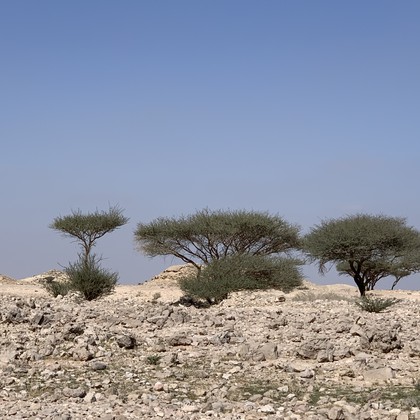
In the region mainly in coastal mangroves of Avicennia and adjacent scrub of Prosopis, tamarisk and saltbush; also in parks, gardens and plantings along the coast. On migration also in acacia scrub and wadis inland.
Where the bird is most at home, classified by the habitats of North Africa and the Middle East.


Range and movements
Local summer visitor along the Arabian side of the Persian Gulf: in eastern Saudi Arabia in the mangroves at Jubail, in the Emirates in the mangroves and on the coastal islands of Abu Dhabi and elsewhere on the west coast, and in Oman along the coast; scarce in Bahrain and Qatar and partly only a passage migrant there. In Kuwait a scarce passage migrant that does not breed, recorded at Al Abraq and Jahra Pools. Elsewhere in Arabia and in Iraq a scarce passage migrant; the Levant and Egypt have only a few vagrants. Beyond the region the species breeds from southern Iran and Afghanistan to Turkmenistan, Kazakhstan, Pakistan and western China, and winters in the Indian subcontinent south to Sri Lanka.
- Summer visitor (c. Oct–Mar)
- Passage (Mar–Apr, Oct–Nov)
- dark = core range, pale = thinly spread
How and when to look
Visit the mangroves along the Abu Dhabi coast, such as the Eastern Mangroves park, or those north of Jubail in May or June and listen for the monotonous, grating babble; the bird then often shows itself while pumping its tail.
Conservation status
Not globally threatened. The small breeding populations along the Gulf are vulnerable to the loss of mangroves and coastal scrub to land reclamation, ports and building, although new mangroves are also being planted in the Emirates. Little is known about numbers; its distribution in Arabia is still poorly mapped because of the difficult separation from Booted Warbler.
Scientific name
Iduna rama | (Sykes, 1832)
Sykes described the species in 1832 as Sylvia rama; because it was later moved to another genus, the author and year stand in brackets. The genus Iduna was introduced in 1840 by Keyserling & Blasius. Iduna is usually linked to Iðunn, the Norse goddess who guarded the apples of eternal youth; the authors of the name gave no explanation, and other derivations have been proposed as well. rama comes from Hindu mythology, where Rama is the seventh incarnation of the god Vishnu. The specimen the first description was based on came from the Deccan, India.