All species › Passerines › Reed warblers › Upcher's Warbler
Upcher's Warbler | Hippolais languida
Grote vale spotvogel | Zarcero de Upcher
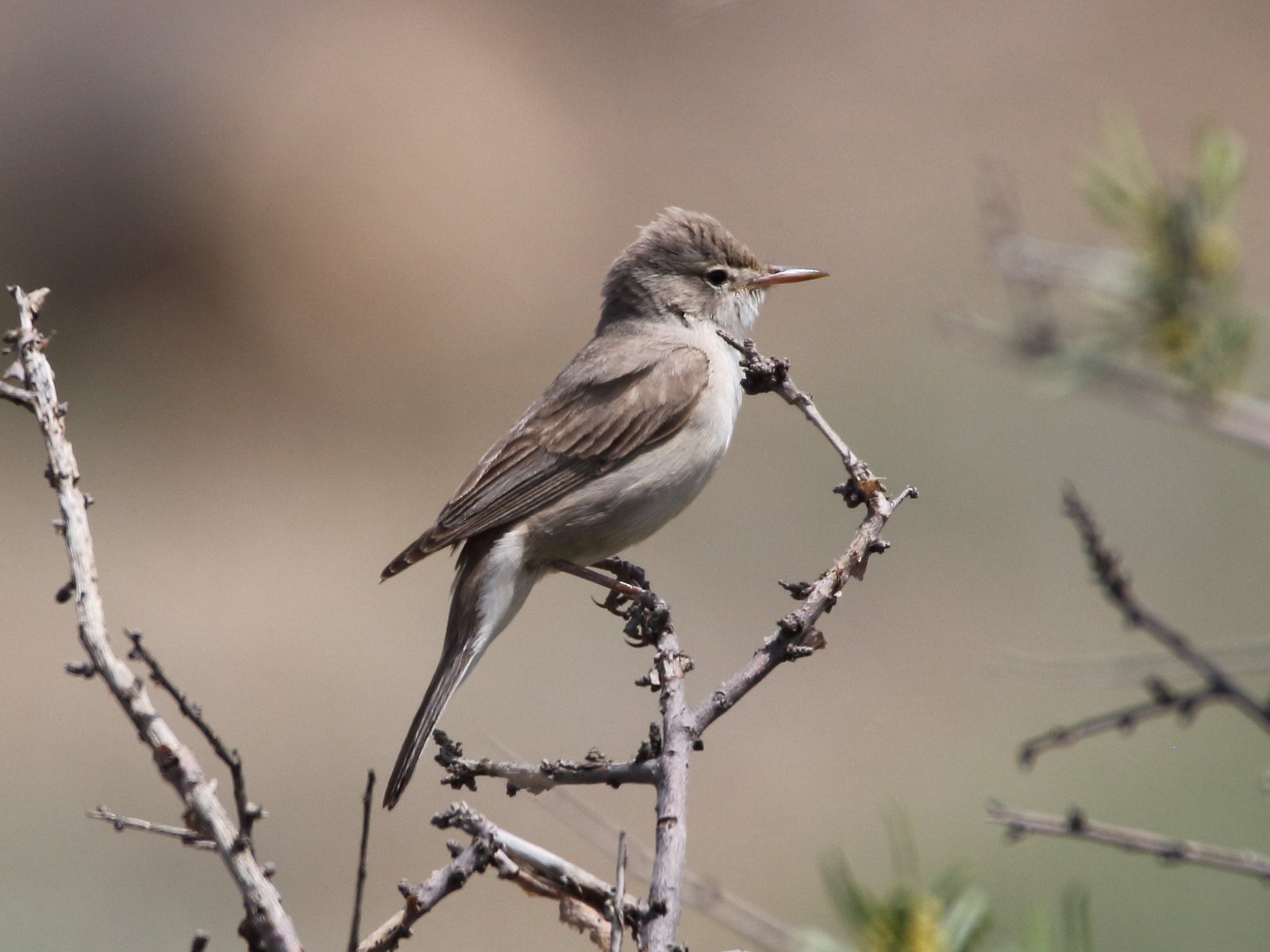
Upcher's Warbler is a large, grey Hippolais of dry, bushy slopes in the northern Middle East. In the region it breeds only in the Levant and northern Iraq, and in spring and autumn it migrates across the Arabian Peninsula to East Africa. Its dark, white-edged tail and the way it slowly waves it up, down and sideways are characteristic.
Voice
The song is a series of short, reed-warbler-like phrases with clear, almost whistled notes between them, slower and purer than the fast song of Eastern Olivaceous Warbler. It often turns into a song flight: rising with slow wingbeats and gliding down at an angle on widely spread wings. The call is a deep chek or tak, often in short series.
Recording: isaac kilusu — CC BY-NC-SA 4.0 · shortened to the first 60 s, mono · xeno-canto
Identification
14–15 cm. Larger and greyer than the olivaceous warblers, with a long, heavy bill with an orange lower mandible, a pale supercilium in front of the eye and a narrow white eye-ring. Head and nape are cool grey and contrast slightly with the brownish-grey mantle; the underparts are white with a cream to greyish-buff wash on the flanks. The tail is decisive: long, broad and blackish-brown, with white edges and tips to the outer feathers, so it looks darker than the back. A pale panel on the secondaries, primary projection medium. Legs sturdy, grey to greyish flesh. Sexes alike.
Confusion species
Eastern Olivaceous Warbler (Iduna pallida), which occurs alongside it in the Levant and Iraq, is smaller and more compact, warmer brownish-grey, has a tail the same colour as the back and dips it in short jerks rather than waving it slowly. Sykes's Warbler (Iduna rama) is much smaller and sandier, with a pale tail. Olive-Tree Warbler (Hippolais olivetorum) is a size larger, even heavier-billed, with a grey rather than blackish-brown tail and a striking white wing panel. Lesser Whitethroat (Curruca curruca) and other Curruca warblers have a finer bill and a darker head or ear-coverts.
Habitat
Breeds on dry, rocky slopes and plateaus with scattered bushes and low trees: garrigue, steppe with oak, almond, pistachio and hawthorn, and neglected orchards, mostly between 500 and 2000 m. On migration in acacia scrub, wadis, gardens and rough vegetation, often low in a bush.
Where the bird is most at home, classified by the habitats of North Africa and the Middle East.



Range and movements
Summer visitor to the north of the region: in Iraq in the uplands of Kurdistan, in Syria mainly in the west and north, in Lebanon on the slopes of Mount Lebanon and the Anti-Lebanon, and in Israel a rare breeder on Mount Hermon, the northern Golan and the eastern Lakhish hills (formerly also in Galilee and the hills of Judea and Samaria); in northern Jordan at most a rare breeder. On migration, April – May and August – September, fairly common through eastern Arabia: in Kuwait, Bahrain, Qatar, the Emirates and Oman, and further via Saudi Arabia and Yemen; rare in Egypt. Beyond the region the species breeds from central and eastern Turkey through Iran to Turkmenistan, Uzbekistan and Afghanistan, and winters in East Africa, from Ethiopia and Somalia to Kenya and Tanzania.
- Summer visitor (c. Oct–Mar)
- Passage (Mar–Apr, Oct–Nov)
- dark = core range, pale = thinly spread
How and when to look
In the Emirates and Oman it turns up in April and May in parks, gardens and acacia scrub, for example in Mushrif Park and at Al Ansab; look for a large grey warbler slowly waving its dark tail. In Israel Mount Hermon in May offers the best chance of a singing breeder.
Conservation status
Not globally threatened. In the north of the region it is locally rare and declining: in Israel the breeding population numbers fewer than 1000 adults and is listed as Vulnerable on the national Red List, through loss of garrigue to building, agriculture and afforestation, and through fires. Little is known of numbers in Syria and Iraq.
Scientific name
Hippolais languida | (Hemprich & Ehrenberg, 1833)
Hemprich & Ehrenberg described the species in 1833 as Curruca languida; because it was later moved to another genus, the author and year stand in brackets. The genus Hippolais was introduced in 1827 by Conrad von Baldenstein. Hippolais goes back to Greek hupolais, a small bird mentioned by Aristotle, misspelt by Linnaeus; the word may be onomatopoeic or formed from hupo 'under' and laas 'stone'. languida is Latin for 'languid, listless'. The specimen the first description was based on came from Syria.