All species › Passerines › Reed warblers › Olive-Tree Warbler
Olive-Tree Warbler | Hippolais olivetorum
Griekse spotvogel | Zarcero grande
The Olive-Tree Warbler is the largest and most heavily built Hippolais, a grey warbler of olive groves and open oak woodland. In the region it is mainly a scarce passage migrant through the Levant and western Arabia, on its way to and from its winter quarters in eastern and southern Africa. As a breeding bird it has become extremely rare here.
Voice
The song is a slow, deep and grating series of short phrases, like a Great Reed Warbler at half speed: a scratchy chrek-chrek, then a sonorous kootchook, then a pause. Usually silent on migration; the call is a heavy, sparrow-like chak or tok.
Recording: Stanislas Wroza — CC BY-NC-SA 4.0 · shortened to the first 60 s, mono · xeno-canto
Identification
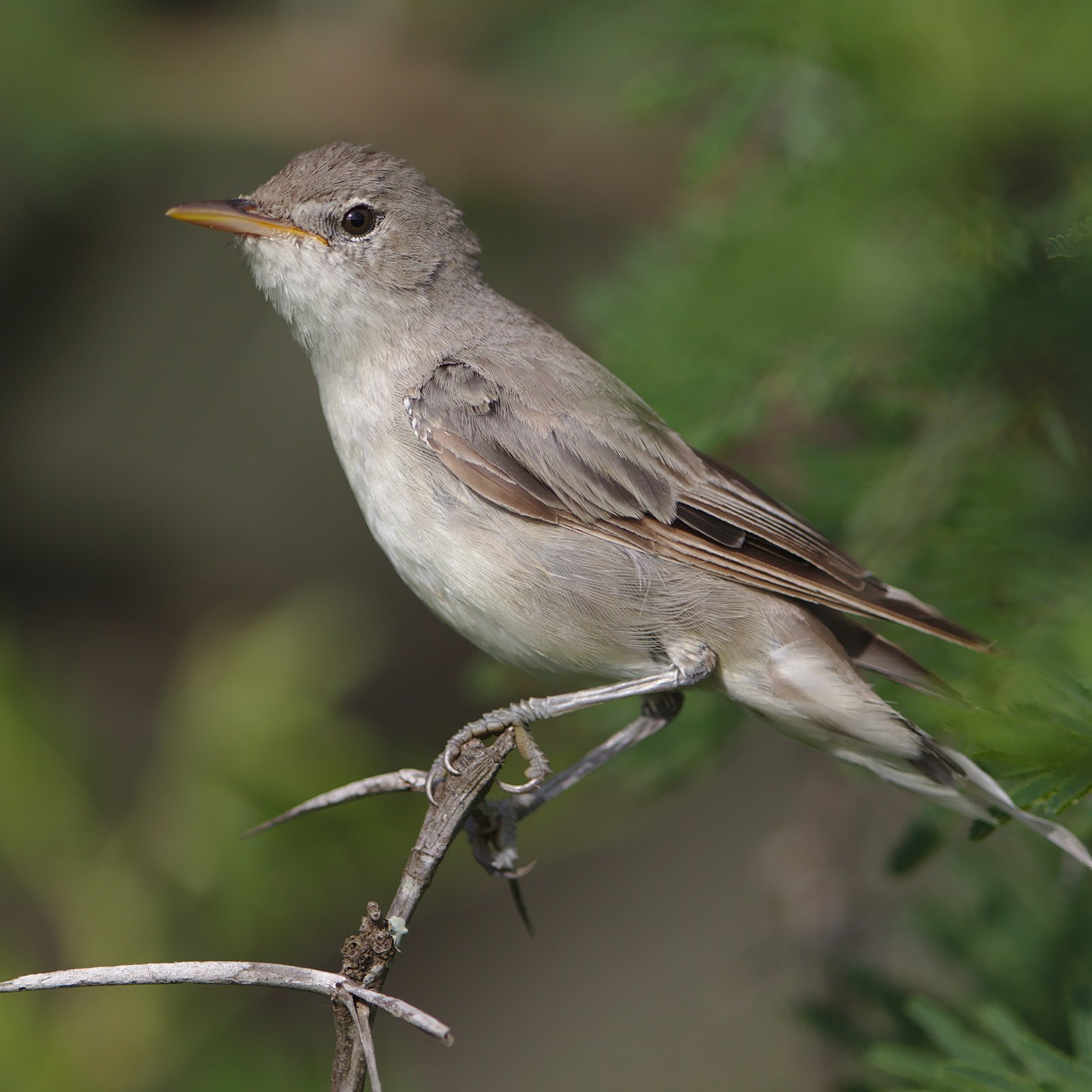
16–18 cm. Large and elongated, dull grey above with a faint olive wash and off-white below with a grey cast on breast and flanks, without any yellow. The bill is strikingly long and broad, with a lower mandible orange-yellow to the tip. The face looks open thanks to pale lores and a thin white eye-ring. A clear white wing panel on the secondaries; primary projection long. The long, square-ended tail is dark grey with white edges to the outer feathers. Legs heavy and blue-grey. Sexes alike.
Confusion species
Upcher's Warbler (Hippolais languida) is a size smaller, with a shorter bill, a blackish-brown tail that it slowly waves and a less striking wing panel. Icterine Warbler (Hippolais icterina) is smaller and has yellow in the plumage. Great Reed Warbler (Acrocephalus arundinaceus) is as bulky but warm brown with a rounded tail and a clear supercilium, and lives in reeds. Eastern Olivaceous Warbler (Iduna pallida) is a third smaller, finer-billed, and constantly dips its tail.
Habitat
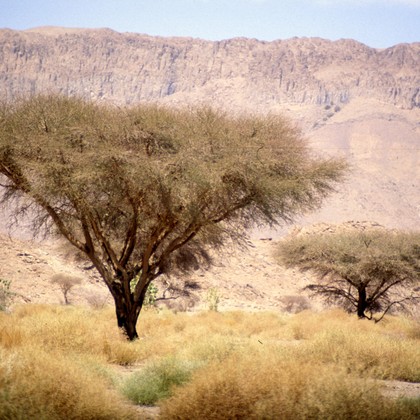
Breeds in olive groves, open oak and pistachio woodland and bushy slopes with scattered tall trees. On migration in trees and tall bushes: acacias in wadis, orchards, gardens and parks, usually in dense foliage where it forages slowly and unobtrusively.
Where the bird is most at home, classified by the habitats of North Africa and the Middle East.


Range and movements
As a breeder extremely rare in the northern Levant: in Israel it was rediscovered in the early 1990s in Upper Galilee, from Mount Meron to the Lebanese border, but the last breeding records date from the early 2000s and it has probably disappeared as a breeder there; in Lebanon and western Syria there are old and scarce breeding records. On migration, mid-April – May and mid-August – September, scarce through Israel, Jordan, Syria and Lebanon, and on through western Saudi Arabia and Yemen; rare in Egypt. Absent from the Maghreb and Libya. Beyond the region the species breeds in south-east Europe from Croatia and Greece to Bulgaria and western Turkey, and winters in eastern and southern Africa, from Kenya and Tanzania to Botswana, Zimbabwe and north-east South Africa.
- Summer visitor (c. Oct–Mar)
- Passage (Mar–Apr, Oct–Nov)
- dark = core range, pale = thinly spread
How and when to look
The best chance is a migrant in May or late August in the big acacias of the Arava or the parks of Eilat, or a bird turning up in autumn at Israel's ringing stations. Look for a large, grey warbler with a white wing panel moving slowly through the foliage.
Conservation status
Not globally threatened, but with a small breeding range and numbers declining in parts of south-east Europe through the loss of old olive groves. In Israel the species is listed as Critically Endangered on the national Red List and has probably disappeared as a breeder; too little is known about Lebanon and Syria.
Scientific name
Hippolais olivetorum | (Strickland, 1837)
Strickland described the species in 1837 as Salicaria olivetorum; because it was later moved to another genus, the author and year stand in brackets. The genus Hippolais was introduced in 1827 by Conrad von Baldenstein. Hippolais goes back to Greek hupolais, a small bird mentioned by Aristotle, misspelt by Linnaeus; the word may be onomatopoeic or formed from hupo 'under' and laas 'stone'. olivetorum is Latin for 'of the olive groves', after the habitat in which the bird breeds. The specimen the first description was based on came from Zakynthos, Greece.