All species › Passerines › Reed warblers › Melodious Warbler
Melodious Warbler | Hippolais polyglotta
Orpheusspotvogel | Zarcero común
The Melodious Warbler is the Hippolais of the Maghreb: a summer visitor that breeds in Morocco, northern Algeria and northern Tunisia in scrub and orchards with dense undergrowth. It is rounder and shorter-winged than Icterine Warbler and sings a fast, sparrow-like babble from deep inside a bush. East of Tunisia it is a rarity in the region.
Voice
The song is a fast, low, chattering babble recalling an excited House Sparrow: a sustained stream of short, scratchy and twittering notes kept up for minutes from inside a bush, flatter and more even than Icterine Warbler and without the nasal dee-dee-roy. The call is a dry, sparrow-like tret-tret-tret and a short tek. Sings from April into July.
Recording: David Darrell-Lambert — CC BY-NC-SA 4.0 · converted to mono · xeno-canto
Identification
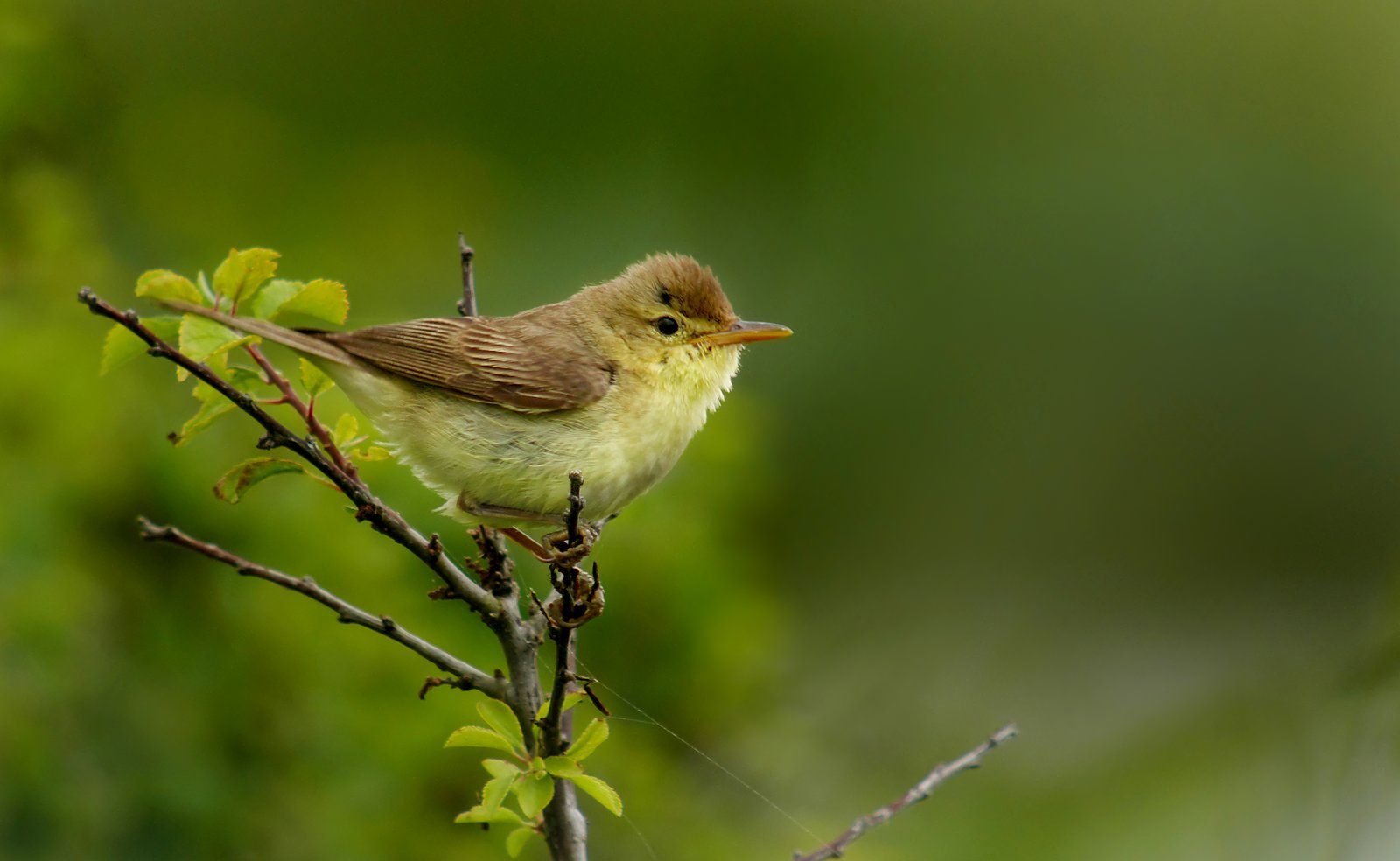
12–13 cm. Olive-brown to greenish-brown above and soft yellow below, with a rounded head, a broad bill with an orange lower mandible and a short, compact look. The wing formula is decisive: primary projection short, at most half the visible tertials, so the wing looks blunt and the tail long. A pale wing panel is usually absent, or at most a faint pale fringe on the secondaries. Legs brownish-grey to brownish flesh. Juveniles in autumn are duller but keep a yellow wash on throat and breast.
Confusion species
Icterine Warbler (Hippolais icterina) has a long primary projection about equal to the tertials, a clear pale wing panel, blue-grey legs and a more angular head; in the Maghreb it is mainly a scarce passage migrant. Western Olivaceous Warbler (Iduna opaca), which breeds in the same areas, is grey-brown without yellow, longer-billed and constantly dips its tail. Willow Warbler (Phylloscopus trochilus) is smaller, finer-billed and has a sharp supercilium.
Habitat
Rank, sunny scrub with bramble, mastic and young trees, woodland edges and open oak and cork-oak woodland, banks with willow and tamarisk, and orchards and olive groves with dense undergrowth; in the Atlas up to about 2000 m. On migration also in oases and wadis with bushes.
Where the bird is most at home, classified by the habitats of North Africa and the Middle East.



Range and movements
Summer visitor to the northern Maghreb: in Morocco fairly common in the Rif, the Atlantic lowlands, the Middle Atlas and the High Atlas to the Souss valley, in Algeria in the Tell and Kabylie, in Tunisia in the north and the Kroumirie; in north-west Libya at most a rare passage migrant. On migration through Morocco and Western Sahara along the Atlantic coast to West Africa; further east in the region (Egypt, Israel and Arabia) a vagrant. Beyond the region the species breeds in south-west Europe, from Portugal and Spain to France and north-west Italy, and winters in West Africa from Senegal to Nigeria and Cameroon.
- Summer visitor (c. Oct–Mar)
- Winter visitor (c. Apr–Sep)
- Passage (Mar–Apr, Oct–Nov)
- dark = core range, pale = thinly spread
How and when to look
In May and June listen in the valleys of the Middle Atlas around Ifrane and Azrou or in the bramble scrub of the Rif for the sparrow-like babble from a bush; with patience the singer climbs to an open twig. In Tunisia it is easy to find in the Kroumirie near Aïn Draham.
Conservation status
Not globally threatened; the European range has been spreading north-east for decades. Little is known of numbers in the Maghreb; locally it loses breeding sites through clearance of scrub and hedges and intensification of orchards.
Scientific name
Hippolais polyglotta | (Vieillot, 1817)
Vieillot described the species in 1817 as Sylvia polyglotta; because it was later moved to another genus, the author and year stand in brackets. The genus Hippolais was introduced in 1827 by Conrad von Baldenstein. Hippolais goes back to Greek hupolais, a small bird mentioned by Aristotle, misspelt by Linnaeus; the word may be onomatopoeic or formed from hupo 'under' and laas 'stone'. polyglotta is Greek, from polus 'many' and glossa 'tongue', pointing to the many-voiced song. The specimen the first description was based on came from France.