All species › Passerines › Chats and flycatchers › Variable Wheatear
Variable Wheatear | Oenanthe picata
Ekstertapuit | Collalba variable
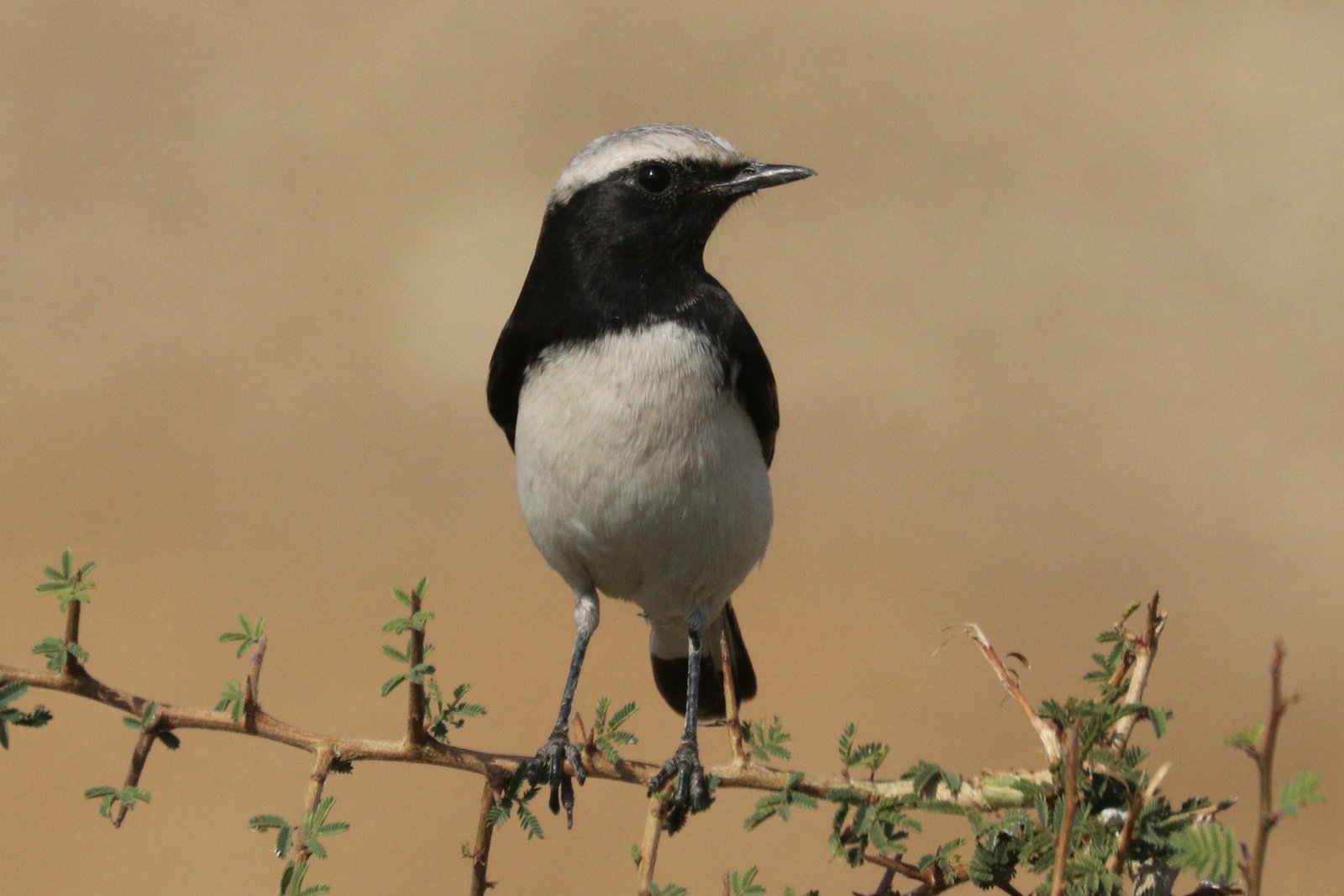
The Variable Wheatear is a black-and-white wheatear of the mountains of Iran, Afghanistan and Central Asia, which migrates in winter as far as Pakistan and north-west India. In the region it is a rare sight, mainly in northern Oman and the United Arab Emirates.
Voice
Mostly silent in winter. The call is a hard chek and a whistled weet; the song, on the breeding grounds, is a short, clear whistled phrase with mimicry.
Recording: David Darrell-Lambert — CC BY-NC-SA 4.0 · shortened to the first 60 s, mono · xeno-canto
Identification
14.5–15.5 cm. A medium-sized wheatear with a fairly long tail. The male comes in three forms: entirely black with a white rump, undertail coverts and tail base (opistholeuca); black with a white belly (picata); or black with a white belly and a white crown and nape (capistrata). In all forms the black is dull and the tail white with a broad, even black terminal band and a black centre. The female is sooty brown to grey-brown, with the same tail pattern and, in the pale forms, a paler buff belly.
Confusion species
Hume's Wheatear (Oenanthe albonigra), resident in the Hajar Mountains, closely resembles the white-bellied form but is larger, with a bigger head, glossier black and a sharp border between black breast and white belly; the sexes are alike. Mourning Wheatear (Oenanthe lugens) has white panels in the wing and buff undertail coverts. The male Hooded Wheatear (Oenanthe monacha) has an almost entirely white tail. White-crowned Wheatear (Oenanthe leucopyga) has a white tail with only black central feathers and spots.
Habitat
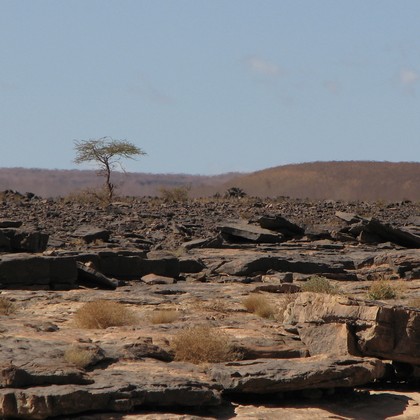
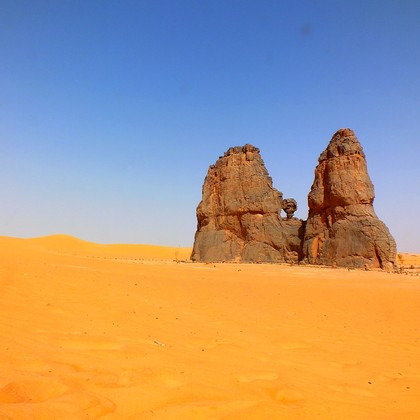
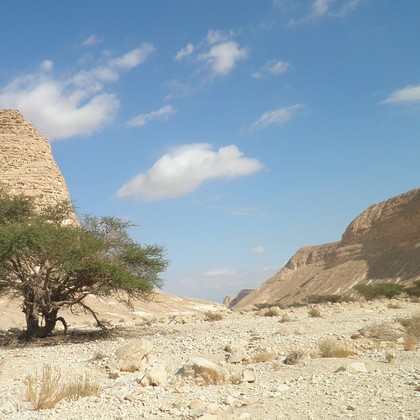
In winter on stony plains, dry wadis and slopes at the foot of rocky mountains, also near farms, plantations and village outskirts.
Where the bird is most at home, classified by the habitats of North Africa and the Middle East.
Range and movements
A rare winter visitor and vagrant to northern Oman and the United Arab Emirates, with a small number of records, mainly at the foot of the Hajar Mountains; four records in Kuwait up to 2026. Not reliably recorded elsewhere in the region. Beyond the region it breeds from eastern and north-eastern Iran to Turkmenistan, the Pamirs and Pakistan; winters in Pakistan and north-west India.
How and when to look
Your best chance is in winter at the foot of the mountains in the Emirates or northern Oman; check every black-and-white wheatear there that does not turn out to be a Hume's.
Conservation status
Not globally threatened. A vagrant in the region; it occurs here naturally as a rare winter visitor from Iran, not as a breeding bird.
Scientific name
Oenanthe picata | (Blyth, 1847)
Blyth described the species in 1847 as Saxicola picata; because it was later moved to another genus, the author and year stand in brackets. The genus Oenanthe was introduced in 1816 by Vieillot. Oenanthe was used by Aristotle for a bird that can no longer be identified; the word comes from the Greek oinos, oinoē 'wine, vine' and anthos 'flower, bloom'. picata is Latin for 'smeared with pitch', from pix 'pitch', for the black plumage. The specimen the first description was based on came from Sindh, Pakistan.