All species › Cranes, rails and allies › Rails and crakes › Water Rail
Water Rail | Rallus aquaticus
Waterral | Rascón europeo
A shy, slender rail with a long red bill that usually betrays itself only by its pig-like squealing from the reeds. It breeds in the marshes of the Maghreb, the Nile Delta, the Levant and Iraq; in winter migrants from Europe and Asia join them, and it then turns up at sewage ponds and oases deep in Arabia.
Voice
The best-known sound is a squealing, pig-like screech that fades into grunts, kruiih-kruiih-krr-krr, often from dense cover and also at night. In the breeding season also a rhythmic, hammering kip-kip-kip-kip and a sharp tchik in alarm. In winter often the only sign of its presence.
Recording: Vandousselaere Patrick — CC BY-NC-SA 4.0 · converted to mono · xeno-canto
Identification
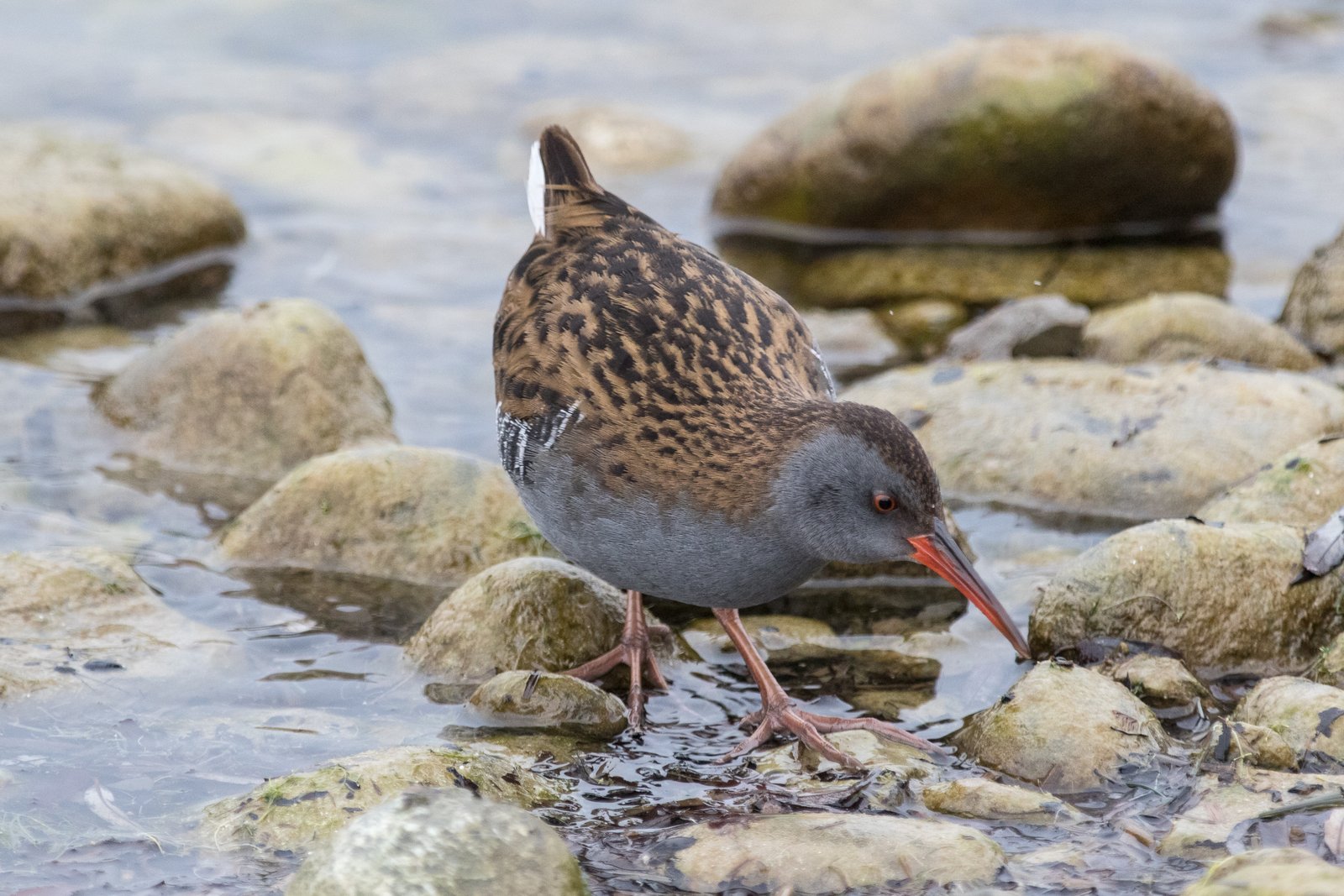
Laterally compressed, with a long, slightly decurved red bill with a dark tip. Upperparts warm olive-brown streaked black; face, neck and breast slate-grey; flanks barred black and white; undertail pale buff to white, conspicuous when it flicks its short tail. Legs pinkish-brown. Juveniles are paler and browner below, with a dull brown bill. Flight short, with dangling legs.
Confusion species
Spotted Crake (Porzana porzana), Little Crake (Zapornia parva) and Baillon's Crake (Zapornia pusilla) have short, conical bills and are smaller and more compact. A juvenile Eurasian Moorhen (Gallinula chloropus) is larger and plainer brownish-grey, with a white flank line and no long bill. White-breasted Waterhen (Amaurornis phoenicurus) has a white face and breast.
Habitat
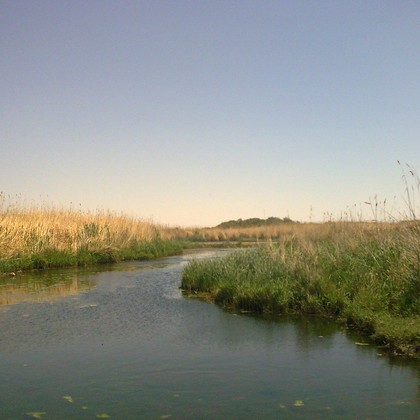
Dense reeds, reedmace and rushes with shallow water and muddy edges: marshes, lake and river margins, canals in the Nile Delta and the reed marshes of southern Iraq. In winter and on passage also in small patches of waterside vegetation at reservoirs, sewage ponds, irrigation channels and oases. Feeds on invertebrates, small fish and sometimes seeds.
Where the bird is most at home, classified by the habitats of North Africa and the Middle East.

Range and movements
Breeds in Morocco, northern Algeria and Tunisia, in the Nile Delta and valley in Egypt, in the Levant (Israel, Lebanon, Syria) and in the marshes of Iraq. In winter commoner and more widespread: throughout North Africa to the northern oases, along the Nile, in the Jordan Valley and in Iraq and Kuwait. On the Arabian Peninsula a scarce but regular winter visitor and passage migrant in Saudi Arabia, the Gulf states, the United Arab Emirates and Oman; rare in Yemen. Migrants are also found far into the Sahara. Outside the region from Iceland and western Europe to Central Asia, western Siberia and northern China.
- Resident
- Summer visitor (c. Oct–Mar)
- Winter visitor (c. Apr–Sep)
- Passage (Mar–Apr, Oct–Nov)
- dark = core range, pale = thinly spread
How and when to look
Do not play recordings; instead wait at dawn at the edge of a reedbed next to an open strip of mud: after a quarter of an hour of silence it often steps out briefly. In winter, small reed fringes at sewage ponds in the Emirates, Oman and Israel are good places, because the birds concentrate in the little cover available. Listen above all for the squealing at dusk.
Conservation status
Not threatened, but poorly counted because of its secretive habits. In the region it suffers from the drainage of marshes and the loss of reed fringes along canals; the restored marshes of southern Iraq and new artificial waters in Arabia offer it fresh opportunities.
Scientific name
Rallus aquaticus | Linnaeus, 1758
Linnaeus described the species in 1758 and placed it straight away in the genus where it still stands. He introduced the genus Rallus in that same work. Rallus is the name English ornithologists such as Willughby and Albin already used for the water rail before Linnaeus; the precise origin of the word is uncertain. aquaticus is Latin for 'living in water', from aqua 'water'. The specimen the first description was based on came from Great Britain.