All species › Passerines › Starlings › Wattled Starling
Wattled Starling | Creatophora cinerea
Lelspreeuw | Estornino carunculado
The Wattled Starling is a nomadic starling of the savannas of eastern and southern Africa, wandering in the wake of locust swarms and rain. In this region it is a rare vagrant to Arabia, where escaped cage birds cannot always be ruled out.

Voice
Rather quiet; gives a soft, squeaky sreee and rasping notes. The song is a soft series of squeaks and grating sounds.
Recording: Campbell Fleming — CC BY-NC-SA 4.0 · converted to mono · xeno-canto
Identification
19–21 cm. A pale grey-brown starling with a whitish rump, black primaries and tail and a pale pinkish-white bill. The breeding male has a bare yellow head with black wattles on the forehead and throat; outside the breeding season only a bare yellow patch behind the eye and a dark malar stripe remain. Males have a white patch at the base of the primaries. Females and juveniles are browner, without wattles, with a narrow dark malar stripe. In flight the pale rump stands out between the dark wings and tail.
Confusion species
Juvenile Rosy Starlings (Pastor roseus) are also pale sandy brown with a pale rump and a yellowish bill, but lack the bare skin behind the eye and the malar stripe and have browner wings without a white patch. Juvenile Common Starling (Sturnus vulgaris) is uniform grey-brown without a pale rump. Common Myna (Acridotheres tristis) has a black head, a yellow eye patch and a large white wing patch.
Habitat
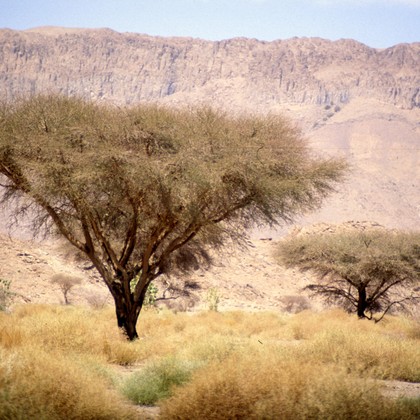
In Africa open savanna and grassland with scattered trees, often with livestock and game. Birds in Arabia have been seen in parks, on lawns and in irrigated land, often among other starlings and mynas. Eats mainly locusts and other insects, as well as fruit.
Where the bird is most at home, classified by the habitats of North Africa and the Middle East.

Range and movements
In this region only as a vagrant. There are a few records from southern Yemen and from Oman, presumably birds that crossed from the Horn of Africa. In Saudi Arabia the first records were in 2023: five birds in February in a town park, a single bird in May near Jubail on the Gulf coast, and two again in November in the same park, among Common Mynas; escape from captivity cannot be ruled out for these birds. Beyond the region from Ethiopia and Somalia to South Africa and west to Angola and Namibia.
How and when to look
A chance in southern Yemen or Oman after a year with many locusts in the Horn of Africa. In parks and on lawns in the Gulf states, look among flocks of Rosy Starlings and mynas for a pale starling with a pale rump.
Conservation status
Not globally threatened; common in Africa, with strongly fluctuating numbers. In this region a vagrant; every record is worth reporting, with attention to rings, worn feathers and other signs of captivity.
Scientific name
Creatophora cinerea | (Meuschen, 1787)
Meuschen described the species in 1787 as Rallus cinereus; because it was later moved to another genus, the author and year stand in brackets. The genus Creatophora was introduced in 1847 by Lesson. Creatophora comes from the Greek kreas, genitive kreatos, 'flesh', and -phoros, 'bearing' — for the fleshy wattles and bare yellow skin on the head of the breeding male. cinerea is Latin for 'ash-grey', from cinis, 'ash' — for the largely grey plumage. The specimen the first description was based on came from Cape of Good Hope.