All species › Passerines › Reed warblers › Western Olivaceous Warbler
Western Olivaceous Warbler | Iduna opaca
Westelijke vale spotvogel | Zarcero bereber
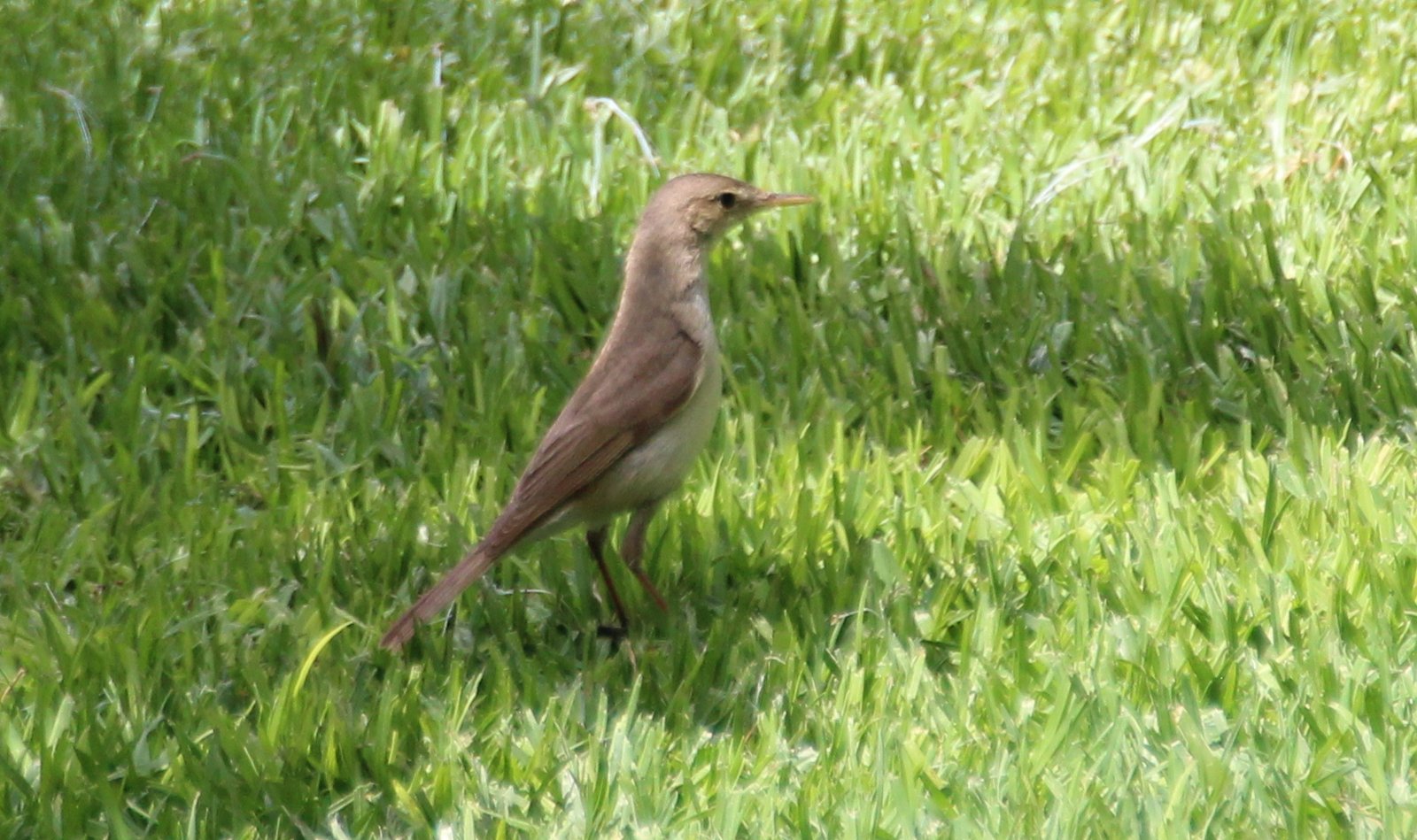
Western Olivaceous Warbler is the large, brownish Iduna of the Maghreb, a summer visitor that breeds in Morocco, northern Algeria, Tunisia and north-west Libya in tamarisks, riverine woodland and orchards. It was split from Eastern Olivaceous Warbler only in 2002 and differs from it mainly in size, bill and song.
Voice
The song is a fast, low, grating babble with the halting rhythm of a Sedge Warbler, without clear whistles or mimicry: a sustained stream of nasal, rattling notes from deep inside a tamarisk or bush, slower and fuller than that of Eastern Olivaceous Warbler. The call is a hard, dry chek, a rattling chrrr when alarmed. Sings from mid-April into July, even in the midday heat.
Recording: Pablo Guillemaud — CC BY-NC-SA 4.0 · converted to mono · xeno-canto
Identification
13–14 cm. Plain grey-brown to olive-brown above and off-white to pale buff below, without yellow, without streaking and without a supercilium worth mentioning. The bill is long, broad and straight, with an all-orange lower mandible; the forehead runs flat into the bill, making the head long and peaked. Primary projection short, the long tail square-ended with narrow pale edges to the outer feathers. Legs grey to greyish flesh. At every move the tail is jerked down, though less emphatically than in Eastern Olivaceous Warbler. Sexes alike.
Confusion species
Eastern Olivaceous Warbler (Iduna pallida), present as the form reiseri in the Saharan oases south of its breeding range, is smaller and shorter-billed, paler and sandier or colder grey and sings faster and shriller; on migration in Morocco and Algeria the combination of size, bill and song decides. Melodious Warbler (Hippolais polyglotta) is yellow below and greenish above and does not dip its tail. Eurasian Reed Warbler (Acrocephalus scirpaceus) is warmer brown, has a rounded tail and lives mainly in reeds.
Habitat
Tamarisk scrub, oleander and riverine woodland along rivers and wadis, orchards, olive and orange groves, palm groves on the desert edge, hedges in irrigated farmland and parks and gardens; from the coast to about 1500 m in the Atlas valleys. On migration also in scrub in Western Sahara.
Where the bird is most at home, classified by the habitats of North Africa and the Middle East.


Range and movements
Summer visitor to the northern Maghreb: in Morocco widespread and common, from the Atlantic lowlands and the Rif to the Souss, the Atlas valleys and the desert edge beyond; in Algeria in the Tell, on the high plateaus and in the northern Saharan Atlas; in Tunisia in the north and centre; in north-west Libya (Tripolitania) locally. On migration, April – May and August – October, through Western Sahara and the western Saharan oases; further east there are no confirmed records. Beyond the region the species breeds in southern and eastern Spain and (scarcely) southern Portugal, and winters in the Sahel and savannas of West Africa, from Senegal and Gambia to Nigeria and Chad.
- Resident
- Summer visitor (c. Oct–Mar)
- Winter visitor (c. Apr–Sep)
- Passage (Mar–Apr, Oct–Nov)
- dark = core range, pale = thinly spread
How and when to look
In May listen in the tamarisks and oleanders along the Oued Souss and Oued Massa or in the orchards around Taroudant and Ouarzazate for the low, grating babble; the singer often stays hidden but gives itself away by its tail-dipping as it moves from bush to bush.
Conservation status
Not globally threatened and still common in Morocco. It locally loses riverside vegetation to canalisation, sand extraction and the cutting of tamarisks, and elsewhere benefits from orchards and irrigation; little is known about numbers in Algeria, Tunisia and Libya.
Scientific name
Iduna opaca | (Cabanis, 1851)
Cabanis described the species in 1851 as Hypolais opaca; because it was later moved to another genus, the author and year stand in brackets. The genus Iduna was introduced in 1840 by Keyserling & Blasius. Iduna is usually linked to Iðunn, the Norse goddess who guarded the apples of eternal youth; the authors of the name gave no explanation, and other derivations have been proposed as well. opaca is Latin for 'dark, shaded'. The specimen the first description was based on came from Senegal.