All species › Passerines › Wagtails and pipits › Western Yellow Wagtail
Western Yellow Wagtail | Motacilla flava
Gele kwikstaart | Lavandera boyera
The Western Yellow Wagtail is the short-tailed yellow wagtail of wet meadows and fields, and in the region mainly a bird of migration: in April hundreds of thousands pass through the Nile valley, Sinai and the Jordan valley. Almost all forms of the species, each with its own male head pattern, can be seen here.

Voice
The call is a full, musical psree or tsli-ee; that of feldegg and related south-eastern forms sounds harsher, srree. The song is simple: a few scratchy call-like notes, sree-sree-sreet, from a stem or post.
Recording: Stanislas Wroza — CC BY-NC-SA 4.0 · converted to mono · xeno-canto
Identification
15–16 cm. Smaller and especially shorter-tailed than the other wagtails, with black legs and a fine black bill. The upperparts are olive-green, the underparts yellow, in the spring male bright yellow down to the undertail coverts; the wing is dark with two narrow pale bars and the tail black with white outer feathers. The male head differs by form: iberiae (Maghreb) grey with a white supercilium and white throat; pygmaea (Egypt) small and dark, with a grey head lacking or with a faint supercilium; feldegg (Levant, Iraq) wholly glossy black; flava blue-grey with a white supercilium; thunbergi slate-grey without a supercilium and with dark cheeks; beema pale grey with a broad white supercilium and white throat; lutea almost wholly yellow; cinereocapilla grey with a white throat and at most a white spot behind the eye. Females are duller, and autumn juveniles are beige-brown with a creamy supercilium and a necklace of dark spots.
Confusion species
Citrine Wagtail (Motacilla citreola) is grey above without olive in all plumages, has broader white wingbars and a pale surround to the ear coverts; juveniles are white below. Eastern Yellow Wagtail (Motacilla tschutschensis), a vagrant in the region, is cold grey-brown in juvenile plumage with a white throat and a harsh, rasping call. Gray Wagtail (Motacilla cinerea) has a much longer tail, a grey back, pink legs and a yellow rump. Intergrades between the races (such as superciliaris, a black-headed bird with a white supercilium) mean that some males cannot be assigned to race.
Habitat
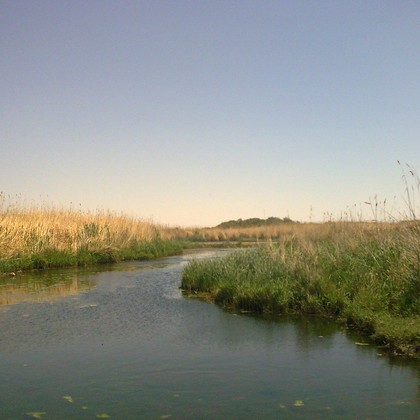
Damp pasture, wet fields, rice and clover fields, irrigated land with livestock, the shores of lakes and marshes and, on passage, also lawns, golf courses, sewage works and grassy fields in oases. It often follows cattle, camels and sheep to catch flushed insects. In winter it roosts in large flocks in reedbeds.
Where the bird is most at home, classified by the habitats of North Africa and the Middle East.


Range and movements
The form iberiae breeds in Morocco, northern Algeria and Tunisia and sparsely into Libya; pygmaea is resident in the Nile delta and Nile valley, the Faiyum and the oases of Egypt. feldegg breeds in Syria, Lebanon, northern Israel (scarce) and Iraq. In spring all northern forms pass in very large numbers through Egypt, Sinai, Israel, Jordan and Arabia, and along the Mediterranean through Libya and Tunisia. It winters in the Nile valley, south-western Arabia, around the Gulf and in southern Iraq, scarcely elsewhere. Beyond the region it breeds from Europe to central Siberia and Mongolia and winters in sub-Saharan Africa and India.
- Resident
- Summer visitor (c. Oct–Mar)
- Winter visitor (c. Apr–Sep)
- Passage (Mar–Apr, Oct–Nov)
- dark = core range, pale = thinly spread
How and when to look
Mid-April along the Nile, at Eilat or in the Jordan valley: flocks of dozens to hundreds in fields and among livestock, with a colourful mix of races. Take time to study the males' heads, as seldom will you see so many forms side by side. In Egyptian farmland pygmaea is present all year.
Conservation status
Not globally threatened, but strongly declined in parts of its European breeding range through agricultural intensification. In the region the species depends on wet grassland and irrigated farming; the loss of wetlands costs habitat, while irrigation in the desert creates new stopover sites on migration.
Scientific name
Motacilla flava | Linnaeus, 1758
Linnaeus described the species in 1758 and placed it straight away in the genus where it still stands. He introduced the genus Motacilla in that same work. Motacilla was the Roman name for the wagtail; it is really a diminutive of motare 'to move about', but from medieval times -cilla was wrongly taken to mean 'tail'. flava is Latin for 'golden-yellow', after the yellow underparts. The specimen the first description was based on came from southern Sweden.