All species › Passerines › Wagtails and pipits › Citrine Wagtail
Citrine Wagtail | Motacilla citreola
Citroenkwikstaart | Lavandera cetrina
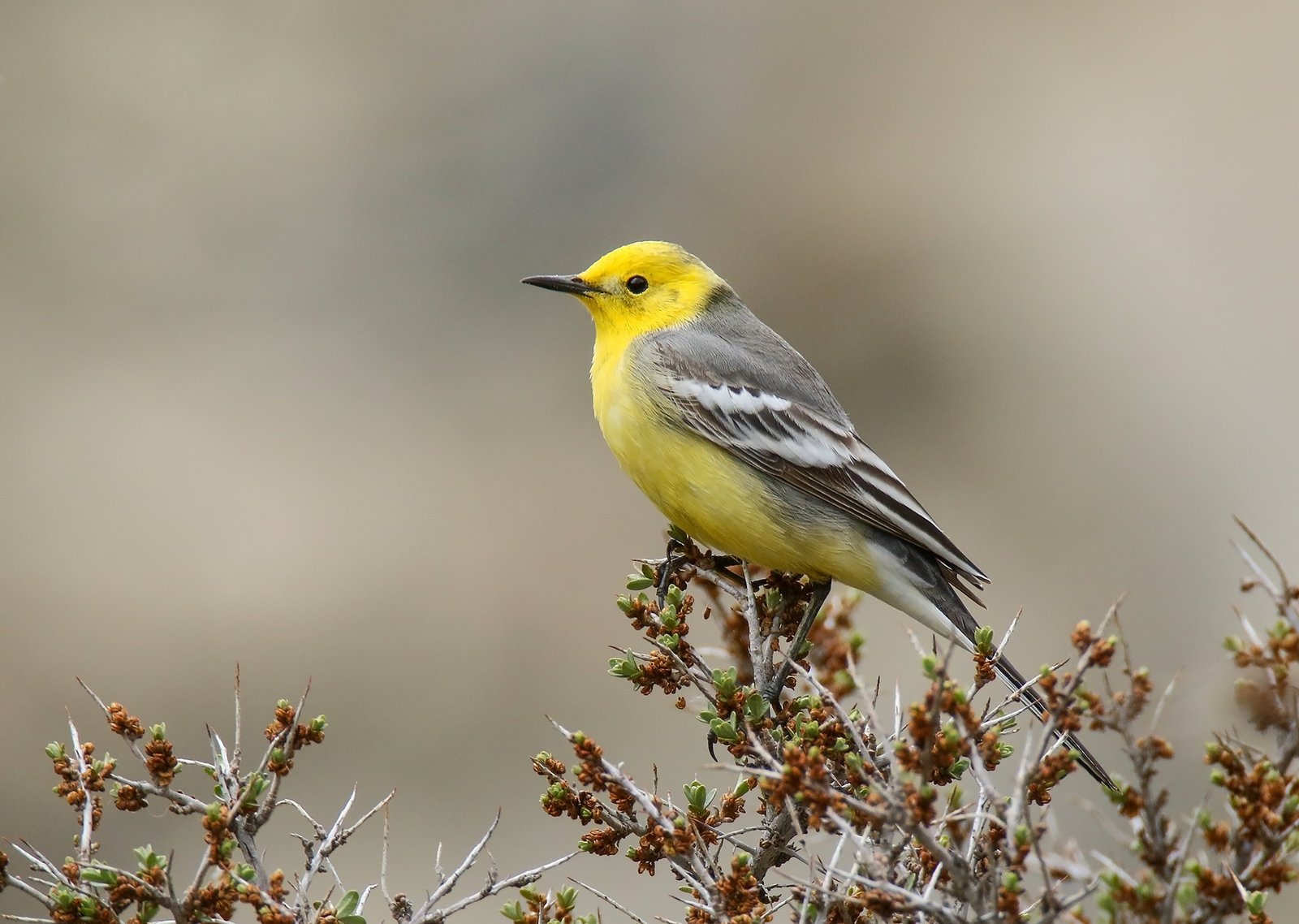
The Citrine Wagtail is a marsh-edge wagtail from Central Asia that regularly passes through and winters in the east of the region. The male with its lemon-yellow head and black nape band is unmistakable; the grey first-autumn birds are the real challenge.
Voice
The call is a rasping, hoarse tsrreep or dzheep, harsher than that of most Western Yellow Wagtails and very similar to that of feldegg and Eastern Yellow Wagtail. The song is a short series of such calls.
Recording: Daan van der Hoeven — CC BY-NC-SA 4.0 · converted to mono · xeno-canto
Identification
15.5–17 cm, slightly larger and longer-tailed than Western Yellow Wagtail, with black legs. The breeding male has a bright lemon-yellow head and underparts, a black band across the nape, a pure blue-grey back and a black wing with two very broad white bars and white edges to the secondaries. The female is duller, with a grey crown and a yellow face framed by grey ear coverts. First-autumn birds are grey above without any olive, white below, with a pale surround to the whole ear-covert patch, a pale forehead, a broad pale lore and two broad, clean white wingbars; the undertail is white.
Confusion species
Young Western Yellow Wagtails (Motacilla flava) always keep an olive or brown tinge on the back, are yellowish-buff below and have narrower, dingier wingbars and a supercilium that does not wrap around the ear coverts. Eastern Yellow Wagtail (Motacilla tschutschensis) is also cold grey in juvenile plumage, but has narrower wingbars and no framed ear coverts. A young White Wagtail (Motacilla alba) is larger and longer-tailed, with a dark breast band. It differs from Gray Wagtail (Motacilla cinerea) in its shorter tail, black legs, white wingbars and white, not yellow, undertail.
Habitat
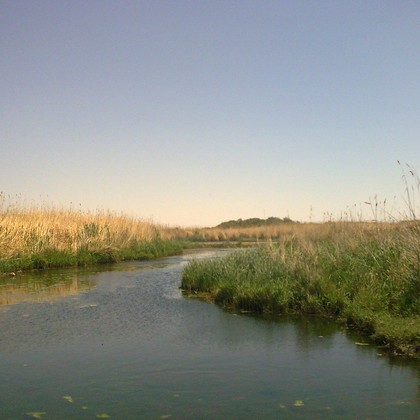
Wet ground with short vegetation or mud: marsh edges, reed fringes and wet grassland, freshwater pools, sewage works, irrigated land, the edges of salt pans and livestock watering places. It often walks with its feet in the water or over floating vegetation.
Where the bird is most at home, classified by the habitats of North Africa and the Middle East.


Range and movements
A regular passage migrant and winter visitor in the east of the region: common in the marshes of southern Iraq and in Kuwait, fairly common in eastern Saudi Arabia, Bahrain, Qatar, the United Arab Emirates and Oman, scarcer in Yemen. In Israel, Jordan and Syria a scarce passage migrant, in Egypt scarce to rare and in the Maghreb a vagrant. Beyond the region it breeds from eastern Europe and Turkey through Iran and Central Asia to Siberia, Mongolia and the Himalaya, and winters in India and South-East Asia.
- Resident
- Summer visitor (c. Apr–Sep)
- Winter visitor (c. Oct–Mar)
- Passage (Mar–Apr, Oct–Nov)
- dark = core range, pale = thinly spread
How and when to look
In winter at a sewage works, an irrigated field or a marsh edge in the Emirates, Oman or Kuwait, often among Western Yellow Wagtails. Listen for the rasping tsrreep, and with grey young wagtails check for the framed ear coverts and the broad white wingbars.
Conservation status
Not globally threatened; its breeding range has been expanding westwards for decades. In the region it depends on shallow wetlands, such as the marshes of southern Iraq, which were partly restored after being drained in the 1990s.
Scientific name
Motacilla citreola | Pallas, 1776
Pallas described the species in 1776 and placed it straight away in the genus where it still stands. The genus Motacilla was introduced in 1758 by Linnaeus. Motacilla was the Roman name for the wagtail; it is really a diminutive of motare 'to move about', but from medieval times -cilla was wrongly taken to mean 'tail'. citreola is Latin for 'lemon-yellow', after the head and underparts of the male. The specimen the first description was based on came from eastern Siberia.