All species › Passerines › Wagtails and pipits › African Pied Wagtail
African Pied Wagtail | Motacilla aguimp
Afrikaanse bonte kwikstaart | Lavandera africana
The African Pied Wagtail is a large, boldly black-and-white wagtail of African rivers that reaches the region only in the far south of Egypt: a small resident population lives along the Nile at Aswan and on Lake Nasser. It is tame there and likes to perch on boats, jetties and roofs.
Voice
A loud, clear call, tcheep or tchoo-ee, louder and more whistled than that of White Wagtail. The song is a varied, melodious twittering of whistles and trills, heard year-round from roofs and boats.
Recording: Corné_29 — CC BY-NC-SA 4.0 · converted to mono · xeno-canto
Identification
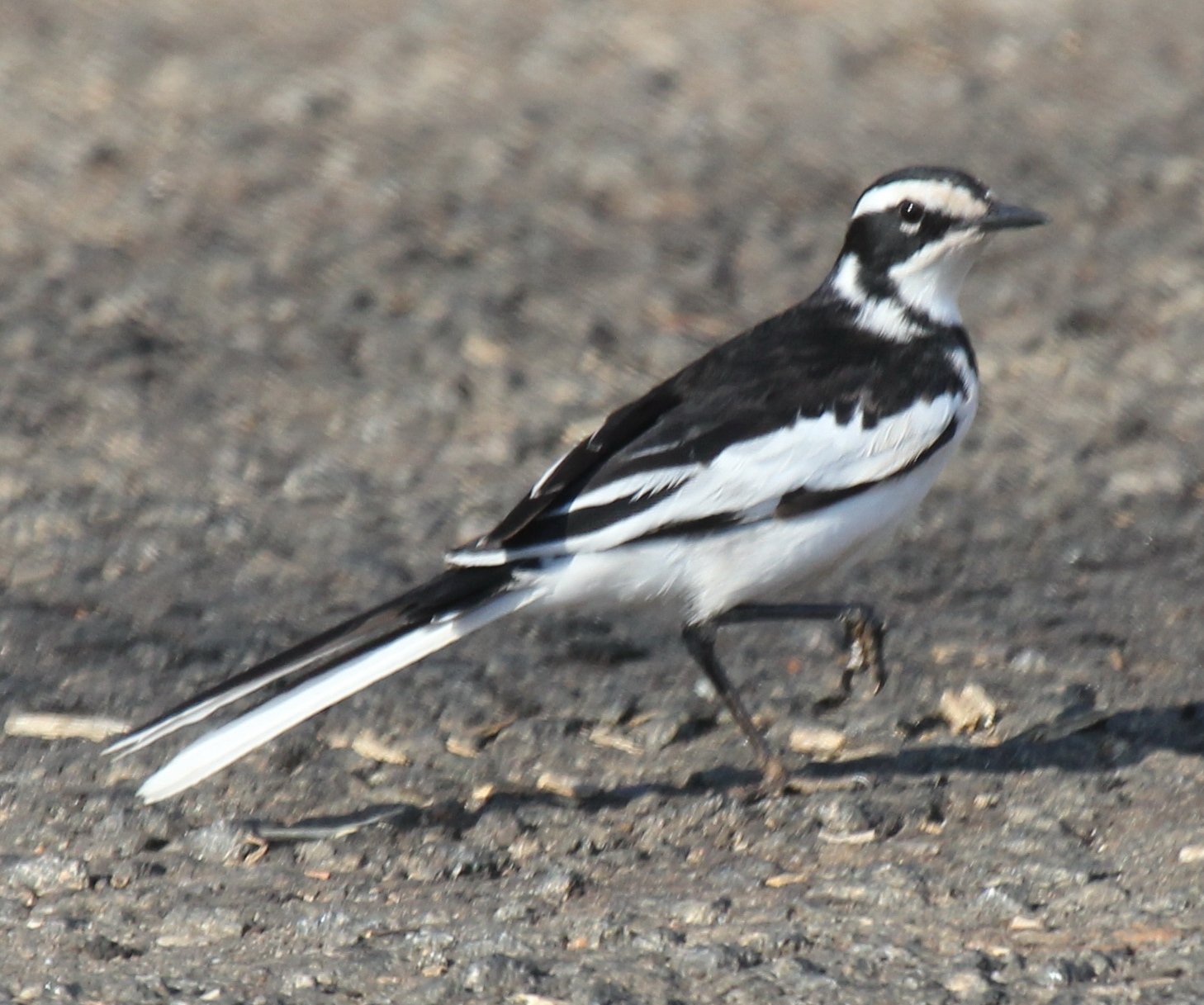
19–21 cm, larger and more heavily built than White Wagtail. The upperparts, head, throat and a broad breast band are deep glossy black; the forehead and a long, broad supercilium are white, as is the side of the neck, which projects as a white patch below the ear coverts. The wing is black with a very large white patch across the coverts and the bases of the secondaries, forming a striking white panel even at rest. The underparts below the breast band are white, the long tail black with white outer feathers, the legs black. Females are slightly duller; juveniles are grey-brown above where adults are black, with a faint brown breast patch.
Confusion species
White Wagtail (Motacilla alba), common along the Nile in winter, has a grey back, a white face with at most a black crown and a much smaller white wing pattern of two narrow bars. The masked form personata and the Moroccan form subpersonata of White Wagtail show much black on the head and throat, but also have a grey back. Only African Pied Wagtail is black above with a white supercilium and a large white wing patch.
Habitat
The banks of large rivers and lakes, sandbars, rocky shores and islets in the Nile, and especially villages, quays, jetties, gardens and fields near water. It nests in cavities in walls, under roofs, in bridges and on river boats.
Where the bird is most at home, classified by the habitats of North Africa and the Middle East.


Range and movements
In the region only in southern Egypt: along the Nile from around Kom Ombo and Aswan southwards and around Lake Nasser to Abu Simbel and the Sudanese border, a small resident population of the Nile form vidua. North of Aswan at most a rare wanderer. Beyond the region widespread across sub-Saharan Africa, from the Sahel and Sudan to South Africa.
- Resident
- Winter visitor (c. Oct–Mar)
- Passage (Mar–Apr, Oct–Nov)
- dark = core range, pale = thinly spread
How and when to look
At Aswan, on the Nile around the islands and at the felucca landings, and on Lake Nasser at Abu Simbel. Check hotel rooflines, boats and the waterfront; the birds are tame and allow close views. In winter it mixes there with numerous White Wagtails.
Conservation status
Not globally threatened and common in Africa. The Egyptian population is small and isolated at the northern edge of the range, but appears stable; it benefits from human settlement along the water.
Scientific name
Motacilla aguimp | Temminck, 1820
Temminck described the species in 1820 and placed it straight away in the genus where it still stands. The genus Motacilla was introduced in 1758 by Linnaeus. Motacilla was the Roman name for the wagtail; it is really a diminutive of motare 'to move about', but from medieval times -cilla was wrongly taken to mean 'tail'. aguimp is the name the Nama used for this bird according to Levaillant: two syllables each preceded by a click, meaning 'shore runner'. The specimen the first description was based on came from lower Orange River.