All species › Passerines › Buntings › White-Capped Bunting
White-Capped Bunting | Emberiza stewarti
Stewarts gors | Escribano de Stewart
A small bunting of the dry mountain slopes of Central Asia that winters in north-west India and Pakistan. In the region it is an extremely rare vagrant, so far recorded only in the United Arab Emirates.

Voice
Call: a short, sharp tit or tsik, repeated in small parties. The song, on the breeding grounds, is a short series of quick, high notes recalling Rock Bunting; not to be expected from vagrants.
Recording: David Farrow — CC BY-NC-SA 3.0 · converted to mono · xeno-canto
Identification
A small, slim bunting with a fairly long tail with white outer feathers and a chestnut rump. The male is unmistakable: a greyish-white crown and cheeks, a black eyestripe and a black chin and throat, below which a white band and a broad chestnut breast band that runs into rufous flanks; the mantle is chestnut with dark streaks, the belly dirty white. The female is grey-brown and streaked on head and mantle, with a pale, barely streaked breast washed rufous, and also has a chestnut rump.
Confusion species
Male Rock Bunting (Emberiza cia) has a grey head with bold black stripes and plain orange-brown underparts without a breast band; female Rock Buntings are warmer brown below. Male Pine Bunting (Emberiza leucocephalos) has a white crown with a black side border, but a chestnut throat and supercilium and a white cheek patch. Grey-necked Bunting (Emberiza buchanani) has a blue-grey head with a white eye-ring and a yellowish throat, and lacks the chestnut breast band. Females are tricky: note the small size, the chestnut rump and the rufous-washed, little-streaked breast.
Habitat
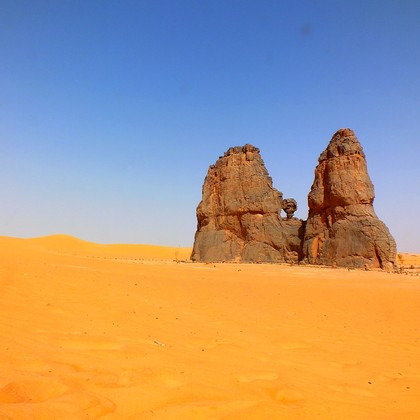
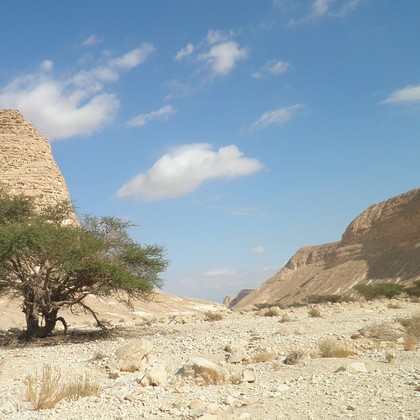
Breeds on dry, open mountain slopes with grass, rocks and scattered bushes, up to over 3000 m. In winter on stony scrubby hills, dry grassland and field edges. The vagrants in the Emirates were found in a green park in a wadi on the east coast and on a private estate at the foot of Jebel Hafeet.
Where the bird is most at home, classified by the habitats of North Africa and the Middle East.
Range and movements
United Arab Emirates: three records — one at the Emirates Golf Club in Dubai in November 1992, one at Green Mubazzarah at the foot of Jebel Hafeet near Al Ain in November 2016, and one at Wadi Shees Park in the Hajar Mountains near Khor Fakkan on 22–23 October 2024. No confirmed records from Oman or elsewhere in the region. Beyond the region it breeds in the mountains of Turkmenistan, Uzbekistan, Tajikistan, Kyrgyzstan, Afghanistan and northern Pakistan, and winters on the lower hills of Pakistan and north-west India.
How and when to look
There is no regular site: all three records fell in October–November, in green oases of parks and gardens in the east of the Emirates. Check bunting and pipit parties carefully there in autumn, looking for a small bunting with a chestnut rump and rufous breast.
Conservation status
Not globally threatened (IUCN: Least Concern). In the region a vagrant, with three records in the United Arab Emirates (1992, 2016 and 2024).
Scientific name
Emberiza stewarti | (Blyth, 1854)
Blyth described the species in 1854 as Euspiza stewarti; because it was later moved to another genus, the author and year stand in brackets. The genus Emberiza was introduced in 1758 by Linnaeus. Emberiza comes from Old German Embritz, a name for a bunting. stewarti honours someone named Stewart; exactly who is meant cannot be established with certainty. The specimen the first description was based on came from Landour and Dehradun, India.