All species › Passerines › Buntings › Rustic Bunting
Rustic Bunting | Emberiza rustica
Bosgors | Escribano rústico
The Rustic Bunting is a bunting of the wet taiga of northern Europe and Siberia, which normally winters in eastern Asia. In the region it is a rare vagrant, with a handful of records in the east, mainly in late autumn and winter.
Voice
The call is a short, hard tchip or tsik, sharper than that of Reed Bunting and without the fall; this call is usually all a vagrant gives. The song, a soft, melancholy whistled phrase, is not to be expected in the region.
Recording: Stanislas Wroza — CC BY-NC-SA 4.0 · shortened to the first 60 s, mono · xeno-canto
Identification
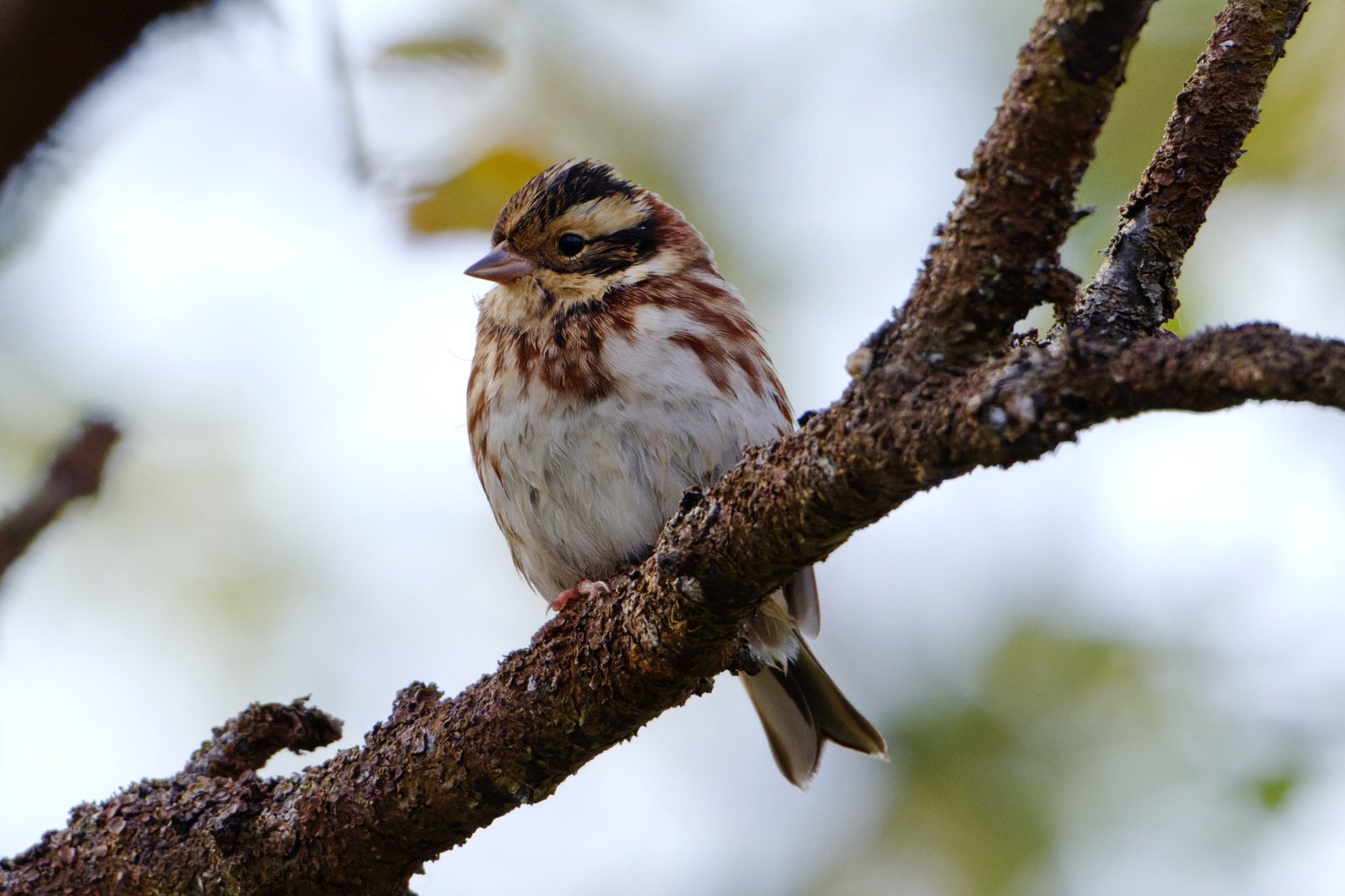
13–14.5 cm, slightly larger than a Little Bunting and with a peaked crown that can be raised as a small crest. In winter, when it appears here, the male has a brown-and-black mottled head with a broad white supercilium and a white spot behind the ear-coverts; female and young bird show the same pattern in brown. Characteristic are the rufous nape, a rufous breast band that may be broken into spots, rufous streaks on the flanks against a white belly, two white wingbars and a rufous, scaly rump. The bill is bicoloured with a pale pink lower mandible, the legs flesh-coloured.
Confusion species
Reed Bunting (Emberiza schoeniclus) lacks the rufous breast band and flank streaks, has a grey-brown rump and a plaintive tsiuu. Little Bunting (Emberiza pusilla) is smaller, with a rufous cheek framed in black and black rather than rufous streaks below. Female Pine Bunting (Emberiza leucocephalos) has a brown, not rufous-streaked breast and no prominent white supercilium.
Habitat
On passage and in winter in field edges, rough ground with bushes near water, oases, parks and gardens. It looks for seeds on the ground, often near bushes into which it darts when disturbed, sometimes in the company of other buntings or finches.
Where the bird is most at home, classified by the habitats of North Africa and the Middle East.


Range and movements
A rare vagrant in the east of the region: a handful of records in Israel, Kuwait (including Al-Abraq oasis), the United Arab Emirates and Oman, and isolated reports elsewhere in Arabia and the Levant; almost unknown in North Africa. Most birds were seen from October into the winter. It breeds from northern Scandinavia through the taiga to Kamchatka and winters mainly in China, Korea and Japan.
How and when to look
Not a species to search for deliberately; the chance is greatest in late autumn in a bird-rich oasis or park in the Gulf States or Kuwait, among other buntings and pipits. Listen for a hard tsik and look for a bunting with rufous flanks and a raised crest.
Conservation status
Near Threatened. Since the 1980s the species has declined steeply over much of its breeding range, in Scandinavia and Russia by an estimated three quarters or more within a few decades, probably because of trapping and wetland loss in the wintering areas in eastern Asia. Partly as a result, vagrants to the region are becoming rarer.
Scientific name
Emberiza rustica | Pallas, 1776
Pallas described the species in 1776 and placed it straight away in the genus where it still stands. The genus Emberiza was introduced in 1758 by Linnaeus. Emberiza comes from Old German Embritz, a name for a bunting. rustica is Latin for 'rustic, plain'. The specimen the first description was based on came from Transbaikalia, Siberia.