All species › Waders, gulls and terns › Sandpipers and snipes › White-Rumped Sandpiper
White-Rumped Sandpiper | Calidris fuscicollis
Bonapartes strandloper | Correlimos culiblanco
A long-winged American sandpiper with a gleaming white rump, which commutes each year between northern Canada and Tierra del Fuego. In the region it is an extremely rare vagrant, so far recorded in Israel and the United Arab Emirates.

Voice
A high, thin, mouse-like tseet or jeet, very different from the calls of other small sandpipers.
Recording: Jacob Wijpkema — CC BY-NC-SA 4.0 · converted to mono · xeno-canto
Identification
Slightly smaller than Dunlin, but strikingly attenuated: at rest the long primaries project clearly beyond the tail. Short, slightly decurved black bill, often with a brownish base to the lower mandible, and black legs. In breeding plumage brown-scaled upperparts with rufous tones and finely streaked breast and flanks; greyer in winter plumage. A distinct white supercilium. In flight the narrow, all-white uppertail band across the base of the tail stands out, with a faint wing bar.
Confusion species
Curlew Sandpiper (Calidris ferruginea) also has a white rump, but is longer-legged, has a longer, more strongly decurved bill and no flank streaking. Baird's Sandpiper (Calidris bairdii) is equally attenuated but has a dark rump, a buffier breast and a shorter supercilium. Dunlin (Calidris alpina) has shorter wings and a dark central stripe on the rump. At rest the long wingtips and streaked flanks are the best features.
Habitat
Mudflats, salt pans, lagoons and margins of shallow lakes and sewage ponds, often among other sandpipers.
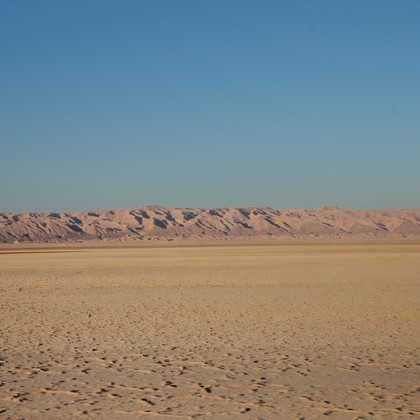
Where the bird is most at home, classified by the habitats of North Africa and the Middle East.

Range and movements
Extremely rare. Israel has one record (April 2004) and the United Arab Emirates its first at the Al Ain water treatment plant (18–26 May 2012); together with a Turkish record from 1996 these were the only three in the Middle East. There are hardly any records from North Africa, though it is to be expected on Morocco's Atlantic coast. Beyond the region it breeds on the tundra of Arctic Canada and Alaska and winters in southern South America; an annual vagrant to western Europe, mainly in autumn.
How and when to look
The Middle Eastern records are spring birds, which probably wintered in southern Africa after crossing the Atlantic and moved north with other waders in April–May. In those months, look at sewage ponds and salt pans in Arabia and at Eilat for a sandpiper with long wingtips and a white rump.
Conservation status
Vulnerable. The world population is declining through loss of feeding areas along its long migration route from Arctic America to Tierra del Fuego. In the region an extremely rare vagrant facing no specific threats.
Scientific name
Calidris fuscicollis | (Vieillot, 1819)
Vieillot described the species in 1819 as Tringa fuscicollis; because it was later moved to another genus, the author and year stand in brackets. The genus Calidris was introduced in 1804 by Merrem. Calidris goes back to Ancient Greek kalidris or skalidris, a name Aristotle used for an unidentified grey waterside bird. fuscicollis combines Latin fuscus 'dusky, brown' with -collis '-necked', so 'dusky-necked'. The specimen the first description was based on came from Paraguay.