All species › Waders, gulls and terns › Sandpipers and snipes › Long-Billed Dowitcher
Long-Billed Dowitcher | Limnodromus scolopaceus
Grote grijze snip | Agujeta escolopácea
A stocky, snipe-like wader with a long, straight bill that breeds in north-eastern Siberia and Alaska and winters in the southern United States and Central America. In western Europe it is a well-known vagrant; in the region it is extremely rare.
Voice
A high, sharp keek, single or in a rapid series keek-keek-keek; this is the best difference from Short-billed Dowitcher, which gives a softer tu-tu-tu.
Recording: AUDEVARD Aurélien — CC BY-NC-SA 4.0 · converted to mono · xeno-canto
Identification
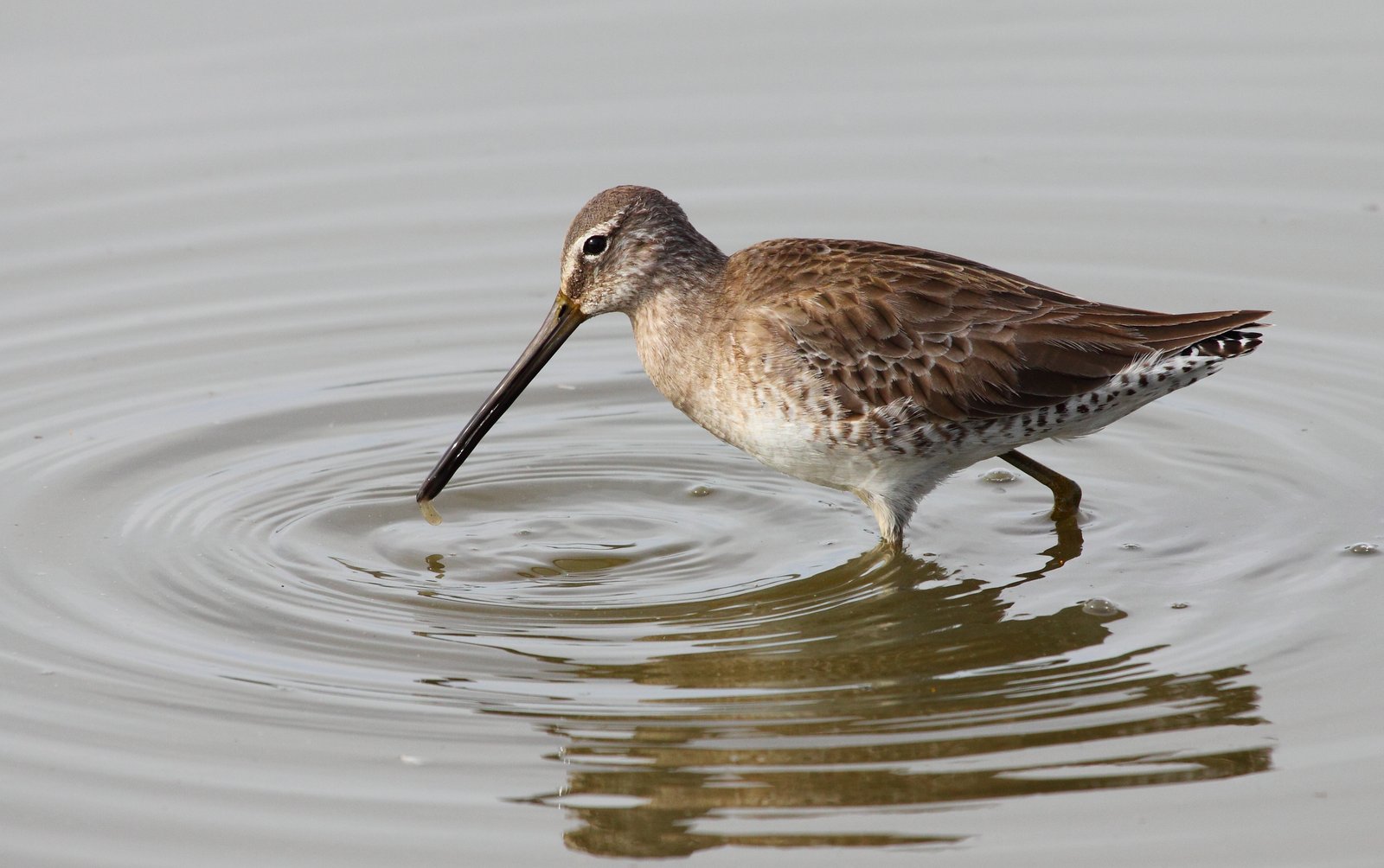
About the size of a Common Redshank but stockier, with short greenish legs and a very long, straight bill that moves up and down like a sewing machine when feeding. In winter plumage plain grey on head, breast and upperparts, with a clear white supercilium and a white belly. In breeding plumage entirely rufous below, with barred flanks. In flight a striking white wedge from rump to mid-back and a densely barred tail. Juveniles have grey tertials with narrow rufous fringes.
Confusion species
Short-billed Dowitcher (Limnodromus griseus), not recorded in the region, is almost identical; check the call and, in juveniles, the patterned tertials. Common Snipe (Gallinago gallinago) has a striped head and back and no white wedge. Asian Dowitcher (Limnodromus semipalmatus) is larger, with black legs and bill and no white wedge. Bar-tailed Godwit (Limosa lapponica) is larger and longer-legged.
Habitat
Shallow fresh or brackish water with soft mud: sewage ponds, fish ponds, marsh edges and coastal lagoons; less on open mudflats than other dowitchers.
Where the bird is most at home, classified by the habitats of North Africa and the Middle East.


Range and movements
In the region an extremely rare vagrant. In Israel two records, the first a bird that stayed from July to August 1984 at the Shafdan sewage ponds near Tel Aviv. In Oman a few records are known and in the United Arab Emirates one. From North Africa there are at most a few accepted records; the density map does show sightings, but these are largely unverified reports. Beyond the region it breeds on the tundra of north-eastern Siberia and Alaska and winters from the southern United States to Guatemala; in Europe an annual vagrant.
How and when to look
A dowitcher in the region is most likely to be found at sewage ponds and fish ponds, where it usually feeds among Wood Sandpipers and Ruffs. Listen for the high keek call and photograph the tail and tertials for identification.
Conservation status
Not globally threatened, with a large and stable population. In the region a vagrant without specific protection.
Scientific name
Limnodromus scolopaceus | (Say, 1822)
Say described the species in 1822 as Limosa scolopacea; because it was later moved to another genus, the author and year stand in brackets. The genus Limnodromus was introduced in 1833 by Wied-Neuwied. Limnodromus is Ancient Greek, from limnē 'marsh' and -dromos '-runner'. scolopaceus means 'snipe-like', from Latin scolopax 'snipe', after the long straight bill. The specimen the first description was based on came from near Council Bluffs, Iowa.