All species › Passerines › Bulbuls › White-Spectacled Bulbul
White-Spectacled Bulbul | Pycnonotus xanthopygos
Arabische buulbuul | Bulbul árabe
The White-spectacled Bulbul is the garden bird of the Levant and of western and southern Arabia: from Jerusalem and Amman to the wadis of Yemen and Dhofar it sits high and visible in bushes and trees, calls all day long and gives itself away on take-off with a bright yellow patch under the tail.

Voice
Noisy and heard all day. The song is a short, full and clear whistled phrase of four to seven notes, roughly bulbul-bul-bulbul or chook-chook-chiwee, repeated every few seconds from a roof, aerial or treetop. The contact call is a sharp queet or chip; at a cat or owl a rasping, persistent chrr-chrr that brings the whole neighbourhood in.
Recording: Mischa Keijmel — CC BY-NC-SA 4.0 · converted to mono · xeno-canto
Identification
19–20 cm. A sturdy bulbul with a fairly long tail and no crest, though the crown feathers are raised when excited. The head is sooty black to dark sooty-brown and extends over the throat and upper breast; set in that darkness is a narrow, striking white ring around the eye. Mantle, wings and tail are greyish-brown, the underparts pale greyish-beige, slightly paler towards the belly, and the undertail coverts bright warm yellow. Bill and legs are black. The sexes are alike; juveniles have a browner head, a duller eye-ring and paler yellow under the tail.
Confusion species
Common Bulbul (Pycnonotus barbatus), from the Nile Valley westwards, lacks the white eye-ring and has white rather than yellow undertail coverts; hybrids occur in north-east Egypt and Sinai. White-eared Bulbul (Pycnonotus leucotis) has a black head with a large white cheek patch and no eye-ring; it also hybridises where the two meet, as around Riyadh and in northern Oman. Red-vented Bulbul (Pycnonotus cafer) has a small crest, a scaly breast, a white rump and red undertail coverts. A female Common Blackbird (Turdus merula) is bulkier, uniformly brown without a dark cap and without yellow under the tail.
Habitat
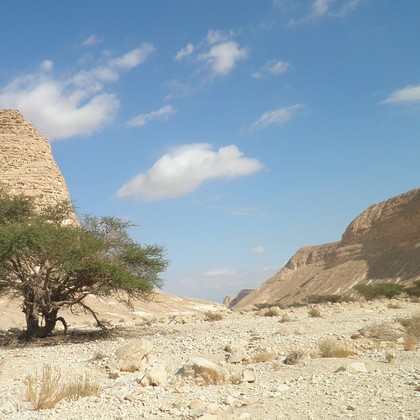
Wherever shrubs, trees and water come together: town gardens, parks, hotel grounds, orchards, olive and date plantations, maquis and garrigue, and the tamarisk, oleander, acacia and Christ's-thorn scrub of the wadis, down to the oases of the Arava Valley and around the Dead Sea. In Yemen and south-west Arabia also in juniper and acacia scrub in the mountains, to above 2000 m. It avoids closed forest and bare desert. Eats mainly fruit, berries, flower buds and nectar, supplemented with insects.
Where the bird is most at home, classified by the habitats of North Africa and the Middle East.


Range and movements
In the Levant common in Lebanon, western Syria, Israel with Samaria and Judea (from Galilee to the Arava and Eilat) and Jordan (Jordan Valley, Dead Sea, south to Wadi Rum and Aqaba). In Egypt in Sinai and on the east side of the Suez Canal. On the Arabian Peninsula in western and southern Saudi Arabia (Hejaz and Asir, locally into Najd and Riyadh), in almost all of Yemen (highlands, Tihama and Hadhramaut), in Oman (Dhofar and the Hajar Mountains) and in the east of the United Arab Emirates (Hajar, east coast, Al Ain). Scarce and local in western Iraq; rare in Kuwait, Bahrain and Qatar. Absent from Socotra. Beyond the region only along the south coast of Turkey, where it has spread westwards in recent decades.
- Resident
- Summer visitor (c. Apr–Sep)
- Passage (Mar–Apr, Oct–Nov)
- dark = core range, pale = thinly spread
How and when to look
No searching needed: sit anywhere in Jerusalem, Amman, Eilat or Taiz where a garden hose or drip irrigation is running. In the midday heat they come to drink and bathe, showing the white eye-ring and the yellow vent in one view. For song, the first half hour after sunrise is best.
Conservation status
Not globally threatened and common to very common over almost its whole range. The species benefits from gardens, irrigation, urban greenery and orchards. In fruit-growing areas it is locally regarded as a nuisance because it eats ripe figs, dates and grapes. There are no significant threats; hybridisation with introduced bulbuls in the Gulf states and with Common Bulbul in north-east Egypt is mainly an identification problem.
Scientific name
Pycnonotus xanthopygos | (Hemprich & Ehrenberg, 1833)
Hemprich & Ehrenberg described the species in 1833 as Ixus xanthopygos; because it was later moved to another genus, the author and year stand in brackets. The genus Pycnonotus was introduced in 1826 by Boie. Pycnonotus is Greek, from puknos 'thick, compact' and -nōtos '-backed', from nōton 'back', after the dense plumage of the back. xanthopygos is Greek for 'yellow-rumped', from xanthos 'yellow' and pugē 'rump'; in this bird it is the undertail-coverts that are yellow. The specimen the first description was based on came from Muwailah on the Red Sea.