All species › Waders, gulls and terns › Plovers and lapwings › White-Tailed Lapwing
White-Tailed Lapwing | Vanellus leucurus
Witstaartkievit | Avefría coliblanca
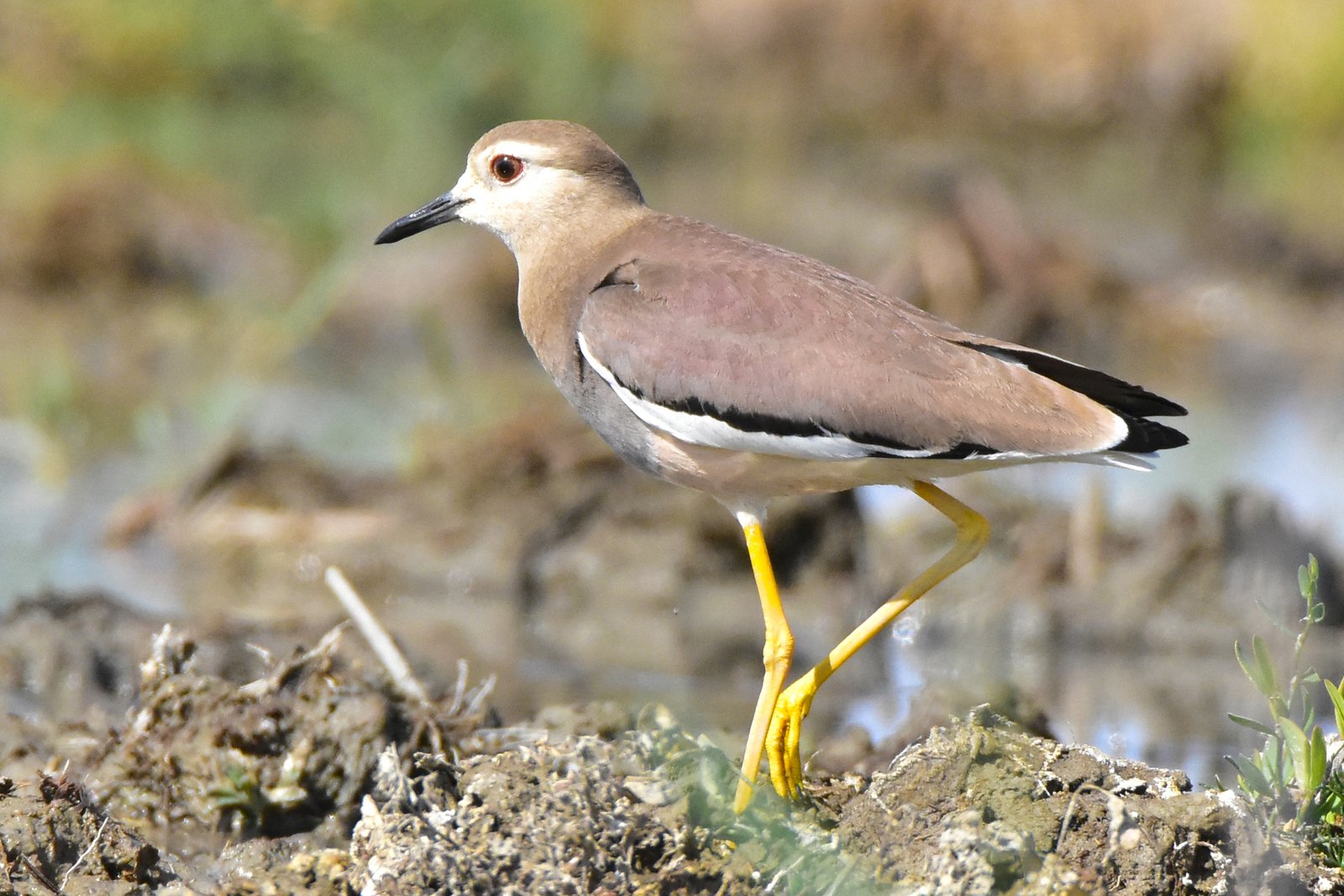
A slender, long-legged lapwing of fresh and brackish marshes, with long yellow legs and an all-white tail. The core of its occurrence in the region lies in the marshes of Mesopotamia; around the Gulf and in the Levant it is a scarce winter visitor.
Voice
Fairly quiet outside the breeding season. A plaintive, somewhat nasal pee-wick or pe-tee-wick; at the nest a repeated, agitated kee-wick kee-wick.
Recording: David Darrell-Lambert — CC BY-NC-SA 4.0 · converted to mono · xeno-canto
Identification
Slender and very long-legged, with strikingly long bright yellow legs and a thin black bill. Head and neck are plain pale grey-brown, with a paler face and a dark eye; the upperparts grey-brown with a lilac or pinkish tinge. The breast is grey-brown, the belly pinkish-buff, the undertail coverts white. In flight a striking wing pattern: black primaries, a broad white band across secondaries and greater coverts, brown forewing, and an all-white tail without a terminal band. Juveniles have a scaly mantle with pale fringes and dark spots.
Confusion species
Sociable Lapwing (Vanellus gregarius) has a strongly patterned head, black legs and a black tail band. Red-wattled Lapwing (Vanellus indicus) also has yellow legs, but a black head and breast and red wattles. Spur-winged Lapwing (Vanellus spinosus) is black, white and brown with black legs.
Habitat
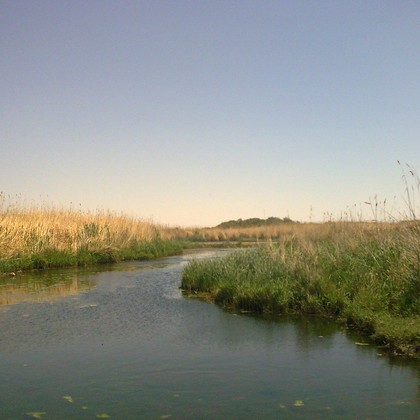
Shallow edges of fresh and brackish marshes, flooded meadows, salt flats with pools, reed edges, fish ponds and sewage pools. Wades more often and deeper than other lapwings, sometimes belly-deep. Breeds on muddy islets and drying margins.
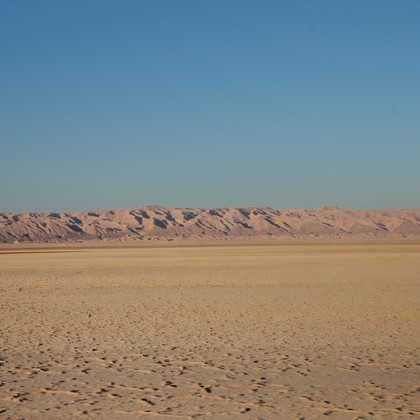
Where the bird is most at home, classified by the habitats of North Africa and the Middle East.

Range and movements
The centre of gravity in the region lies in Iraq: a breeder in the southern marshes and along the lower Tigris and Euphrates, and also present in central Iraq; more numerous in winter. In Syria it breeds locally along the Euphrates and the Khabur. In Kuwait a local breeder at the Jahra pools when conditions are favourable, otherwise a fairly scarce passage migrant. In eastern Saudi Arabia, Bahrain, Qatar, the Emirates and Oman a winter visitor and passage migrant in small numbers. In Israel and Jordan a scarce winter visitor and migrant (Hula Valley, Eilat); in Egypt scarce in the Nile valley; west of Egypt an exceptional vagrant. Beyond the region it breeds in south-eastern Turkey, Iran and Central Asia and winters in Sudan, Pakistan and northern India.
- Resident
- Summer visitor (c. Oct–Mar)
- Winter visitor (c. Apr–Sep)
- Passage (Mar–Apr, Oct–Nov)
- dark = core range, pale = thinly spread
How and when to look
The Jahra pools in Kuwait and the treatment ponds in the Gulf states are the most accessible sites; in Israel it appears in winter in the Hula Valley and at the Eilat salt pans. Search the shallow margins among the stilts: the long yellow legs and the white tail on take-off give it away.
Conservation status
Not globally threatened. In Iraq the drainage of the marshes in the 1990s hit the species hard; it has returned since their partial restoration after 2003. Desiccation caused by upstream dams, hunting and disturbance remain threats.
Scientific name
Vanellus leucurus | (Lichtenstein, 1823)
Lichtenstein described the species in 1823 as Charadrius leucurus; because it was later moved to another genus, the author and year stand in brackets. The genus Vanellus was introduced in 1760 by Brisson. Vanellus is Latin for 'little fan', the diminutive of vannus 'winnowing fan'. leucurus is Greek, from leukos 'white' and -ouros 'tailed', after the wholly white tail. The specimen the first description was based on came from Central Asia.