All species › Waders, gulls and terns › Plovers and lapwings › Northern Lapwing
Northern Lapwing | Vanellus vanellus
Kievit | Avefría europea
The familiar crested lapwing of European meadows, wintering in large numbers on the fields and wet plains of North Africa, the Levant and Iraq. During hard frosts in Europe extra flocks move south; as a breeding bird it is rare and local in the region.
Voice
A plaintive, nasal pee-wit or kee-weet, which gave it its name. In display flight a wild series, chew-ee, wee-wee-weet, with humming wingbeats and tumbling flight.
Recording: Mark James Pearson — CC BY-NC-SA 4.0 · converted to mono · xeno-canto
Identification
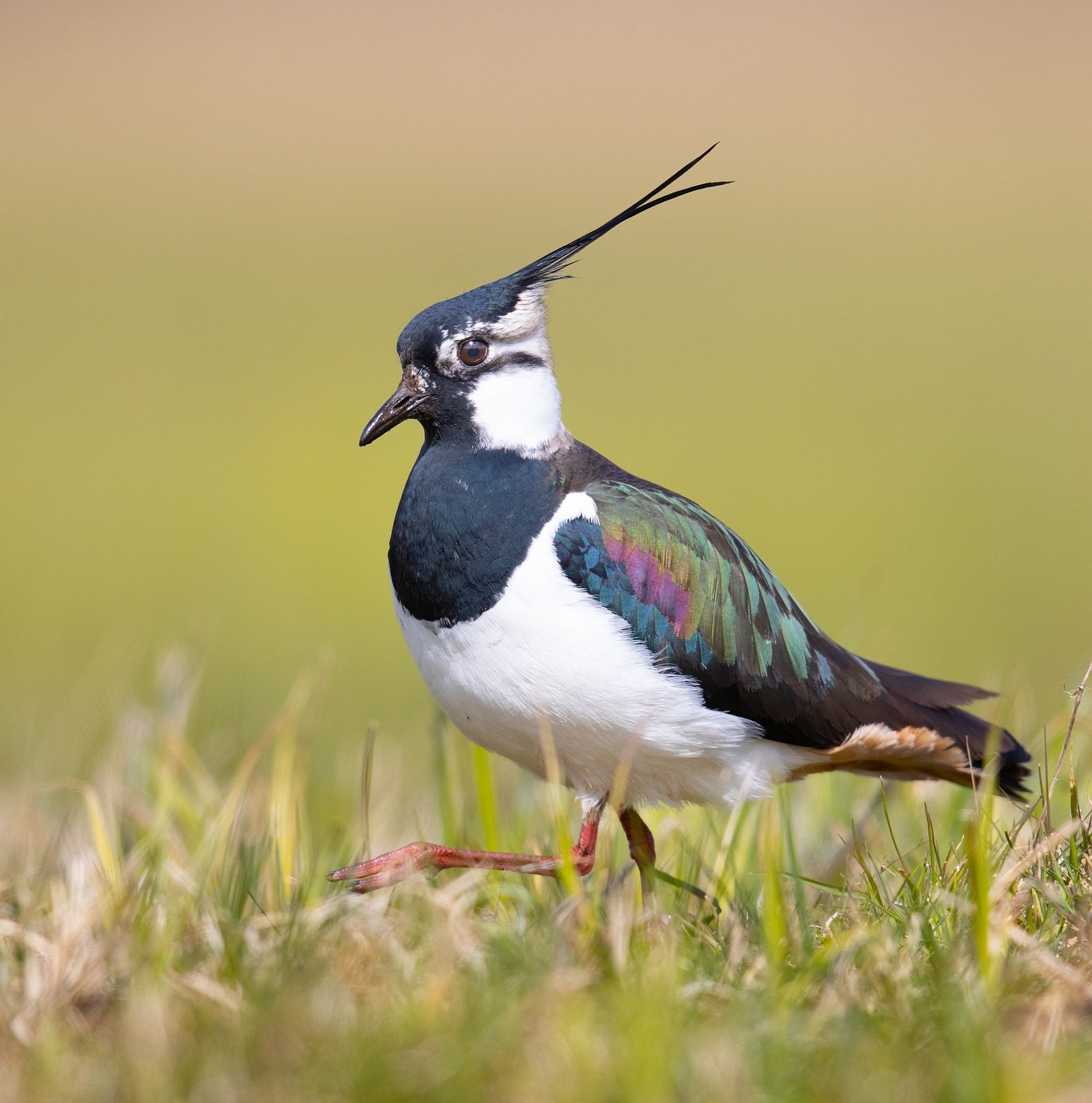
A medium-sized, black-and-white wader with a long, thin, upcurved crest. Upperparts dark green with purple and bronze gloss, head with a black crown and crest, white face with black marks below the eye, broad black breast and white belly; the undertail coverts are orange-buff. In winter and in juveniles the throat and face are buffer, the crest shorter and the back feathers fringed pale brown. Unmistakable in flight: broad, rounded wings widening towards the tip with white spots at the end, a black-and-white underwing and a slow, floppy flight.
Confusion species
Sociable Lapwing (Vanellus gregarius) is paler grey-brown, without a crest, with a black crown and white supercilium and in flight a white triangle on the rear wing. White-tailed Lapwing (Vanellus leucurus) is plain grey-brown with long yellow legs and an all-white tail. Spur-winged Lapwing (Vanellus spinosus) has a black cap without a crest, white cheeks and sandy-brown upperparts. Confusion is practically impossible in good views.
Habitat
Farmland, wet meadows, flooded fields, the edges of lakes and marshes, fish ponds and irrigated farmland; also the bare margins of sebkhas and chotts. In winter in flocks, often with European Golden-Plovers, on ploughed or freshly sown fields.
Where the bird is most at home, classified by the habitats of North Africa and the Middle East.



Range and movements
Winter visitor to northern Morocco (the Gharb, the Loukkos, the Saïss and the coastal plains to Doukkala, more scarcely further south), northern Algeria, northern Tunisia, northern Libya and northern Egypt (mainly the Nile Delta). Common in the east in Israel (Hula Valley, Jezreel Valley, coastal plain), Lebanon, Syria, Jordan and Iraq; scarce in Kuwait and north-east Saudi Arabia and rare further into Arabia to the Emirates and Oman. Breeds in small numbers and irregularly in northern Morocco and northern Algeria, and in Syria and northern Iraq. Beyond the region it breeds from Ireland and Iberia to eastern Siberia and northern China; winters from western Europe to Japan.
- Resident
- Summer visitor (c. Apr–Sep)
- Winter visitor (c. Oct–Mar)
- Passage (Mar–Apr, Oct–Nov)
- dark = core range, pale = thinly spread
How and when to look
The Hula Valley in Israel holds flocks of hundreds to thousands in December and January, together with Common Cranes and European Golden-Plovers. In Morocco you find them in winter on the wet fields around Merja Zerga and in the Gharb. After cold spells in Europe large flocks can suddenly appear on fields where they are otherwise scarce.
Conservation status
Near Threatened. Since 2015 the species has been listed globally as Near Threatened owing to a steep decline in Europe, mainly through agricultural intensification, drainage and low breeding success. In the region it is hunted on its wintering plains and loses wet fields to drainage.
Scientific name
Vanellus vanellus | (Linnaeus, 1758)
Linnaeus described the species in 1758 as Tringa Vanellus; because it was later moved to another genus, the author and year stand in brackets. The genus Vanellus was introduced in 1760 by Brisson. Vanellus is Latin for 'little fan', the diminutive of vannus 'winnowing fan'. The specific name repeats the genus name. The specimen the first description was based on came from Sweden.