All species › Passerines › Dippers › White-Throated Dipper
White-Throated Dipper | Cinclus cinclus
Waterspreeuw | Mirlo acuático europeo
White-throated Dipper is the only songbird that forages underwater: a stocky, dark bird with a gleaming white bib that bobs on stones in fast mountain streams. In this region it is scarce and tied to the cold, clear streams of the Atlas, the Levant and Kurdistan.
Voice
Mainly in flight a sharp, rasping zrits or chrit, easily heard above the noise of the water. The song, also in winter, is a soft, scratchy, babbling warble with sharp notes.
Recording: bert de bruin — CC BY-NC-SA 4.0 · shortened to the first 60 s, mono · xeno-canto
Identification
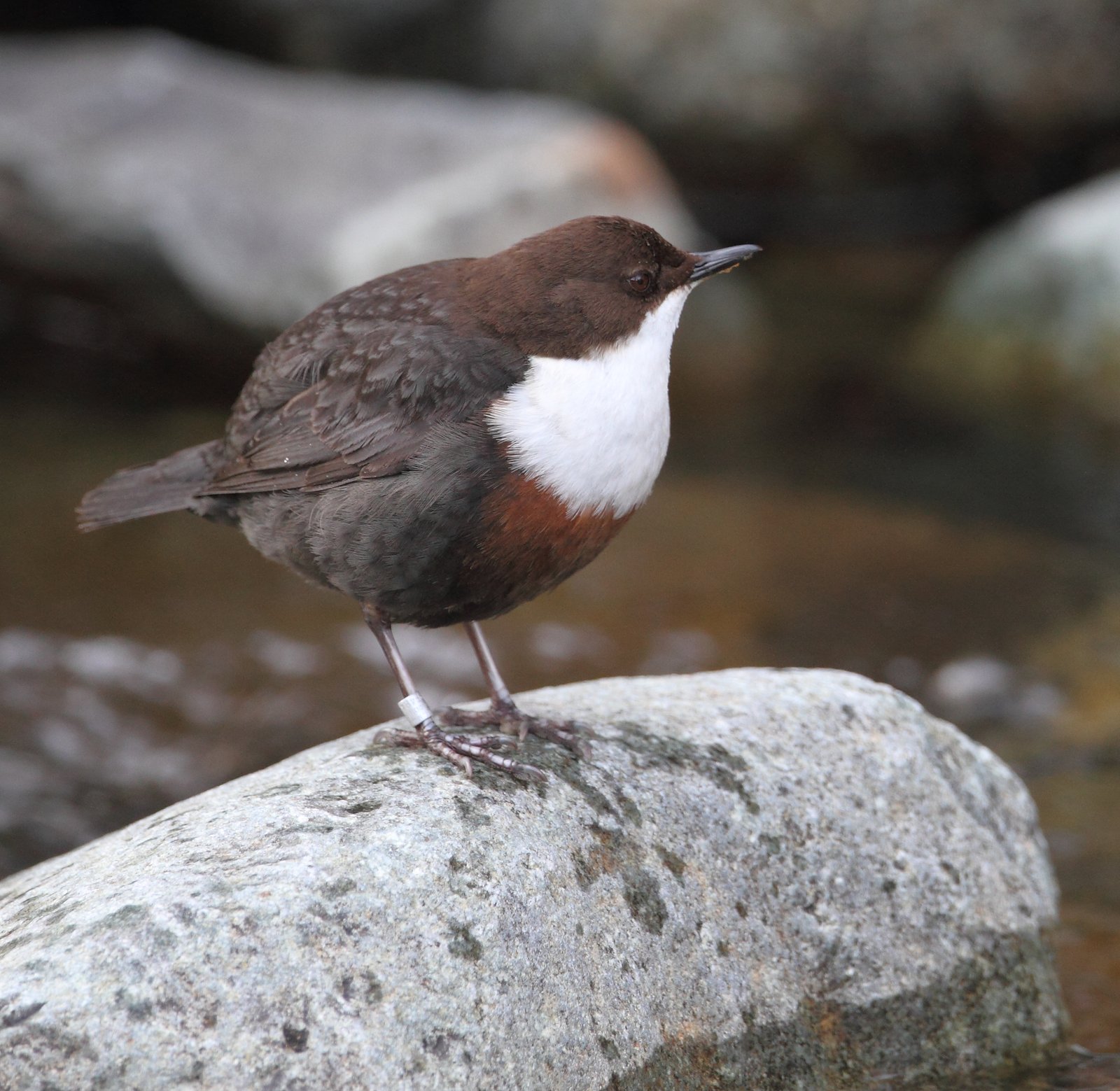
17–20 cm. Round and stocky, with a short, often cocked tail, short wings and strong legs. Adults have a dark chocolate-brown head and nape, a slate-grey, darkly scaled back and a pure white throat and breast, abruptly bordered by a rufous band and a blackish-brown belly. The North African subspecies minor is slightly smaller, with a broad rufous belly band; birds from the Levant (rufiventris) are even warmer rufous below, those from Kurdistan (caucasicus) darker. Flashes its white eyelids when bobbing. Juveniles are slate-grey, dirty white below with dark scaling. Flies fast, low and straight over the water.
Confusion species
Almost unmistakable in its habitat. Common Blackbird (Turdus merula) lacks the white bib and has a much longer tail; Blue Rock-Thrush (Monticola solitarius) lives on rocks, not in the water, and has no white breast.
Habitat
Fast-flowing, clear, oxygen-rich streams and rivers with stones, rapids and waterfalls, usually in mountain valleys between about 800 and 2800 m, often in gorges with trees along the banks. Dives and walks upstream on the bottom, eating larvae of caddisflies, mayflies and stoneflies, freshwater shrimps and small fish. Builds a domed moss nest under a bridge, behind a waterfall or in a rock crevice above the water.
Where the bird is most at home, classified by the habitats of North Africa and the Middle East.


Range and movements
In Morocco a scarce resident of mountain streams in the Rif, the Middle Atlas (including around Ifrane and Azrou) and the High Atlas (including the Ourika valley); in northern Algeria very rare and local in the Kabylie mountains; in Tunisia formerly in Kroumirie, with no confirmed records for a long time. In Lebanon and western Syria (subspecies rufiventris) very rare and local, possibly gone from some sites; in northern Iraq in the mountain streams of Kurdistan. Absent from the rest of the region. Beyond it from Europe and Asia Minor through Central Asia to the Himalayas and western China.
- Resident
- Summer visitor (c. Apr–Sep)
- Winter visitor (c. Oct–Mar)
- Passage (Mar–Apr, Oct–Nov)
- dark = core range, pale = thinly spread
How and when to look
In Morocco in the Ourika valley south of Marrakech or along the streams around Ifrane in the Middle Atlas: walk slowly along a rushing stream and look for a dark bird with a white bib bobbing on a stone.
Conservation status
Not globally threatened. In this region scarce and vulnerable to water pollution, water abstraction, dams and streams drying up.
Scientific name
Cinclus cinclus | (Linnaeus, 1758)
Linnaeus described the species in 1758 as Sturnus cinclus; because it was later moved to another genus, the author and year stand in brackets. The genus Cinclus was introduced in 1797 by Borkhausen. Cinclus is from the Ancient Greek kinklos, a classical name for a small tail-wagging bird living by the water. The specific name repeats the genus name. The specimen the first description was based on came from Sweden.