All species › Passerines › Chats and flycatchers › White-Throated Robin
White-Throated Robin | Irania gutturalis
Perzische roodborst | Ruiseñor coliblanco
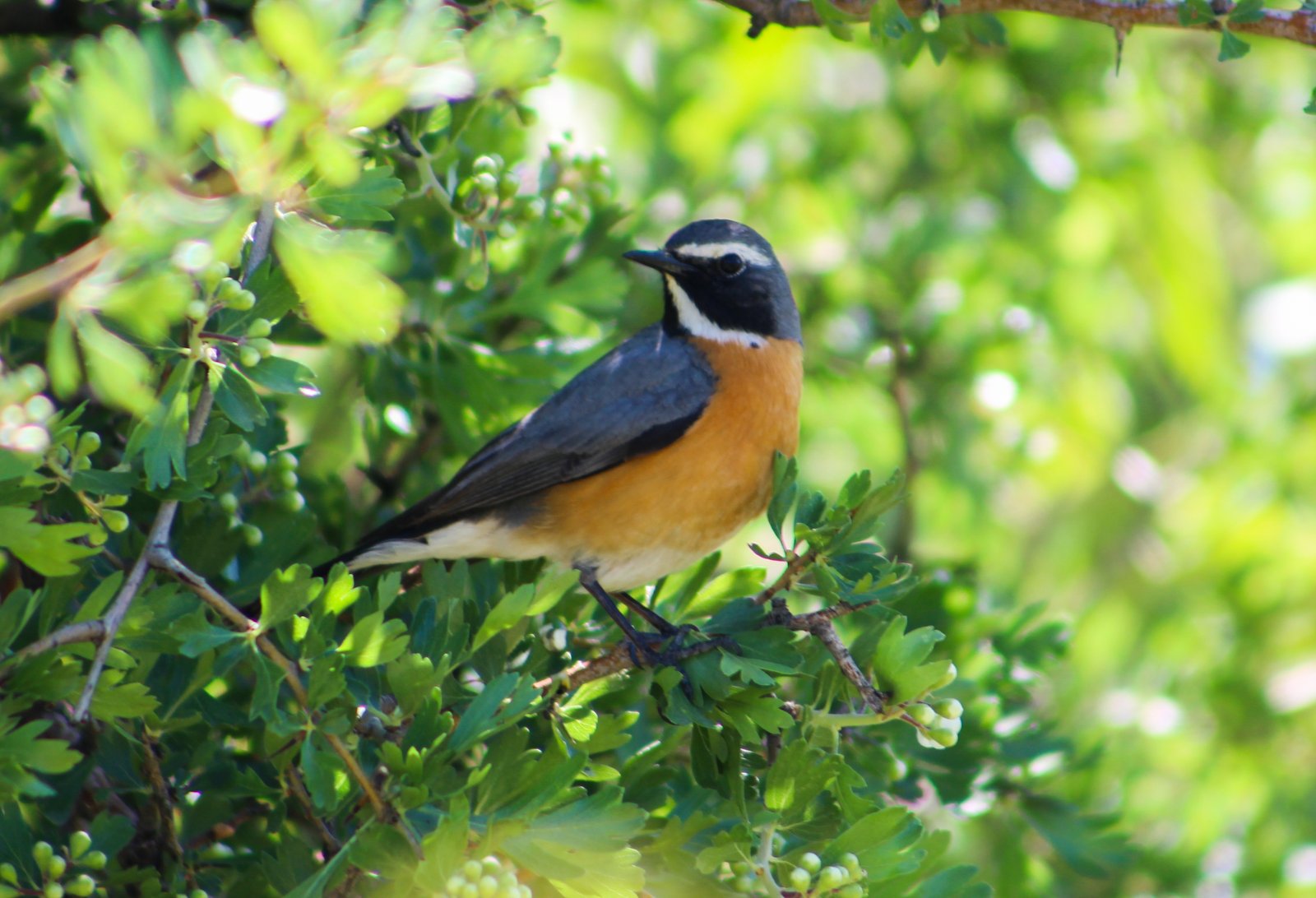
The White-throated Robin is a boldly patterned, slender songbird of dry, bushy mountain slopes; the male has a blue-grey back, a black face with a white throat and an orange breast. It breeds in the north-east of the region on Mount Hermon and in the mountains of Lebanon, Syria and Iraqi Kurdistan, and migrates through Arabia to East Africa.
Voice
The song is a fast, scratchy, rather shrill series of varied notes with mimicry, often from a bush top and sometimes in a short song flight. Calls are a hard tek and a soft whistled tsee.
Recording: Frantz Barrault — CC BY-NC-SA 4.0 · shortened to the first 60 s, mono · xeno-canto
Identification
16–17.5 cm. The male is blue-grey above, with a narrow white supercilium, a black face and black neck sides enclosing a narrow white throat stripe, a warm orange breast and flanks and a white lower belly; the long tail is black, often cocked and fanned. The female is grey-brown above, with a pale throat, an orange wash on the flanks and a dark tail; she lacks the black and white face pattern. Juveniles are spotted. Long wings with a long primary projection. Often keeps within scrub but sings from the top of a bush.
Confusion species
A male Common Redstart (Phoenicurus phoenicurus) also has a black face and orange breast, but has a black throat, a white forehead patch and an orange-red tail. The female resembles Thrush Nightingale (Luscinia luscinia) or a female redstart, but has a blackish tail and orange flanks. Eversmann's Redstart (Phoenicurus erythronotus) has a rufous back and a rufous tail.
Habitat
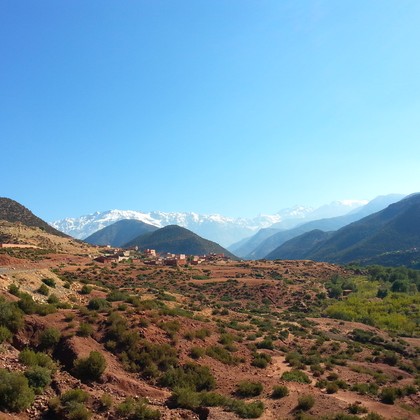
In the breeding season dry, stony mountain slopes with low, scattered bushes, oak scrub and almond or juniper shrubs, mostly between about 1,200 and 2,000 m. On passage scrub in wadis, oases, gardens and parks, usually close to the ground.
Where the bird is most at home, classified by the habitats of North Africa and the Middle East.


Range and movements
Breeds in the north-east of the region: on Mount Hermon (Israel and Syria, about 20 pairs on the Israeli side), in the Lebanon and Anti-Lebanon ranges, in the mountains of northern Syria and in Iraqi Kurdistan. On passage through the Levant, Iraq and Kuwait and across the Arabian Peninsula (Saudi Arabia, Yemen, Oman, United Arab Emirates); in spring regular at Eilat and in the Arava, scarce in Egypt (mainly Sinai). Winters in East Africa, mainly Kenya and Tanzania. Beyond the region it breeds in Turkey, the Caucasus, Iran and Central Asia to Afghanistan.
- Summer visitor (c. Apr–Sep)
- Passage (Mar–Apr, Oct–Nov)
- dark = core range, pale = thinly spread
How and when to look
In late April and early May in the gardens and fields around Eilat or in the parks of Kuwait and the Emirates; almost always in low scrub. Breeding birds sing in May and June on the slopes of Mount Hermon above Neve Ativ.
Conservation status
Not globally threatened. The small Israeli breeding population on Mount Hermon is considered vulnerable and is threatened by road building and ski runs.
Scientific name
Irania gutturalis | (Guérin-Méneville, 1843)
Guérin-Méneville described the species in 1843 as Cossypha gutturalis; because it was later moved to another genus, the author and year stand in brackets. The genus Irania was introduced in 1863 by De Filippi. Irania is formed from Iran, the country of the type locality. gutturalis is Medieval Latin for 'of the throat', for the male's white throat. The specimen the first description was based on came from Ethiopia.