All species › Passerines › Chats and flycatchers › European Robin
European Robin | Erithacus rubecula
Roodborst | Petirrojo europeo
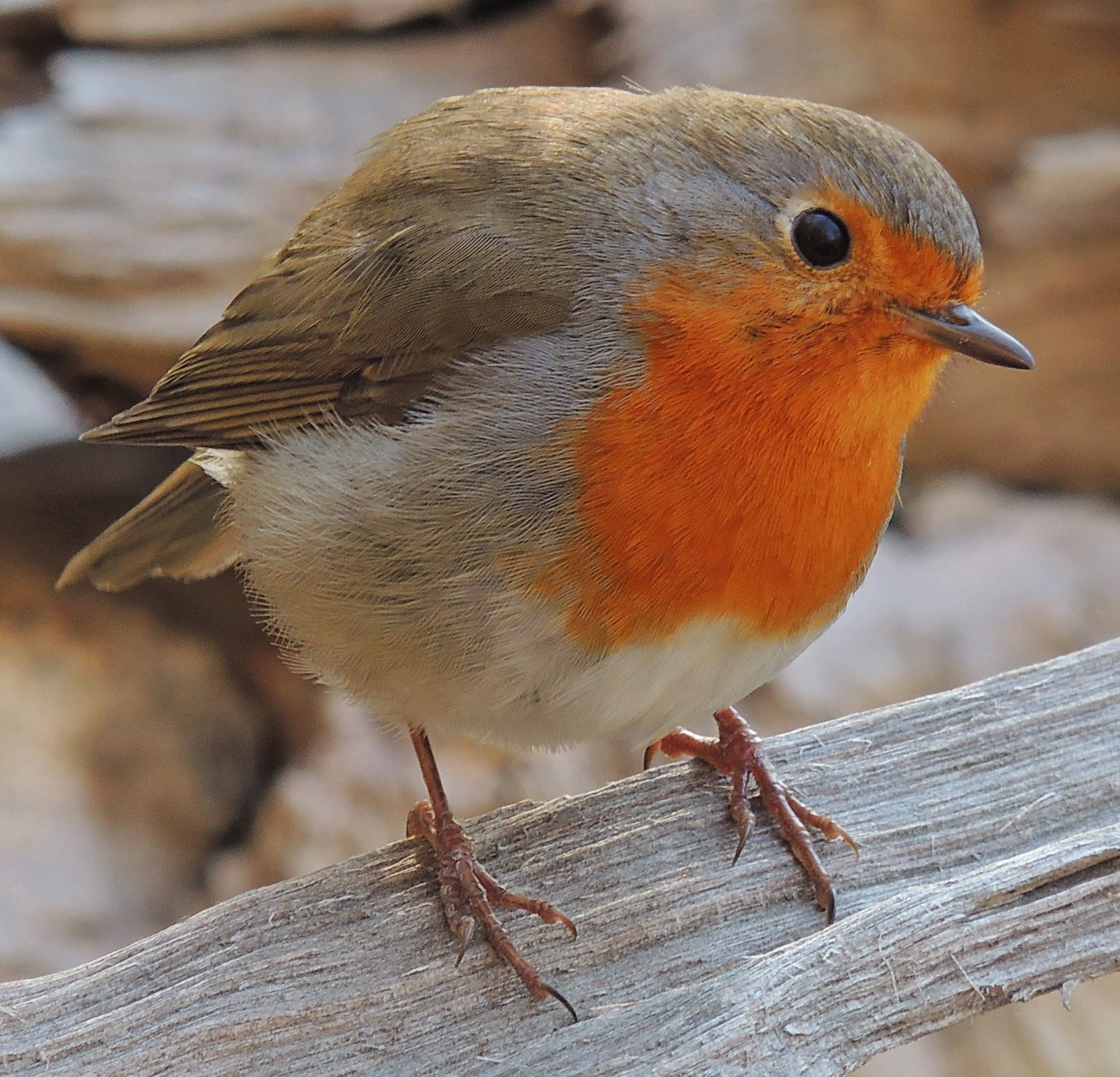
The European Robin is the familiar round songbird with an orange-red face and breast. In this region it breeds only in the woodlands of the northern Maghreb; in winter large numbers of European birds come to North Africa, the Levant and Iraq, where it can then be found in any garden or olive grove.
Voice
The song is a clear, wistful series of liquid whistles and trills, varying in speed and pitch; in winter both sexes sing to defend a feeding territory. Calls are a hard, ticking tic or tic-ic-ic and a thin tseee.
Recording: João Ferreira Tomás — CC BY-NC-SA 4.0 · shortened to the first 60 s, mono · xeno-canto
Identification
12.5–14 cm. Round and large-headed, with a large dark eye. Face, throat and breast orange-red, bordered at the sides by blue-grey; upperparts olive-brown, belly off-white, flanks brownish. A narrow pale wing-bar on the greater coverts, especially in young birds. Sexes are alike. Juveniles are brown with dense buffy spots and no red breast; they moult in late summer. Hops on the ground, pauses with drooped wings and flicks its tail. North African breeders (witherbyi) are slightly darker and deeper red on the breast.
Confusion species
Female or young White-throated Robin (Irania gutturalis) is larger and greyer, with an orange wash on the flanks but no orange breast. A male Red-breasted Flycatcher (Ficedula parva) has a smaller orange throat patch, a grey face and white patches at the tail base. Juvenile robins may resemble a young Common Nightingale (Luscinia megarhynchos), but that has a rufous tail.
Habitat
In the breeding season moist broadleaved and mixed woodland with undergrowth, cedar and oak forest in the Atlas and the Rif, and bushy valleys. In winter any area with bushes or trees: maquis, olive groves, citrus orchards, parks, gardens and coastal dunes, in Egypt and Iraq also gardens and field edges along rivers. Eats insects, worms and in winter also berries.
Where the bird is most at home, classified by the habitats of North Africa and the Middle East.



Range and movements
Breeds as a resident in Morocco (Rif, Middle and High Atlas, also in the Atlantic coastal forests), in northern Algeria and in north-western Tunisia; locally in the mountains of Lebanon and Syria. In winter common throughout the northern Maghreb and in Libya (Cyrenaica), scarcer as far as the oases of the northern Sahara, in northern Egypt and the Nile Delta, in Israel, Jordan, Lebanon, Syria and Iraq; scarce in northern Saudi Arabia and Kuwait, rare further south in Arabia. Beyond the region it breeds across almost all of Europe and western Asia to western Siberia and Iran, and on the Canary Islands and the Azores.
- Resident
- Summer visitor (c. Apr–Sep)
- Winter visitor (c. Oct–Mar)
- Passage (Mar–Apr, Oct–Nov)
- dark = core range, pale = thinly spread
How and when to look
In winter in any garden or olive grove in Morocco, Tunisia or Israel; its ticking call gives it away. In May and June it sings in the cedar forests around Ifrane and Azrou in the Middle Atlas.
Conservation status
Not globally threatened and very numerous. In parts of the Middle East and North Africa robins are still caught in winter with lime sticks and nets.
Scientific name
Erithacus rubecula | (Linnaeus, 1758)
Linnaeus described the species in 1758 as Motacilla Rubecula; because it was later moved to another genus, the author and year stand in brackets. The genus Erithacus was introduced in 1800 by Cuvier, GLCFD. Erithacus is Ancient Greek: erithakos was a classical name for a bird now usually taken to be the robin. rubecula is a Latin diminutive of ruber, 'red', after the orange-red breast. The specimen the first description was based on came from Sweden.