All species › Storks › Storks › Yellow-Billed Stork
Yellow-Billed Stork | Mycteria ibis
Afrikaanse nimmerzat | Tántalo africano
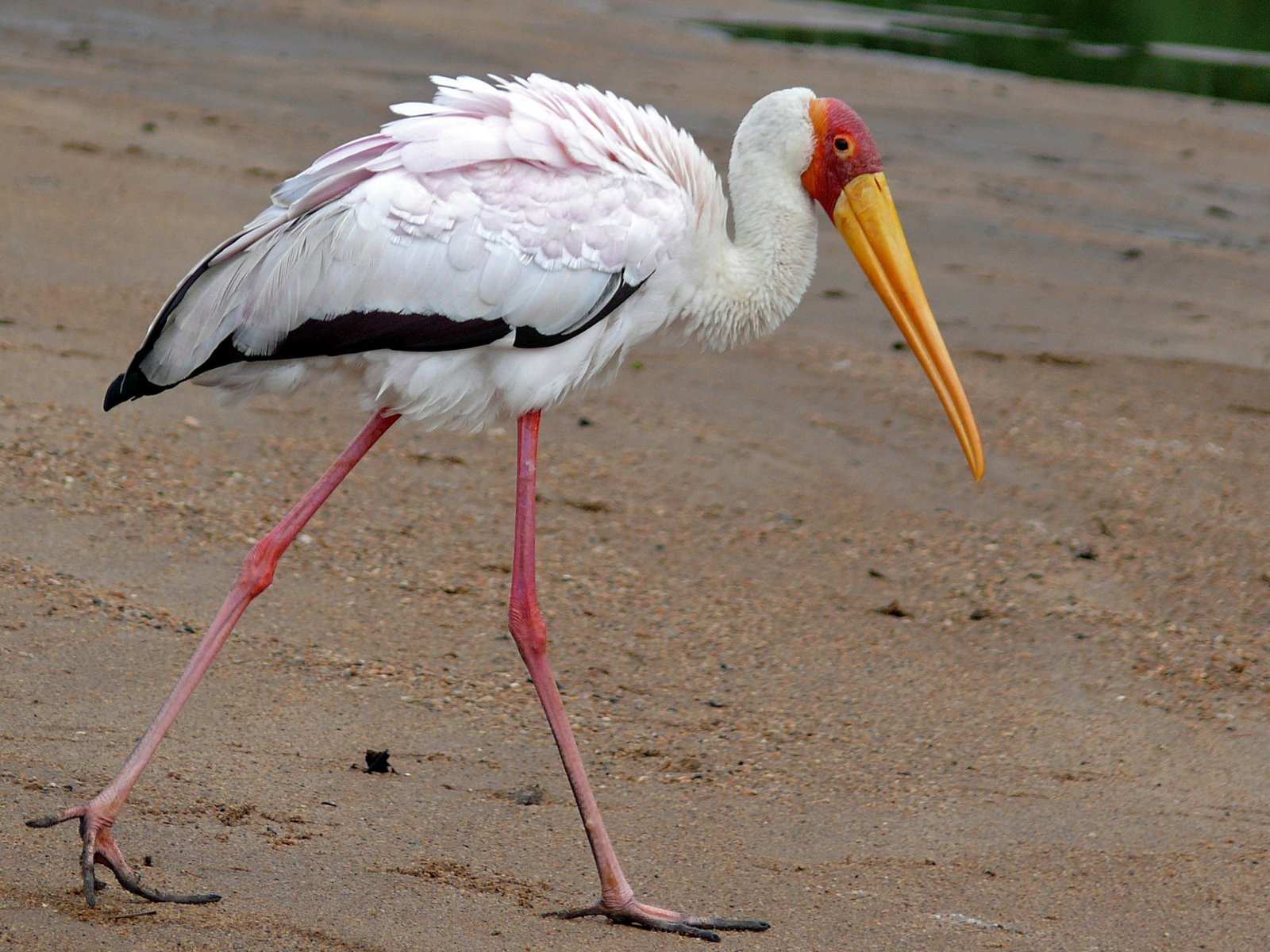
A large white stork with a red face, a yellow, slightly decurved bill and a black tail. It does not breed in the region, but Lake Nasser in southern Egypt attracts hundreds of birds from the Sahel every summer, and in southwest Arabia it is a scarce visitor. That makes it one of the best-known African specialities of the Western Palearctic.
Voice
Virtually silent away from the colony. At the nest bill-clattering, squeaks and hissing.
Recording: Bram Piot — CC BY-NC-SA 4.0 · converted to mono · xeno-canto
Identification
The body is white, with a pink wash on the mantle and wing-coverts when breeding; flight feathers and tail are glossy greenish black. The bare face and forehead are bright red, the long bill is yellow and gently decurved at the tip. The legs are pink to red. Juveniles are grey-brown with a dirty yellow bill and a duller orangey face, and become white only gradually. In flight white with black flight feathers and a black tail, the neck outstretched and slightly drooping, the legs projecting well beyond the tail.
Confusion species
White Stork (Ciconia ciconia) has a red, straight bill, red legs, a white tail and a feathered head without a red face. African Sacred Ibis (Threskiornis aethiopicus) is smaller, with a black, strongly decurved bill and black bare head and neck. Juveniles can look greyish and heron-like at a distance, but the stout, slightly decurved bill and stork shape are distinctive.
Habitat
Shallow shores of large lakes and reservoirs, river channels, marshes and floodplains, also salt pans and lagoons. It feeds by walking through shallow water with the half-open bill in the water, stirring with one foot to flush prey; rests in groups on sandbanks and in dead trees.
Where the bird is most at home, classified by the habitats of North Africa and the Middle East.


Range and movements
In Egypt a regular summer visitor to Lake Nasser, mainly from June to September, peaking mid-June to mid-July, with counts of over 500 birds across the whole lake, including at Abu Simbel and Toshka; breeding has not been confirmed there and further north along the Nile it is rare. In southwest Arabia a scarce, irregular visitor to the Tihama of Yemen and Jizan province in Saudi Arabia. Elsewhere a rare vagrant, including in Israel and Oman. Beyond the region it breeds over much of sub-Saharan Africa and Madagascar and wanders after the rains.
- Resident
- Summer visitor (c. Apr–Sep)
- Winter visitor (c. Oct–Mar)
- Passage (Mar–Apr, Oct–Nov)
- dark = core range, pale = thinly spread
How and when to look
A boat trip or a drive along the shores at Abu Simbel and Toshka in June–July gives the best chance; the birds often stand in groups on the shallow lake margins, together with herons and pelicans.
Conservation status
Not globally threatened and widespread in Africa, though it depends on seasonal wetlands and suffers from drainage and disturbance of breeding colonies. Since the building of the Aswan High Dam, Lake Nasser has become an important refuge for this African species.
Scientific name
Mycteria ibis | (Linnaeus, 1766)
Linnaeus described the species in 1766 as Tantalus Ibis; because it was later moved to another genus, the author and year stand in brackets. The genus Mycteria was introduced in 1758 by Linnaeus. Mycteria comes from the Greek muktēr, 'snout, nose' — for the large, heavy bill. ibis is the Greek and Latin word for the sacred ibis of Egypt; Linnaeus mistakenly took this stork for that bird. The specimen the first description was based on came from Egypt.