All species › Passerines › Swallows and martins › Angola Swallow
Angola Swallow | Hirundo angolensis
Angolese zwaluw | Golondrina Angoleña
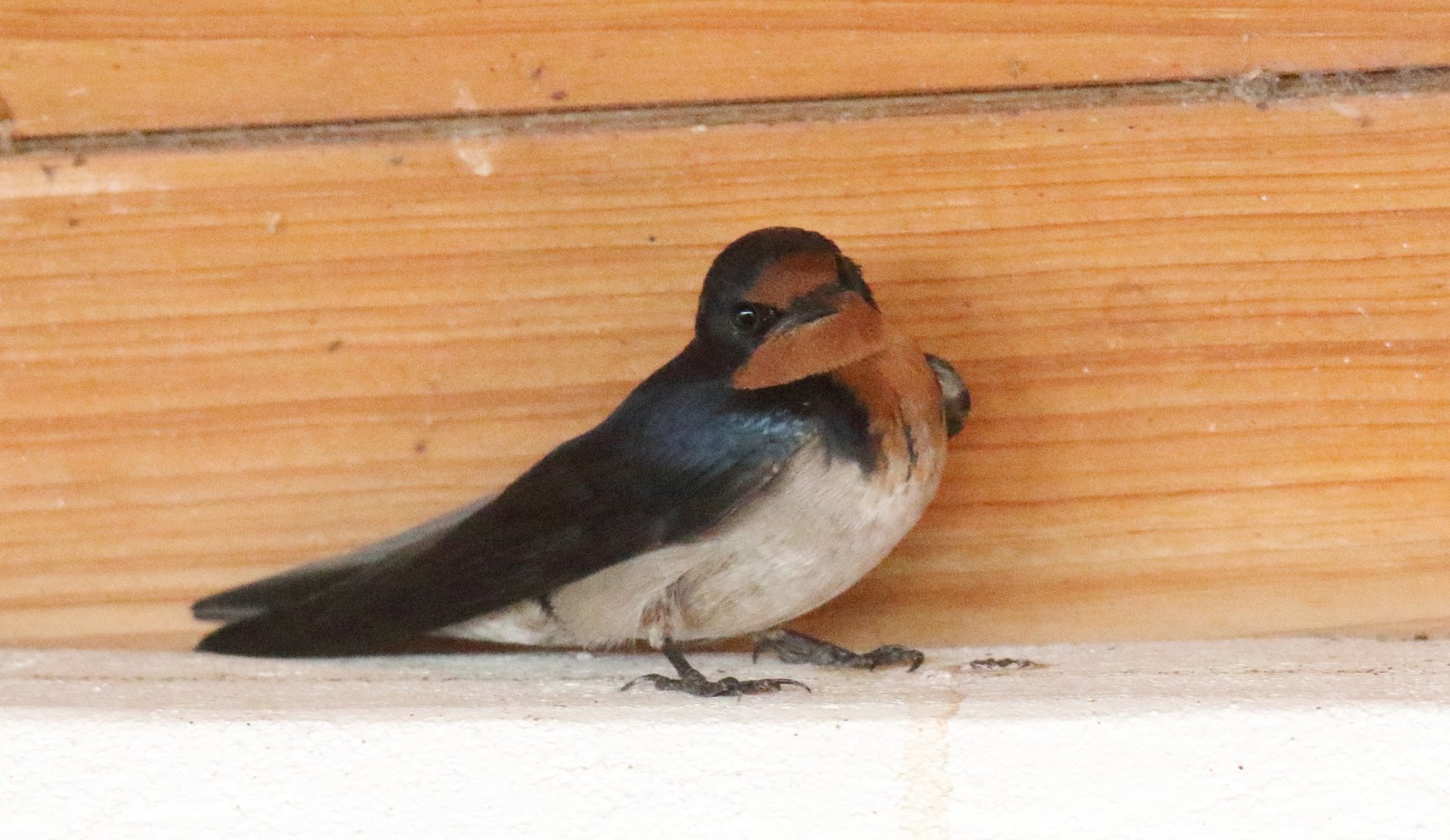
The Angola Swallow is a central African relative of the Barn Swallow, with an extensive rufous throat, greyish underparts and a short tail. In the region it is a resident of the Angolan plateau and northern Zambia, where it is one of the commonest swallows in villages, at bridges and over moist grassland.
Voice
A soft, rather thin twitter and a short tsip or tswit, weaker than the call of the Barn Swallow. The song is an unobtrusive chatter with short trills, usually from a wire or roof edge.
Recording: Stein Ø. Nilsen — CC BY-NC-SA 4.0 · converted to mono · xeno-canto
Identification
14–15 cm, compact, with a fairly short, moderately forked tail; the outer feathers of adults are only shortly elongated. The upperparts are glossy steel-blue, the forehead, throat and upper breast rufous. The blue-black breast band is narrow and often broken in the centre, so that the rufous of the throat runs into the breast. The rest of the underparts is dingy grey-brown, not white, and the undertail coverts are grey with pale fringes. The underwing is grey-brown. The tail has a row of white spots. Juveniles are duller, with a pale orange-brown throat and brownish upperparts. It flies less fast and less high than the Barn Swallow, often low round buildings and over water.
Confusion species
The Barn Swallow Hirundo rustica has white to cream underparts, a broader, complete breast band and, in adults, much longer tail streamers; moulting and young Barn Swallows are the most similar, but they are always paler below and show a sharper border between throat and band. The White-Throated Swallow Hirundo albigularis has a white throat. The Large Rock Martin Ptyonoprogne fuligula is wholly brown, without blue gloss. Within the region, a rufous throat above grey underparts is diagnostic.
Habitat
Open grassland, moist grassland and vleis, rivers and lakes on the central plateau, and above all villages, towns, farms and bridges. It nests in an open half-cup of mud against walls, under roofs, inside buildings and under bridges and culverts, wherever a suitable roof is found above water or open ground. It hunts small flying insects low down.
Where the bird is most at home, classified by the vegetation units of southern Africa.


Range and movements
In the region mainly in Angola, where it is widespread on the central and northern plateau (for example around Huambo, Kuito and Malanje) and absent from the arid south-west; also in northern and western Zambia. Beyond the region from Gabon and Congo-Brazzaville east through DR Congo to Uganda, Rwanda, Burundi, western Kenya and western Tanzania. Makes small local seasonal movements.
- Resident
- dark = core range, pale = thinly spread
How and when to look
In Angolan plateau towns and villages look for swallows flying in and out under eaves and verandas, or at bridges over plateau rivers; in north-western Zambia, for instance around Mwinilunga. A perched bird shows the features well: look for the dingy grey belly and the rufous throat merging without a sharp border into the narrow breast band.
Conservation status
Not threatened. The species is locally common and benefits from buildings and bridges as nest sites; there is no evidence of any significant decline.
Scientific name
Hirundo angolensis | Bocage, 1868
Bocage described the species in 1868 and placed it straight away in the genus where it still stands. The genus Hirundo was introduced in 1758 by Linnaeus. Hirundo is the ordinary Latin word for 'swallow'. angolensis means 'from Angola', where the first specimen was collected. The specimen the first description was based on came from Huíla, Angola.