All species › Passerines › Waxbills › Angola Waxbill
Angola Waxbill | Coccopygia bocagei
Angola-astrild | Estrilda de Bocage
The Angola Waxbill is a tiny olive-green estrildid with a grey head and a scarlet rump that occurs only in the highlands of western Angola. It is sometimes included in Swee Waxbill, but its yellower underparts and restricted range make it one of the Angolan endemics that birders seek out specifically.
Voice
A soft, high, whistled swee-swee or tseep, as in the other Coccopygia species, mainly as a contact call in flight. The song is a high, thin series of whistles.
Recording: Raphaël Jordan — CC BY-NC-SA 4.0 · converted to mono · xeno-canto
Identification
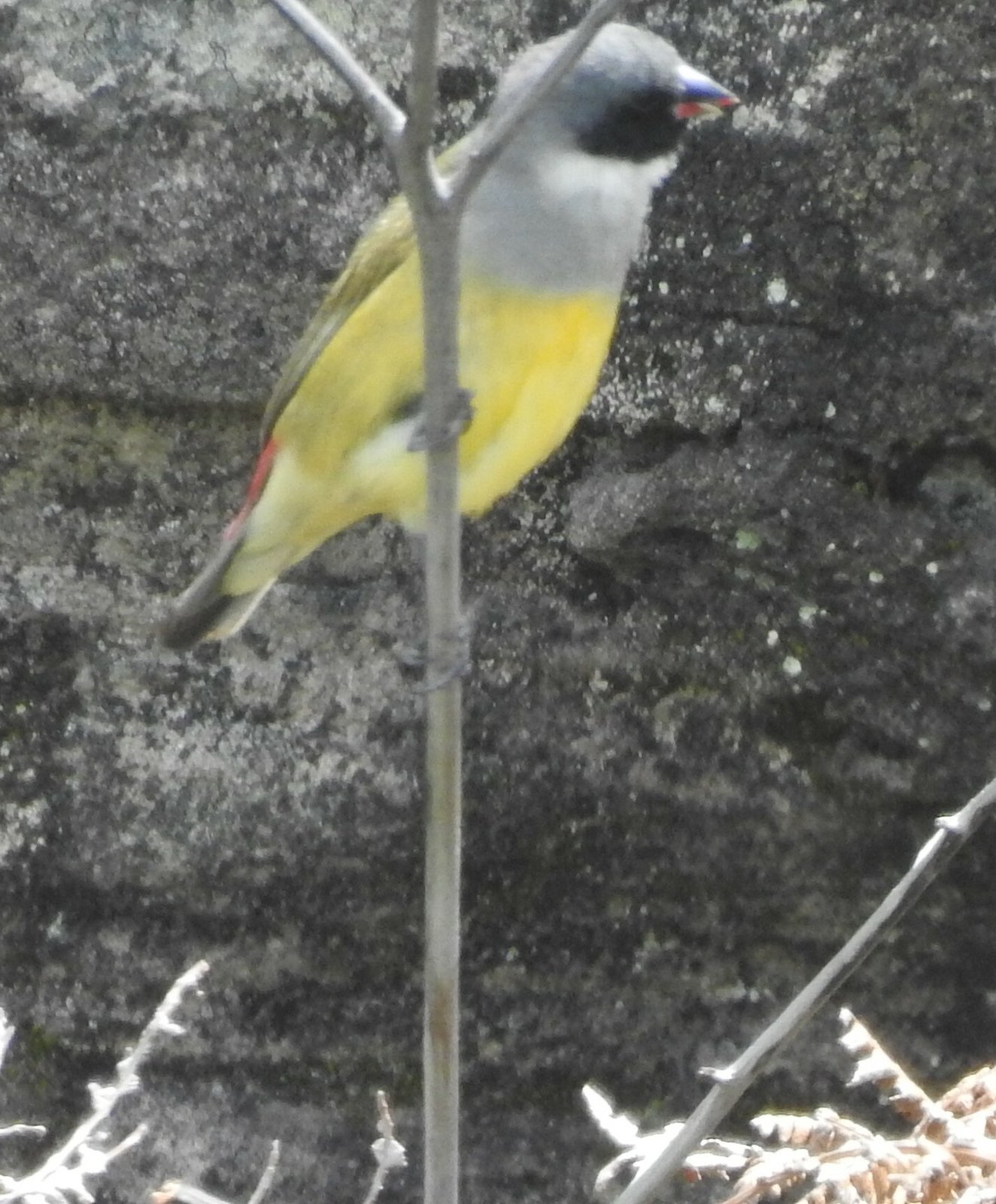
9–10 cm. Crown and nape are grey, back and wings olive-green, rump and uppertail-coverts bright red and tail black. The upper mandible is black, the lower red. The breast is pale grey, merging into a yellow belly and yellow undertail-coverts. The male has a black throat and chin, the female a pale grey throat. Juveniles are duller, with a dark bill.
Confusion species
In Angola mainly Common Waxbill (Estrilda astrild) may occur alongside; it is brown and finely barred with a red eye-stripe and a red bill, without a red rump. Grey Waxbill (Glaucestrilda perreini) is blue-grey with a red rump and a black eye-stripe, but lacks green and yellow. Green Twinspot (Mandingoa nitidula) has a red rump but black, white-spotted flanks. The related Swee Waxbill (Coccopygia melanotis) does not occur in Angola.
Habitat
Edges of montane forest and scrub in the ravines of the western escarpment, rank grassy margins, clearings in moist forest, abandoned coffee plantations and gardens at the forest edge in the highlands. It feeds in pairs or small parties on grass heads and on the ground.
Where the bird is most at home, classified by the vegetation units of southern Africa.


Range and movements
Endemic to Angola: the central and western highlands and the western escarpment, including Cuanza Sul and Huambo. Not known outside Angola.
- Resident
- dark = core range, pale = thinly spread
How and when to look
Best found at the classic Angolan birding sites along the western escarpment and in the highlands around Huambo, often at the edge of forest remnants and in rank grassy margins. Listen for the soft swee-swee and look low near the ground; the male gives itself away by its black throat.
Conservation status
Not threatened according to the IUCN; locally fairly common within its restricted range. The loss of forest edges and montane forest on the Angolan escarpment through logging and agriculture is nevertheless a risk for this endemic species.
Scientific name
Coccopygia bocagei | Shelley, 1903
Shelley described the species in 1903 and placed it straight away in the genus where it still stands. The genus Coccopygia was introduced in 1862 by Reichenbach. Coccopygia comes from the Greek kokkos, 'scarlet', and -pugios, '-rumped' — for the red rump of these waxbills. bocagei honours the Portuguese zoologist José Vicente Barboza du Bocage (1823–1907), who published widely on the birds of Angola. The specimen the first description was based on came from Huíla, Angola.