All species › Passerines › Weavers › Black-Chinned Weaver
Black-Chinned Weaver | Ploceus nigrimentus
Zwartkinwever | Tejedor Gorjinegro
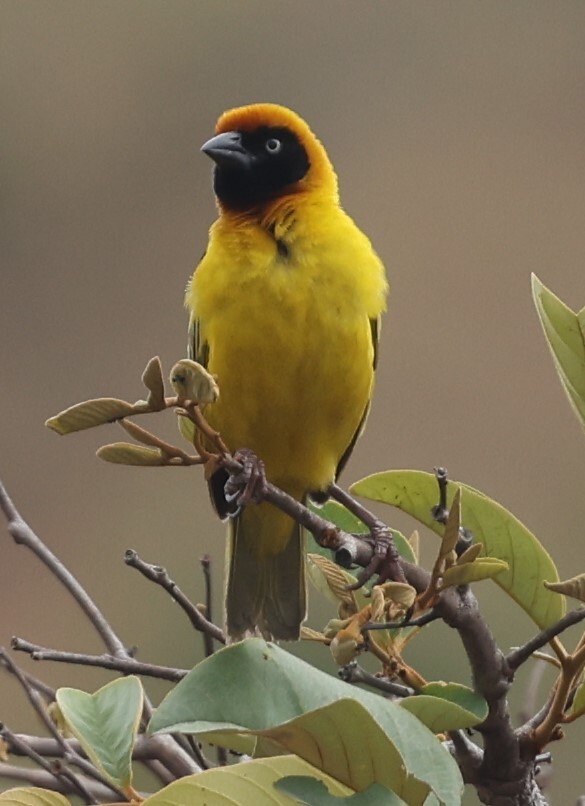
The Black-Chinned Weaver is a scarce black-and-yellow weaver of wooded grassland on the highlands of Angola and the Batéké Plateau. Unusually, the female wears an all-black hood, whereas the male has a yellow-orange crown and nape.
Voice
Harsh, grating chittick calls and a short song described as whit-pu pui trrr pui. The species is little studied and its song is poorly documented.
No recording with a suitable Creative Commons licence is available for this species yet.
Identification
15–16 cm, with a strong black bill. The male has a yellow-orange forehead, crown, nape and neck sides, a black face with black chin and throat, a black back with a yellow half-collar and a yellow rump; the wings are black with yellow feather edges and the underparts bright yellow. The female has an all-black hood down to the throat and otherwise the same black-and-yellow pattern. Juveniles are duller and browner on head and back.
Confusion species
Black-Necked Weaver (Ploceus nigricollis) of north-western Angola has an olive, not black, back, a yellow head with a narrow black eyestripe and, in the male, a black bib; the female lacks the black hood. Yellow-Mantled Weaver (Ploceus tricolor) is a closed-forest weaver with a black head and chestnut underparts. Dark-Backed Weaver (Ploceus bicolor) has a dark grey head and back and a grey throat. The male Vieillot's Black Weaver (Ploceus nigerrimus) is wholly black. The combination of black back, yellow rump and black chin in open wooded grassland is diagnostic.
Habitat
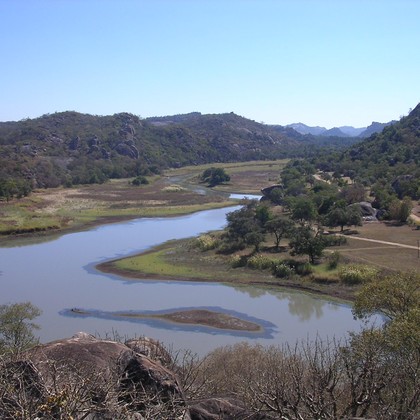
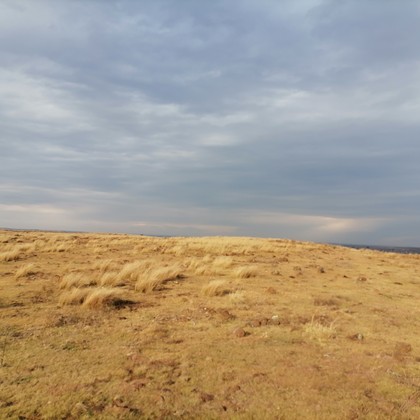
Open grassland with scattered trees and clumps, grassy woodland edges and bushy savanna on sandy Kalahari soils, in Angola between about 1,000 and 1,800 metres. It breeds in loose groups of a few to about ten nests at the branch tips of the tallest tree around. The large, closed grass nest has its entrance on the side near the top, unlike most weavers.
Where the bird is most at home, classified by the vegetation units of southern Africa.
Range and movements
Within the region only in Angola: on the Bailundo Highlands in Huambo and Cuanza Sul, and also in Lunda Norte in the north-east. Beyond the region on the Batéké Plateau in Congo-Brazzaville and eastern Gabon, and very locally in western DR Congo. The range is highly fragmented.
How and when to look
A true Angolan speciality, to be looked for in the highlands around Huambo. Scan the tallest isolated trees in open grassland for clusters of nests at the branch tips and wait for the adults. Black-and-yellow weavers with a black head in open grassland always deserve a second look: it may be a female.
Conservation status
Not threatened on the Red List, but scarce and with a fragmented range. In Angola the conversion of grassland to fields and frequent fires threaten its habitat; the species is poorly studied there.
Scientific name
Ploceus nigrimentus | Reichenow, 1904
Reichenow described the species in 1904 and placed it straight away in the genus where it still stands. The genus Ploceus was introduced in 1816 by Cuvier, GLCFD. Ploceus comes from the Greek plokeus, 'plaiter, weaver', for the tightly woven, ball-shaped nest that gives weavers their name. nigrimentus is Latin for 'black-chinned', from niger, 'black', and mentum, 'chin'. The specimen the first description was based on came from Galanga, Angola.