All species › Passerines › Bulbuls › Black-Collared Bulbul
Black-Collared Bulbul | Neolestes torquatus
Zwartkraagbuulbuul | Bulbul Acollarado
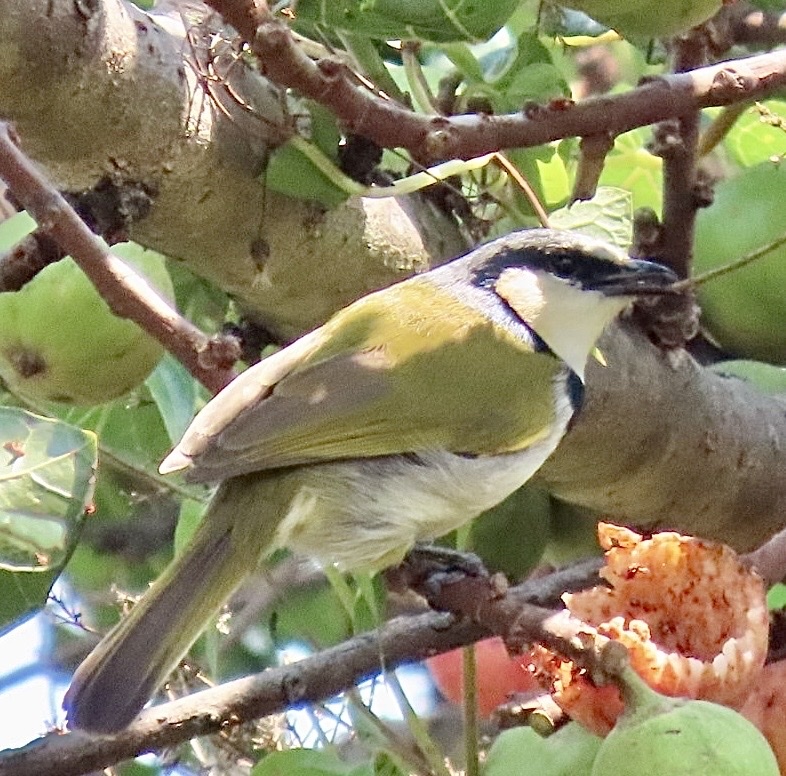
The Black-Collared Bulbul is an aberrant, distinctly marked bulbul of wooded tall grassland in Central Africa, with a grey crown, an olive-green back and a broad black band running from the bill through the eye to a collar across the breast. Its systematic position long remained uncertain; it is now seen as a distinct, ancient branch of the bulbul family. In the region it occurs only in Angola and north-western Zambia.
Voice
The song is a liquid, melodious series of notes that wafts up and down in pitch, sweeter and less harsh than that of Common Bulbul, often from the top of a bush. The call is a fast, high, whining series of notes.
Recording: Dries Van de Loock — CC BY-NC-SA 4.0 · converted to mono · xeno-canto
Identification
16–17 cm, compact, with a short, stout black bill and a medium-length tail. Crown, nape and shoulders are grey, back, wings and tail olive-green. A broad black stripe runs from the bill through the eye and across the ear coverts and joins on the breast to form a broad black collar, which contrasts sharply with the creamy white throat and underparts. The eye is dark and the legs dark grey. The sexes are alike. Juveniles lack the crisp pattern: the collar is faint or absent and the feathers have pale fringes. It often sits upright and in the open on top of a bush or on a loose branch above the grass.
Confusion species
Within its habitat there are few other species to confuse it with. Common Bulbul Pycnonotus barbatus has a dark brown, slightly crested head, a brown back without green and a yellow vent, and lacks the black breast band. Juveniles without a clear collar are best identified by the grey and olive-green plumage, the short black bill and the company of adults. Other birds with a black breast band in the same grassland, such as shrikes and boubous, are larger, have a hooked bill and a very different colour pattern.
Habitat
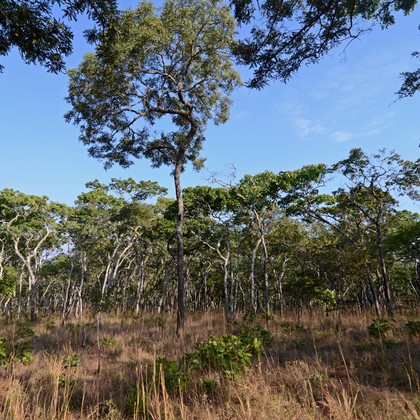
Wooded tall grassland with scattered bushes and thickets, the edges of grassy plains and wetlands (known in Zambia and Angola as chanas or dambos) against miombo and gallery forest, and open, grassy miombo. It lives in pairs that remain on territory year-round; it eats fruit and insects, the latter partly caught from a lookout.
Where the bird is most at home, classified by the vegetation units of southern Africa.

Range and movements
Within the region in Angola, from the north (Uíge, Malanje, the Lunda provinces) south over the central highlands (Cuanza Sul, Huambo, Bié) to the interior of Benguela, and in north-western Zambia (Mwinilunga, the West Lunga and the grassy plains at Chitunta and Nyambela); further east in Zambia only a few scattered records. Beyond the region in Gabon, Congo-Brazzaville and southern Congo-Kinshasa.
- Resident
- dark = core range, pale = thinly spread
How and when to look
Year-round. In Zambia the species is most easily found at the edges of the grassy plains around Mwinilunga and in the West Lunga area, where pairs often sit in the open on bush tops. Drive or walk slowly along the transition from grassland to forest and scan the bush tops; the black collar is easy to see at a distance.
Conservation status
Not threatened, but locally distributed within a relatively small range. The wooded grassland on which it depends is degraded by too-frequent fires, cultivation and the clearing of thickets.
Scientific name
Neolestes torquatus | Cabanis, 1875
Cabanis described the species in 1875 and placed it straight away in the genus where it still stands. He introduced the genus Neolestes in that same work. Neolestes comes from the Greek neos, 'new, strange', and lēistēs, 'robber', here meaning 'shrike' — a 'new shrike', for this bulbul's shrike-like appearance. torquatus is Latin for 'collared' — for the black band across the breast. The specimen the first description was based on came from Chinchoxo, Loango Coast (Cabinda, Angola).