All species › Passerines › Laughingthrushes › Black-Faced Babbler
Black-Faced Babbler | Turdoides melanops
Zwartteugelbabbelaar | Turdoide Enmascarado
The Black-Faced Babbler is a shy, dark babbler of dense thickets in the Kalahari sandveld of northern Namibia, north-western Botswana and south-western Angola. The pale yellow eye in the black face and the nasal, querulous calls separate it from Arrow-Marked Babbler.

Voice
Distinctly nasal and querulous, unlike the other babblers: a repeated weh-weh-weh or kweh-kweh, taken up by the group members into a whining, wailing chorus. The alarm is a hoarse, rasping cherr.
Recording: Niall Perrins — CC BY-NC-SA 4.0 · converted to mono · xeno-canto
Identification
26–28 cm. A fairly large, dark babbler with a long tail. The upperparts are warm dark brown. Head, throat and breast are dark greyish-brown with pale, whitish feather edges and tips, giving a fine scaly or streaked pattern. The lores and forehead are black, forming a small mask. The eye is conspicuously pale lemon-yellow. The belly is slightly paler, wings and tail dark brown. Bill and legs are black. The sexes are alike; juveniles have a dark eye and a less distinct mask.
Confusion species
Arrow-Marked Babbler Turdoides jardineii, which occurs in the same area in the Okavango and along the Kavango, is greyer, lacks black lores, has an orange to red eye and white arrowhead-shaped streaks; its chorus is harsher and more rattling. Hartlaub's Babbler Turdoides hartlaubii has a white rump and a red eye and lives in reeds and waterside vegetation. Bare-Cheeked Babbler Turdoides gymnogenys has a white head and underparts.
Habitat
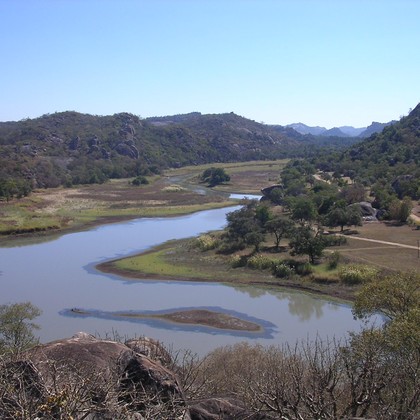
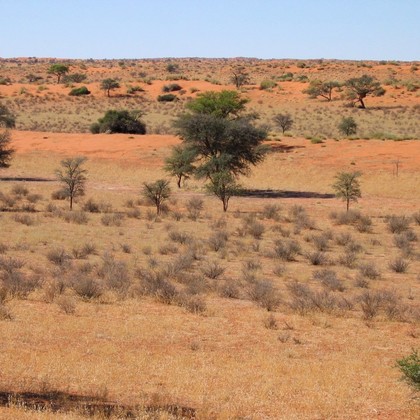
Dense thickets and undergrowth in broad-leaved woodland on Kalahari sand, with Baikiaea, Burkea and Terminalia among others, also dense acacia thickets and scrub along dry riverbeds. Shyer than Arrow-Marked Babbler: groups of three to eight birds usually stay deep in cover and forage on the ground in the leaf litter for insects.
Where the bird is most at home, classified by the vegetation units of southern Africa.
Range and movements
Within the region in northern Namibia (from Ovamboland and the Otavi Mountains via Kavango to the western Zambezi Region, including Mahango), in north-western Botswana (Ngamiland, the Okavango Panhandle and Tsodilo) and in south-western Angola (Huíla, Namibe, Cunene, Benguela and western Cuando Cubango). The East African populations, from Kenya to Rwanda and Tanzania, are sometimes included in this species, but are usually treated as a separate species, Turdoides sharpei.
- Resident
- Winter visitor (c. Apr–Sep)
- Passage (Mar–Apr, Oct–Nov)
- dark = core range, pale = thinly spread
How and when to look
All year. Look for it in dense sandveld thickets around Rundu, in Mahango and the Okavango Panhandle (for example around Shakawe) and at Tsodilo. The nasal wailing is usually the only sign; sit quietly where a group is calling and wait for the birds to show one by one. The yellow eye in the black face is then the decisive feature.
Conservation status
Not threatened; locally fairly common but hard to see. Clearing and burning of dense woodland on Kalahari sand for farming and timber reduces its habitat.
Scientific name
Turdoides melanops | (Hartlaub, 1867)
Hartlaub described the species in 1867 as Crateropus melanops; because it was later moved to another genus, the author and year stand in brackets. The genus Turdoides was introduced in 1826 by Cretzschmar. Turdoides comes from the Latin turdus, 'thrush', with the Greek suffix -oidēs, 'resembling' — for the thrush-like build of the babblers. melanops comes from the Greek melas, 'black', and ōps, 'face, eye' — for the black lores around the pale eye. The specimen the first description was based on came from Damaraland, Namibia.