All species › Passerines › Finches › Black-Faced Canary
Black-Faced Canary | Crithagra capistrata
Maskerkanarie | Serín Carinegro
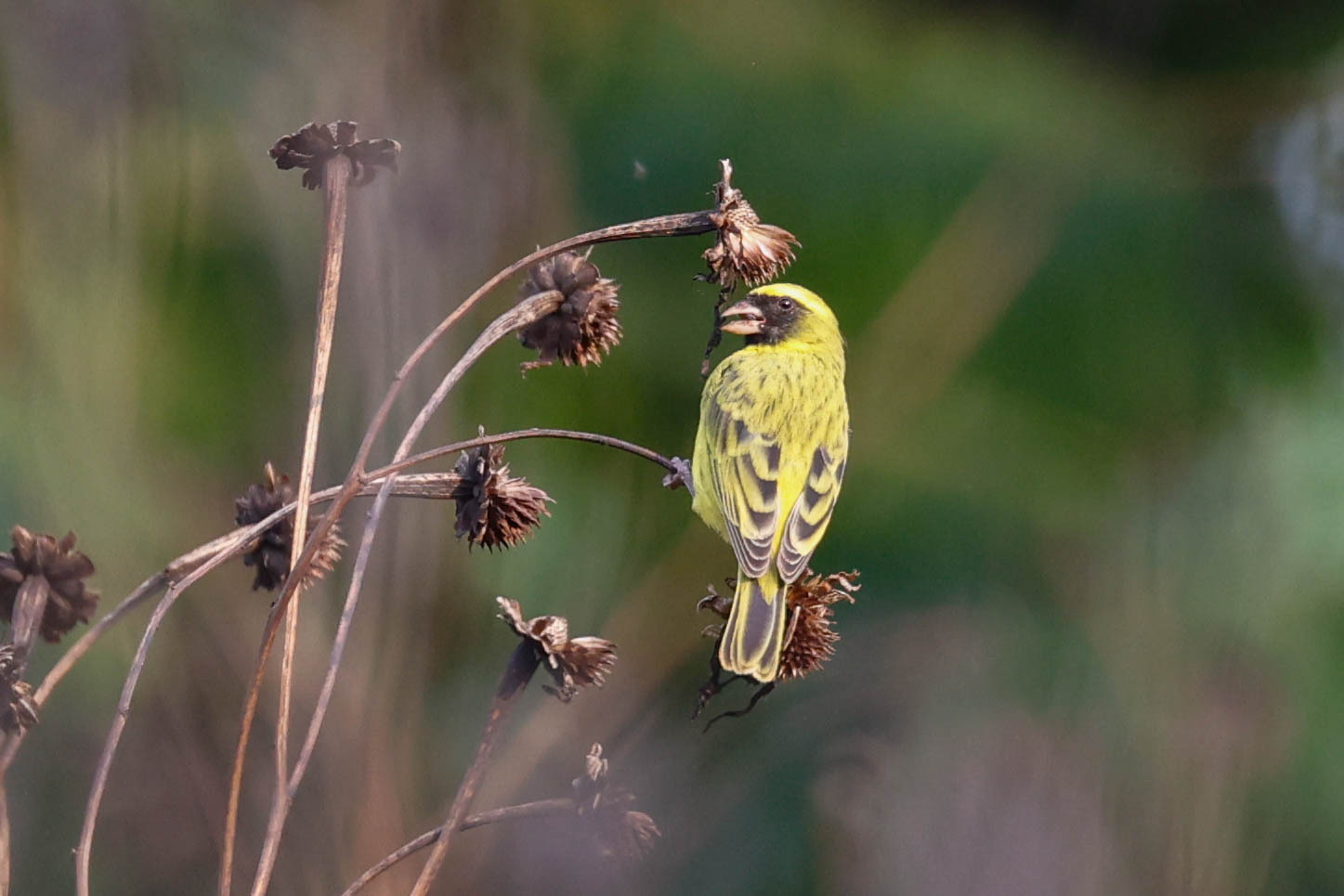
The Black-Faced Canary is a bright yellow canary of the grassy plateaus of central Africa, which in the region occurs only in Angola and north-western Zambia. The male has a black mask that contrasts sharply with a bright yellow forehead and yellow underparts.
Voice
A sweet, varied twittering song with trills and repeated whistles, tsee-tsee-cherree-weechoo-tseep, often from a bush or a tall grass stem. The call is a soft rising tsweet.
Recording: Dries Van de Loock — CC BY-NC-SA 4.0 · converted to mono · xeno-canto
Identification
11–12 cm, compact, with a short, stout grey conical bill. The male has a yellow forehead and a yellow eyebrow above a black mask covering lores, eye area, cheek and chin. Crown and back are yellow-green with dark streaks, the rump is yellow and the underparts plain bright yellow. Wings and tail are dark with greenish-yellow edges. The female lacks the black mask, has a grey-green face and a duller yellow, at most faintly streaked breast. Juveniles are browner and streaked on the breast.
Confusion species
Yellow-Fronted Canary (Crithagra mozambica) has a yellow cheek bordered by narrow dark eye and malar stripes instead of a solid black mask; its female has a spotted necklace. Southern Citril (Crithagra hyposticta) has a longer, more pointed bill, far less black on the face and a heavily streaked female; the two meet at most in northern Zambia. Brimstone Canary (Crithagra sulphurata) is larger with a heavy bill and no black on the face.
Habitat
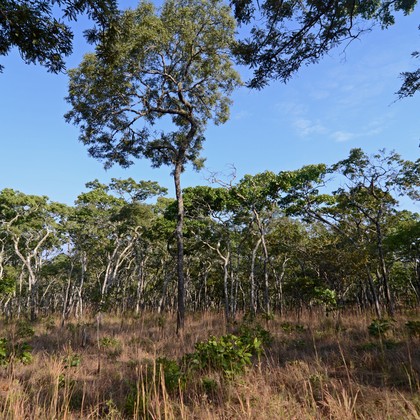
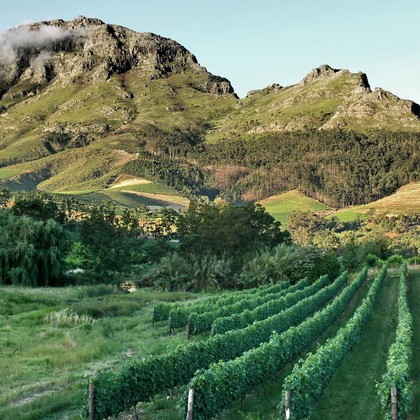
Moist and rank grassland, the edges of dambos and vleis, clearings and margins in miombo and gallery forest, abandoned fields and village gardens. It feeds in pairs and small groups on seed heads of grasses and herbs and on the ground, often with other canaries and waxbills.
Where the bird is most at home, classified by the vegetation units of southern Africa.

Range and movements
In the region in Angola on the central and northern plateaus (from Malanje and Lunda to Bié and Huambo) and in north-western and northern Zambia (Mwinilunga, Solwezi, the Copperbelt). Beyond the region from Gabon and Congo-Brazzaville across southern and eastern DR Congo to Burundi and western Tanzania.
- Resident
- dark = core range, pale = thinly spread
How and when to look
In Zambia the area around Mwinilunga and the Source of the Zambezi is the classic site; search along dambo margins and among the tall grasses near village gardens. Birds are most active early in the morning, when small groups move across the grass heads. At range the black mask often shows only as a dark face; when in doubt, check for the absence of a yellow cheek.
Conservation status
Not threatened. Locally common in suitable grassland; benefits from abandoned fields and cleared margins.
Scientific name
Crithagra capistrata | Finsch, 1870
Finsch described the species in 1870 and placed it straight away in the genus where it still stands. The genus Crithagra was introduced in 1827 by Swainson. Crithagra comes from the Greek krithē, 'barley', and agra, 'hunting' — a 'barley hunter', for the seed-eating diet of these canaries and seedeaters. capistrata is Latin for 'haltered', from capistrum, 'halter' — for the male's black facial mask. The specimen the first description was based on came from Golungo Alto, Angola.