All species › Passerines › Sunbirds › Copper Sunbird
Copper Sunbird | Cinnyris cupreus
Koperhoningzuiger | Suimanga Cobrizo
The Copper Sunbird is a medium-sized sunbird of rank growth, moist grassland edges and cultivation in the north of the region. In the breeding season the male glows copper-red to purplish-bronze on head, back and breast, and looks almost black against the light.

Click a thumbnail to switch the photo above.
Voice
The call is a sharp tchip-tchip or a dry tchit. The song is a rather soft, fast, thin twitter of high notes, sometimes given in flight.
Recording: Bram Piot — CC BY-NC-SA 4.0 · converted to mono · xeno-canto
Identification
12 to 13 cm, with a fairly short, decurved bill and a square, unelongated tail. The breeding male has head, mantle, throat and breast metallic copper with red and purple reflections; wings, tail and belly are velvety black. Outside the breeding season the male wears an eclipse plumage resembling the female, but with black wings and tail and scattered copper feathers. The female is olive-brown above and pale yellow below with faint mottling on the breast, a weak pale supercilium and a dark tail with pale edges.
Confusion species
Bronze Sunbird (Nectarinia kilimensis) is larger and bronze-green rather than copper-red, the male with long elongated central tail feathers. Amethyst Sunbird (Chalcomitra amethystina) is larger and velvety black with a purple throat and green crown, without copper gloss. Purple-Banded Sunbird (Cinnyris bifasciatus) and Variable Sunbird (Cinnyris venustus) have a green head and back. Females are difficult; note the yellow underparts with faint mottling and the company of males.
Habitat
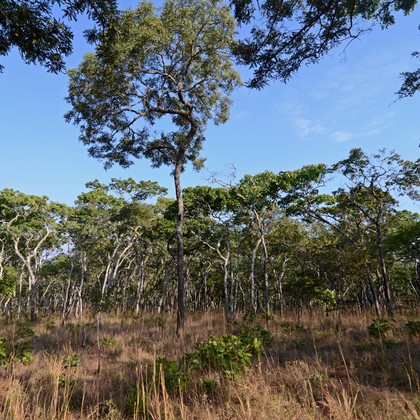
Rank growth and scrub along moist grassland and vleis, forest edges, abandoned fields, banana and cassava plots, village gardens and open miombo. Often in lower-lying, warm valleys. It forages low at flowers of Leonotis, creepers and shrubs and takes many insects.
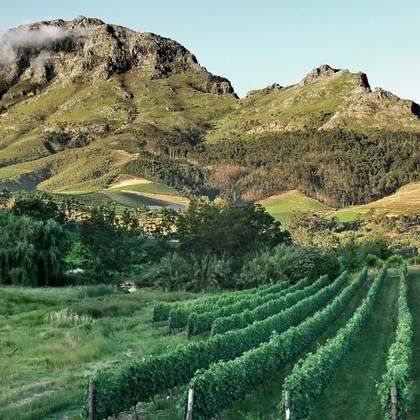
Where the bird is most at home, classified by the vegetation units of southern Africa.

Range and movements
Within the region in Angola (mainly the north and centre), most of Zambia except the south-west, Malawi, central and northern Mozambique and northern and eastern Zimbabwe (including Mashonaland and the Eastern Highlands), where it is mainly present from November to April. Beyond the region from Senegal to Ethiopia and south through East Africa.
- Resident
- Summer visitor (c. Oct–Mar)
- Winter visitor (c. Apr–Sep)
- Passage (Mar–Apr, Oct–Nov)
- dark = core range, pale = thinly spread
How and when to look
In the rains, when males sing in full breeding plumage, look for them in rank grassland edges and moist valleys in the Zimbabwean highlands and in Malawi. Against the light they look black; wait until the bird sits in the sun to see the copper gloss.
Conservation status
Not threatened. Common and widespread; it benefits from fallow land, field margins and rank growth around villages. There is no evidence of decline in the region.
Scientific name
Cinnyris cupreus | (Shaw, 1812)
Shaw described the species in 1812 as Certhia cuprea; because it was later moved to another genus, the author and year stand in brackets. The genus Cinnyris was introduced in 1816 by Cuvier, GLCFD. Cinnyris derives from the Greek kinnuris, the name of a small bird mentioned by the lexicographer Hesychius that cannot be identified further. cupreus is Latin for 'coppery, copper-coloured' — for the male's glossy copper plumage. The specimen the first description was based on came from Malembo, Cabinda (Angola).