All species › Passerines › Waxbills › Crimson-Rumped Waxbill
Crimson-Rumped Waxbill | Estrilda rhodopyga
Teugelastrild | Estrilda Culirroja
The Crimson-Rumped Waxbill is an East African relative of Common Waxbill, with a red eye-stripe, a dark bill and a crimson rump. The region lies at the southern edge of its range: it is seen mainly in northern Malawi and at Lake Tanganyika in northern Zambia.

Voice
A high chee-chee and a nasal, descending cheu, mainly in flight; the song is a short, rapidly repeated chee-chee-cheeuw, comparable with that of Common Waxbill.
Recording: isaac kilusu — CC BY-NC-SA 4.0 · converted to mono · xeno-canto
Identification
10 to 11 cm, with a fairly long tail. The upperparts are grey-brown and finely barred; a red stripe runs through the eye. Rump and uppertail coverts are bright crimson, the tail dark brown, and the greater coverts and tertials have red edges. The underparts are buff to pale brown, faintly barred on the flanks, with no red belly patch; the undertail coverts are buff. The bill is blackish, sometimes with a reddish base to the lower mandible. The sexes are alike. Juveniles lack the eye-stripe and show less red in the wing.
Confusion species
Common Waxbill (Estrilda astrild) also has a red eye-stripe, but a coral-red bill, a brown rather than red rump, no red in the wing, a red belly patch and blackish undertail coverts. This difference must be checked on every sighting, as the two occur together. Fawn-Breasted Waxbill (Estrilda paludicola) has a red rump but a grey head without an eye-stripe and a red bill.
Habitat
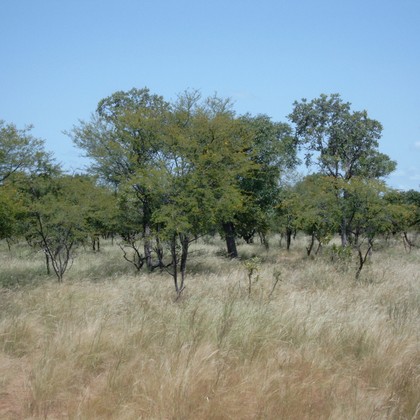
Rank grass, scrub and fallow land in dry to moist savanna, often along cultivation, streams and lakeshores, up to middle altitudes. It forages in pairs or small groups on grass seeds, usually on or near the ground, and sometimes mixes with other waxbills.
Where the bird is most at home, classified by the vegetation units of southern Africa.


Range and movements
Within the region scarce and local: mainly in northern Malawi, such as at Karonga, on the northern shores of Lake Malawi and in the hills around Nyika, with scattered reports further south along the lake and on Likoma, and at Mpulungu at the southern tip of Lake Tanganyika in Zambia; a few reports from the Mozambican shore of Lake Malawi. Beyond the region from Sudan, Eritrea and Ethiopia through Somalia, Kenya and Uganda to Tanzania and the eastern DR Congo.
- Resident
- dark = core range, pale = thinly spread
How and when to look
In northern Malawi check every group of 'Common Waxbills' in dry, rank grass: a blackish bill and a crimson rump as the birds fly off are the first clues. At close range the red edges to the wing feathers and the plain belly are decisive. Reports away from northern Malawi and Lake Tanganyika deserve a good description or a photograph.
Conservation status
Not threatened. Common in much of East Africa; within the region the species is at the edge of its range and scarce. There is no evidence of decline.
Scientific name
Estrilda rhodopyga | Sundevall, 1850
Sundevall described the species in 1850 and placed it straight away in the genus where it still stands. The genus Estrilda was introduced in 1827 by Swainson. Estrilda was formed from astrild, the epithet Linnaeus gave the common waxbill; the origin of that word is uncertain — perhaps a German or Dutch avicultural term for a waxbill, perhaps a misprint for Estrilda. rhodopyga comes from the Greek rhodon, 'rose', and pugē, 'rump' — for the red rump. The specimen the first description was based on came from Sennar, Sudan.