All species › Passerines › Weavers › Dark-Backed Weaver
Dark-Backed Weaver | Ploceus bicolor
Woudwever | Tejedor Bicolor
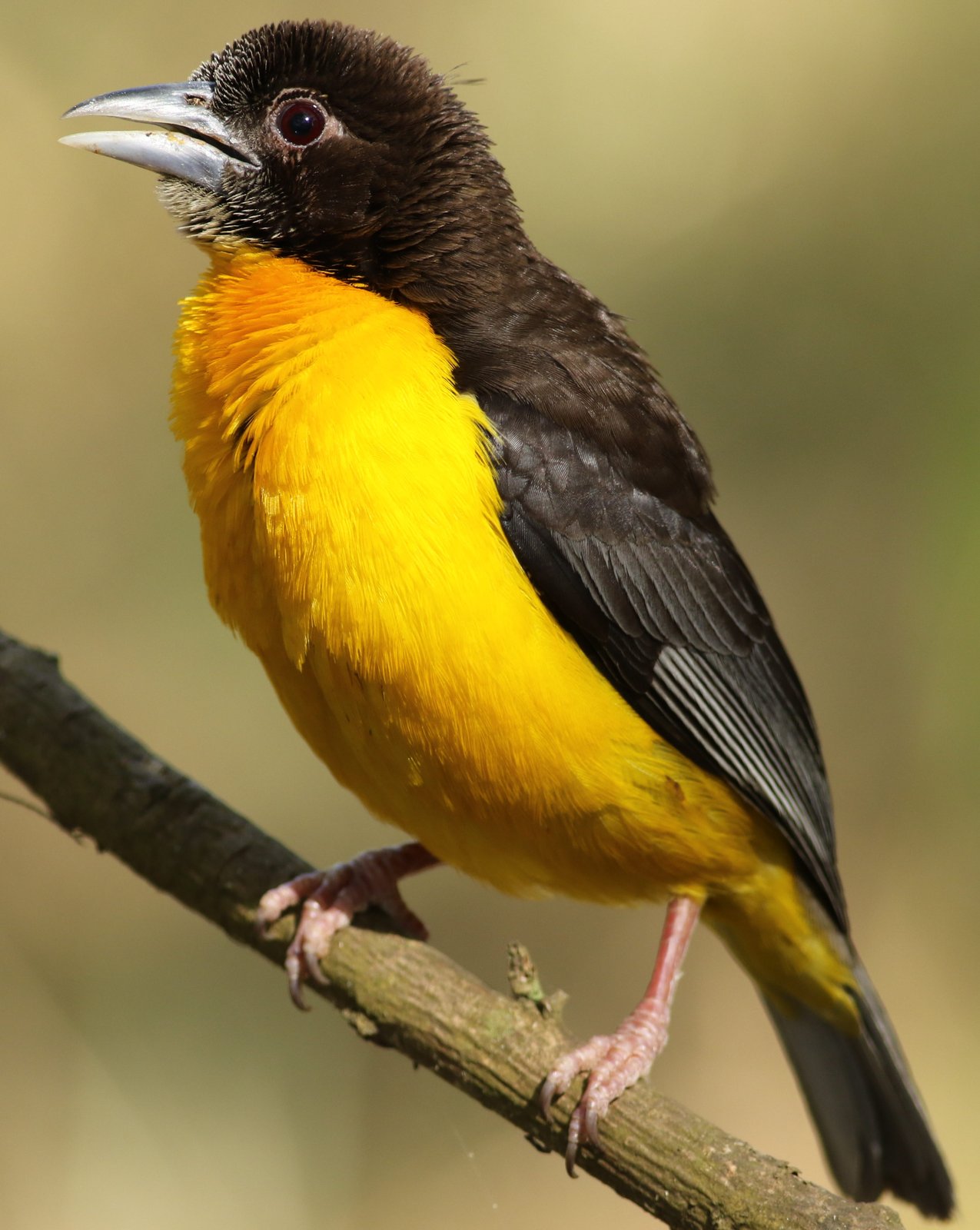
The Dark-Backed Weaver is a solitary forest weaver with dark upperparts and golden-yellow underparts that moves through the canopy in pairs. It is heard more often than seen: the pair sings a melodious, squeaky duet recalling an unoiled hinge. Unlike most weavers it does not breed in colonies.
Voice
The pair sings a duet of clear, squeaky and melodious notes, a descending fwee-oo-fwee, which sounds like an unoiled hinge or a creaking gate, often mixed with a sizzling tszzzz. The call is a sharp chip. The song is heard year-round and is often the first sign of its presence.
Recording: Tim Cockcroft — CC BY-NC-SA 4.0 · converted to mono · xeno-canto
Identification
14–16 cm; a medium-sized weaver with a fairly long, pointed bill. Head, back, wings and tail are dark: blackish to dark slate or chocolate-brown depending on the race. The throat is dark with fine pale speckling, the rest of the underparts bright golden yellow. The bill is strikingly pale, blue-grey to silvery; the eye is red-brown. The sexes are alike and there is no separate non-breeding plumage. Juveniles are duller, with an olive wash above and less bright underparts. It climbs like a tit or nuthatch along branches and among moss and creepers.
Confusion species
No other weaver in the region combines dark upperparts, yellow underparts and a pale bill. Olive-Headed Weaver (Ploceus olivaceiceps) of the miombo of northern Mozambique and Malawi has an olive-green back, a yellow head and a chestnut wash on the breast. Black-Necked Weaver (Ploceus nigricollis) of Angola and Zambia has a yellow head with a black eye-stripe. Yellow-Mantled Weaver (Ploceus tricolor) of northern Angola has chestnut underparts and a yellow back band. Seen from below the species can suggest an oriole; check the bill and listen for the duet.
Habitat
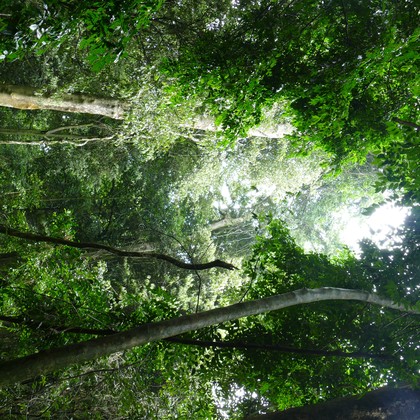
Afromontane forest, coastal and lowland forest, riverine forest and dense thickets, also larger gardens with indigenous trees at the forest edge. It forages in pairs or small family groups in the middle and upper strata of the forest and often joins mixed foraging flocks. It eats mainly insects and spiders, also fruit and nectar. The nest is a loose ball of old man's beard lichen and tendrils with a long entrance tube below, hanging from a branch or creeper, usually solitary.
Where the bird is most at home, classified by the vegetation units of southern Africa.


Range and movements
In eastern South Africa, from the Eastern Cape through KwaZulu-Natal to the escarpment of Mpumalanga and Limpopo, in Eswatini, Mozambique, eastern Zimbabwe, Malawi, northern and eastern Zambia and much of Angola. It is absent from the dry interior and the west. Beyond the region from Tanzania and Kenya through DR Congo to Cameroon.
- Resident
- Summer visitor (c. Oct–Mar)
- Winter visitor (c. Apr–Sep)
- Passage (Mar–Apr, Oct–Nov)
- dark = core range, pale = thinly spread
How and when to look
All year in forest reserves and along forest trails in KwaZulu-Natal, the Eastern Cape and the Eastern Highlands of Zimbabwe. Listen for the squeaky duet and then scan the middle storey of the forest: the pair often moves with other species. The hanging nest with a long tube on an overhanging branch is a good lead in the breeding season (September–January).
Conservation status
Not threatened; common in suitable forest. Locally declined through forest loss, but well represented in protected areas.
Scientific name
Ploceus bicolor | Vieillot, 1819
Vieillot described the species in 1819 and placed it straight away in the genus where it still stands. The genus Ploceus was introduced in 1816 by Cuvier, GLCFD. Ploceus comes from the Greek plokeus, 'plaiter, weaver', for the tightly woven, ball-shaped nest that gives weavers their name. bicolor is Latin for 'two-coloured' — for the sharp contrast between the dark upperparts and yellow underparts. The specimen the first description was based on came from South Africa (originally given in error as Senegal).