All species › Passerines › Sunbirds › Dusky Sunbird
Dusky Sunbird | Cinnyris fuscus
Roethoningzuiger | Suimanga Oscuro
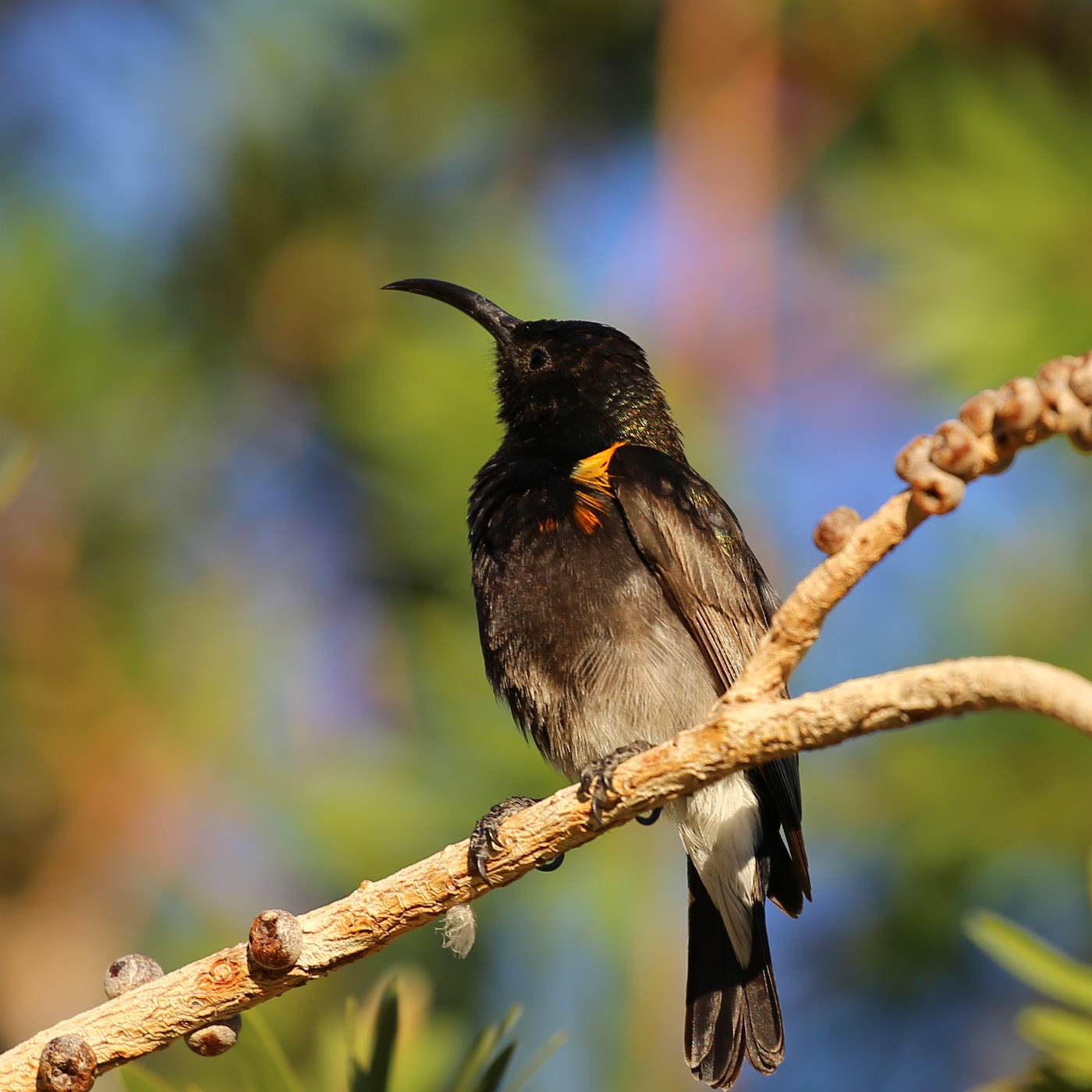
The Dusky Sunbird is the sunbird of the arid western half of the region: karoo, Namib edge and Kalahari. The male is sooty black with a white belly and orange pectoral tufts; the female is one of the plainest, least marked sunbirds in the region.
Click a thumbnail to switch the photo above.
Voice
A fast, loud and melodious song of rolling and chirping notes, chirri-chirri-chirri, often with mimicry woven in. The call is a hard tchek or a dry rattling alarm.
Recording: Bram Vogels — CC BY-NC-SA 4.0 · converted to mono · xeno-canto
Identification
10 to 12 cm, with a short, decurved black bill. The breeding male has head, throat, upperparts and breast dull blackish-brown with a faint bronze-green gloss, a pure white belly into which the black extends irregularly, and bright orange pectoral tufts at the sides of the breast. Outside the breeding season the male is largely grey-brown with a black stripe down the centre of throat and breast, and intermediate plumages with black blotches are common. The female is pale grey-brown above and off-white below, almost unmarked, with a dark tail; juveniles are similar but slightly yellowish below.
Confusion species
The male Marico Sunbird (Cinnyris mariquensis) has a black belly and a metallic green head and back, not a white belly. White-Bellied Sunbird (Cinnyris talatala) has a white belly but a metallic green head and a purple breast band. The female Southern Double-Collared Sunbird (Cinnyris chalybeus) is more olive and darker grey below than the pale, sandy female Dusky. In the western karoo Dusky Sunbird is usually the only sunbird with a white belly.
Habitat
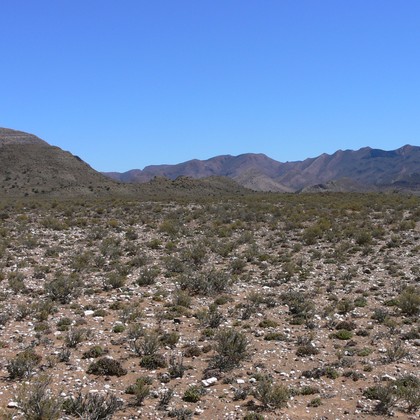
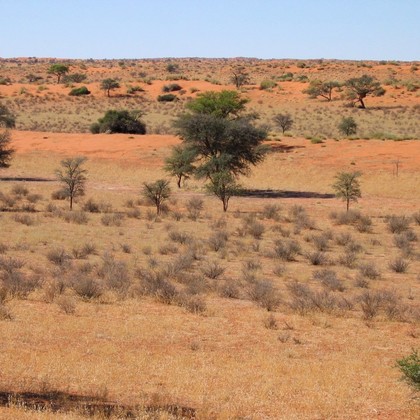
Dry shrub savanna, karoo veld, rocky slopes with aloes, dry riverbeds with acacias, the edge of the Namib and gardens in towns in arid country. It follows the flowering of aloes, Lycium, mistletoe and exotic plants, and also eats many insects.
Where the bird is most at home, classified by the vegetation units of southern Africa.

Range and movements
Near-endemic to the west of the region: almost all of Namibia (except the barest parts of the Namib), south-western and central Botswana, the Northern Cape, the north and interior of the Western Cape (Namaqualand, Tanqua Karoo) and the western Eastern Cape; it sometimes wanders further east. Also in south-western Angola. Not found outside the region.
- Resident
- Winter visitor (c. Apr–Sep)
- Passage (Mar–Apr, Oct–Nov)
- dark = core range, pale = thinly spread
How and when to look
In Namibia the species is common in gardens with flowering shrubs in Windhoek and in the Etosha rest camps. In the Cape karoo, flowering aloes in winter are the best spot. Because the species is nomadic, it may be absent from a site for months and then suddenly be numerous.
Conservation status
Not threatened. Common within a large, thinly populated range; gardens and exotic flowers planted in dry towns provide extra food. There is no evidence of decline.
Scientific name
Cinnyris fuscus | Vieillot, 1819
Vieillot described the species in 1819 and placed it straight away in the genus where it still stands. The genus Cinnyris was introduced in 1816 by Cuvier, GLCFD. Cinnyris derives from the Greek kinnuris, the name of a small bird mentioned by the lexicographer Hesychius that cannot be identified further. fuscus is Latin for 'dark, dusky', for the male's dark upperparts and throat. The specimen the first description was based on came from Great Namaqualand, Namibia.