All species › Kingfishers, bee-eaters and rollers › Rollers › European Roller
European Roller | Coracias garrulus
Scharrelaar | Carraca Europea
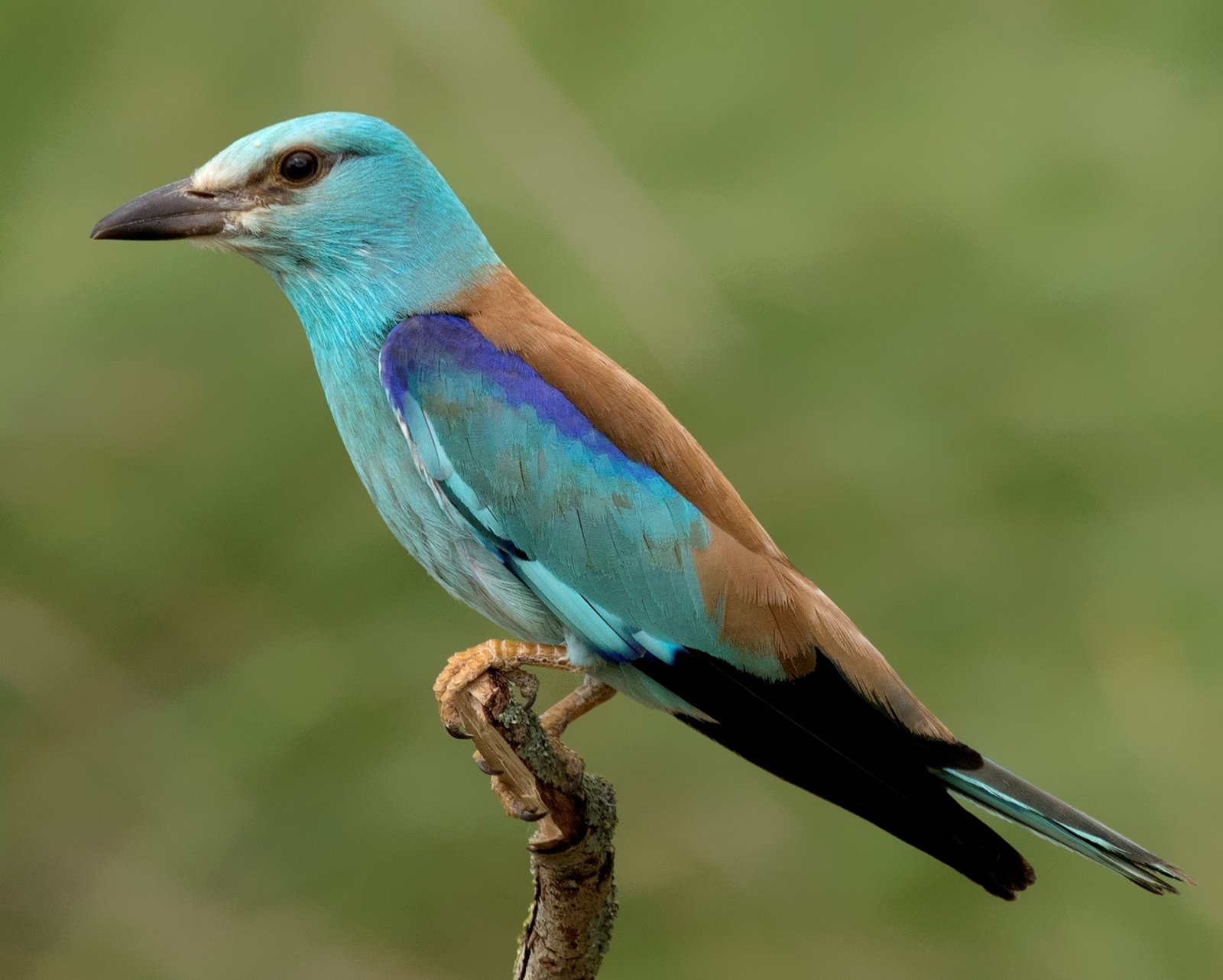
The European Roller is the only roller in the region that does not breed here: a migrant from Europe and Asia that spends the northern winter in the savannas of East and southern Africa. It is bulkier and more uniformly blue than the Lilac-Breasted Roller and, like it, perches in the open on dead branches and wires, often in loose groups on migration.
Voice
Largely silent in the wintering range. At times a short, dry, grating rak-rak or a hoarse kschaak, mainly in squabbles over a perch or when disturbed.
Recording: Esperanza Poveda — CC BY-NC-SA 4.0 · shortened to the first 60 s, mono · xeno-canto
Identification
About 31 cm, with a square tail lacking streamers. Head, neck and underparts are bright turquoise to azure, the mantle and scapulars warm cinnamon-brown. In flight the blackish flight feathers contrast sharply with the pale blue underwing and the ultramarine and turquoise coverts; the rump is violet-blue. The sexes are nearly alike. Many birds in the region are in worn or moulting plumage, duller and washed greenish; first-year birds have a brownish wash on head and breast and fine pale streaking on the throat.
Confusion species
Lilac-Breasted Roller (Coracias caudatus) has a lilac throat and breast and, in adults, two tail streamers; even juveniles without streamers show a lilac-brown breast and a whitish forehead. Racket-Tailed Roller (Coracias spatulatus) is slimmer, with a white forehead and outer tail feathers ending in spatules. Purple Roller (Coracias naevius) is purple-brown with white streaking and a white supercilium. Broad-Billed Roller (Eurystomus glaucurus) is smaller, cinnamon, with a broad yellow bill.
Habitat
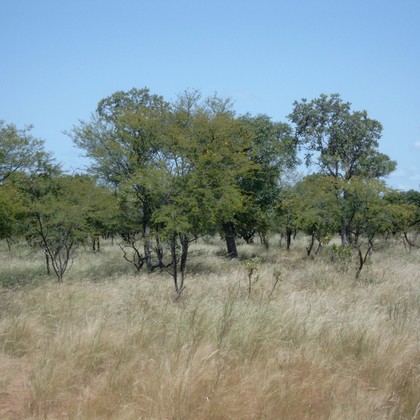
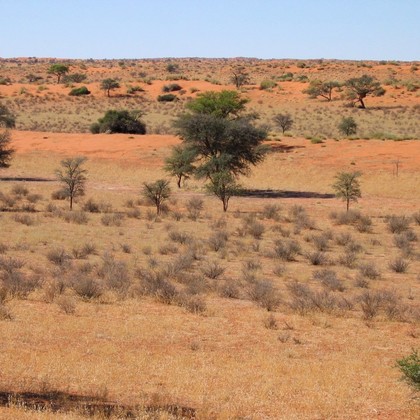
Dry open savanna with scattered trees, thornveld, Kalahari sandveld and open mopane and mixed woodland, also farmland with roadside wires. It hunts from a perch for large insects, mainly grasshoppers and beetles, and gathers at emerging termites after rain. Dense woodland is avoided.
Where the bird is most at home, classified by the vegetation units of southern Africa.

Range and movements
Spread through the north and east of the region: Zambia, Malawi, Mozambique, Zimbabwe, Botswana (especially the east and the Kalahari), northern Namibia, Eswatini and northern and eastern South Africa; scarce further south and west and in Angola. It breeds from north-west Africa and southern and eastern Europe to Central Asia and winters mainly in East and southern Africa, a smaller part in West Africa.
- Summer visitor (c. Oct–Mar)
- Passage (Mar–Apr, Oct–Nov)
- dark = core range, pale = thinly spread
How and when to look
December to March in the dry north of South Africa, in Botswana and in Zimbabwe; in Kruger and the Kalahari dozens may line roadside wires in wet summers. Look among the Lilac-Breasted Rollers for the bulkier, plain blue bird without streamers. Spring migration in March–April heads north through East Africa.
Conservation status
Not globally threatened; the species was formerly listed as Near Threatened, but recovery in parts of Europe led to a lower category. In the breeding range the loss of old trees with nest holes, agricultural intensification and hunting on migration play a part. In the wintering range the conversion of savanna to cropland and insecticides are the main threats.
Scientific name
Coracias garrulus | Linnaeus, 1758
Linnaeus described the species in 1758 and placed it straight away in the genus where it still stands. He introduced the genus Coracias in that same work. Coracias is the Greek word for a crow-like bird, used by Aristotle for a jackdaw or raven; later authors applied the name to the rollers, which are not related to crows in any way. garrulus is Latin for 'chattering, noisy', from garrire 'to chatter', after the harsh call. The specimen the first description was based on came from Sweden.