All species › Passerines › Wagtails and pipits › Fülleborn's Longclaw
Fülleborn's Longclaw | Macronyx fuelleborni
Fülleborns langklauw | Bisbita de Fülleborn
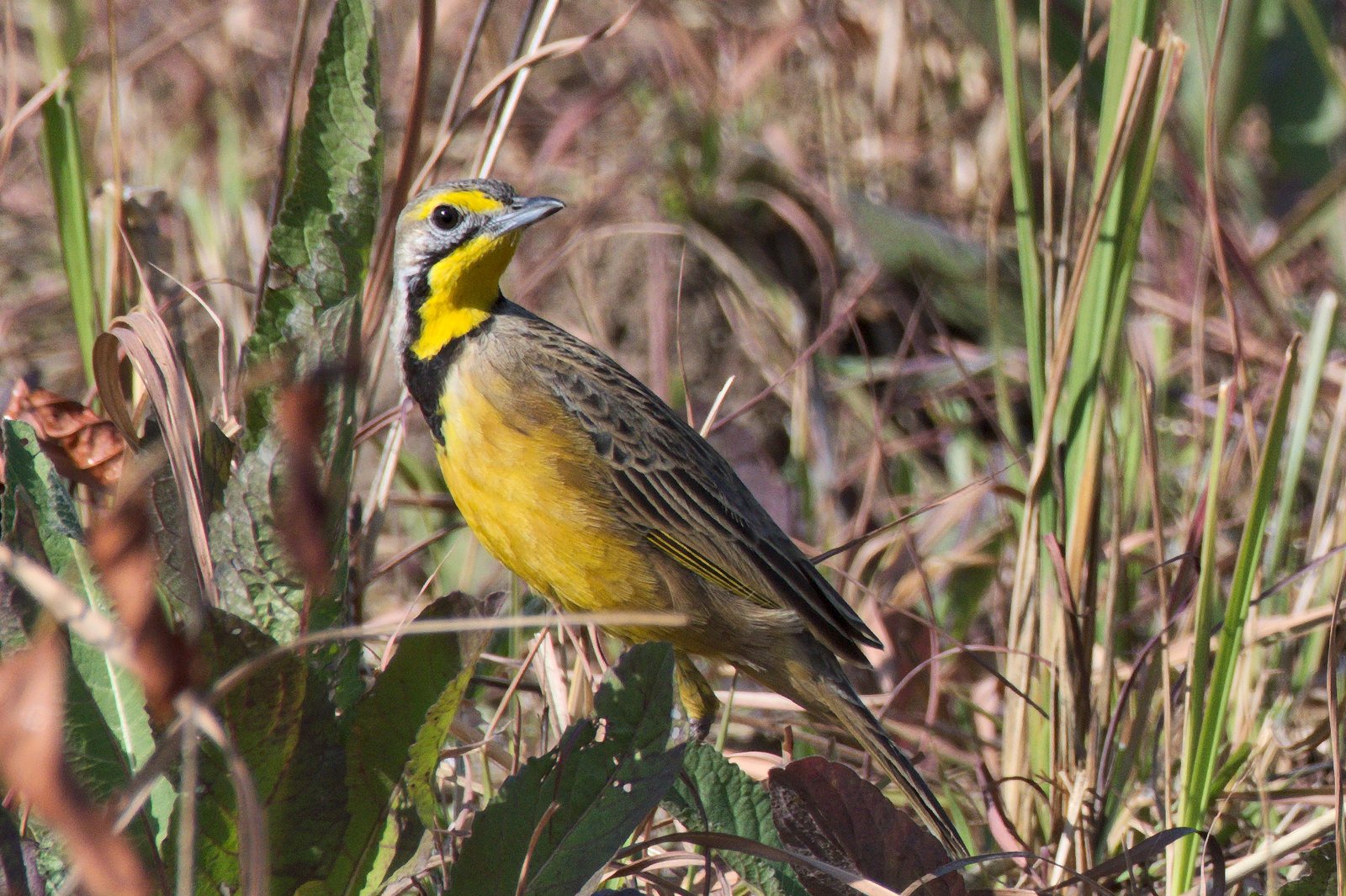
Fülleborn's Longclaw is the dull, ochre-yellow longclaw of the high grasslands and dambos of Angola, Zambia and south-western Tanzania. Where Yellow-Throated Longclaw occupies the wetter lowlands, this species takes over the drier grassland plateaus.
Voice
A clear, penetrating whistled tchoo-wee and a series of chip-chip-chip, given from a termite mound or in song flight. The alarm is a mewing meew, lower and harsher than in Yellow-Throated Longclaw.
Recording: Thibaut Chansac — CC BY-NC-SA 4.0 · converted to mono · xeno-canto
Identification
A heavy longclaw of 20 to 21 cm with a strong bill and a long hind claw. The upperparts are greyish-brown and densely streaked dark. Throat and belly are dull yellow, the breast and flanks ochre to warm tawny-yellow, so the underparts look far less bright than in Yellow-Throated Longclaw. The black necklace is narrow and sometimes broken. The tail is dark with white corners. The sexes are alike; juveniles are buff with hardly any yellow and a necklace of spots. It often perches on a termite mound or grass tuft and flies with stiff, rapid beats and short glides.
Confusion species
Yellow-Throated Longclaw (Macronyx croceus) is brighter lemon-yellow with a broader, sharper necklace and black-streaked flanks, perches more in trees and lives lower and wetter. Grimwood's Longclaw (Macronyx grimwoodi) of north-western Zambia and eastern Angola has a pink rather than yellow throat. Juveniles of both are hard to separate in the field; check the accompanying adults.
Habitat
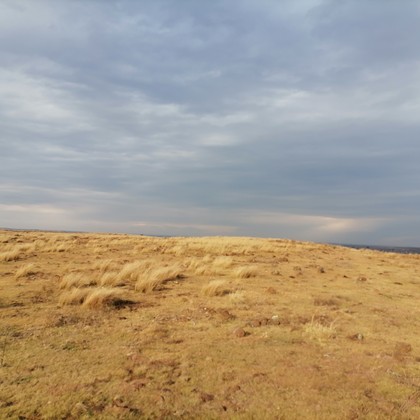
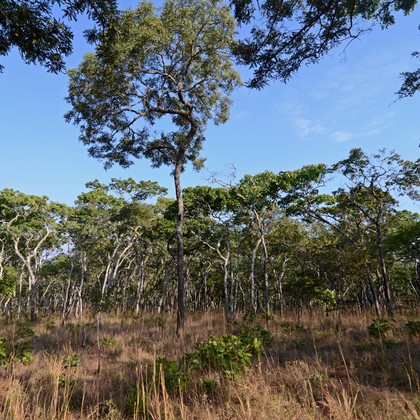
Short to medium grassland on plateaus and high plains, the edges and drier parts of dambos, and grassy plains within miombo, mostly between 1000 and 2400 m. Less tied to wet ground than Yellow-Throated Longclaw. It forages on foot for insects, often on freshly burnt patches.
Where the bird is most at home, classified by the vegetation units of southern Africa.

Range and movements
In the region in central and eastern Angola, in Zambia mainly in the north and west (including the Copperbelt plateau and around Mwinilunga), and locally in northern Malawi. Beyond the region in southern DR Congo and south-western Tanzania.
- Resident
- dark = core range, pale = thinly spread
How and when to look
Look for the species on open grassland plateaus and in broad dambos in north-western Zambia and Angola, ideally in the early morning when the birds sing from termite mounds. Where it occurs alongside Yellow-Throated Longclaw, the duller ochre-yellow underparts with the narrow necklace are the best feature.
Conservation status
Not threatened. The species is locally common across a large range of little-altered grassland. Too frequent burning, intensive grazing and conversion of dambos to cultivation may cause local declines.
Scientific name
Macronyx fuelleborni | Reichenow, 1900
Reichenow described the species in 1900 and placed it straight away in the genus where it still stands. The genus Macronyx was introduced in 1827 by Swainson. Macronyx comes from the Greek makros, 'long', and onux, 'claw' — for the very long hind claw of these birds. fuelleborni honours the German army physician and explorer Friedrich Fülleborn (1866–1933), who collected in German East Africa. The specimen the first description was based on came from Unika highlands, south-western Tanzania.