All species › Birds of prey › Hawks, eagles and kites › Gabar Goshawk
Gabar Goshawk | Micronisus gabar
Gabarhavik | Gavilán Gabar
The Gabar Goshawk is a small, grey hawk of dry savanna and thornveld, with red legs, a red cere and a conspicuous white rump. It hunts small birds, often pulling them from nests and weaver colonies. The nest is almost always covered by the webs of social spiders, which seem to serve as camouflage.

Voice
A high, rapid piping kee-kee-kee-kee-kee, mainly in the breeding season, and a sharp, repeated keep.
Recording: David Darrell-Lambert — CC BY-NC-SA 4.0 · converted to mono · xeno-canto
Identification
28–36 cm, wingspan 56–64 cm. Adults are plain grey above, with grey head, throat and breast and a finely grey-and-white barred belly. The white rump is obvious in flight and when the bird flushes. The tail is grey with four dark bands, the eyes are dark red, cere and legs coral-red. In flight the flight feathers are finely barred below. About a quarter of birds are melanistic: wholly black, without a white rump, but with the same red legs and cere and grey-barred flight feathers and tail. The female is clearly larger. Juveniles are brown with a streaked breast and barred belly, yellow legs and already a white rump.
Confusion species
Shikra Tachyspiza badia lacks the white rump, has a paler, finely rufous-barred breast, yellow legs and an orange-red eye. Little Sparrowhawk Tachyspiza minulla is smaller, with yellow cere and legs and two white spots on the tail. Ovambo Sparrowhawk Accipiter ovampensis is barred all over below, has white shaft spots on the tail and orange to yellow legs; its dark morph also has orange legs but no red cere. Dark Chanting Goshawk Melierax metabates is much larger, with longer legs and a grey-barred rump.
Habitat
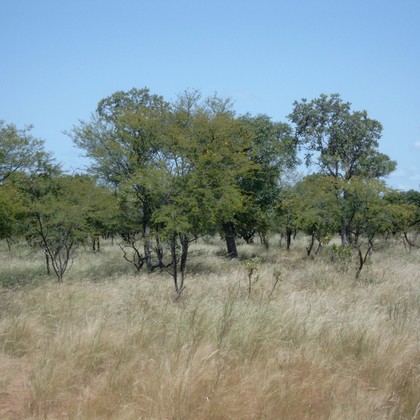
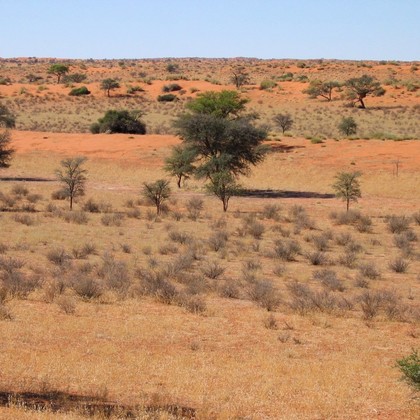
Dry savanna, acacia thornveld, Kalahari thornveld and mopane woodland, also along dry riverbeds in semi-desert and in gardens and farmyards with tall trees. It hunts from a concealed perch and dashes through bushes; it also raids the nests of weavers and other small birds, sometimes tearing open the entrance. The nest is placed in a thin fork high in a thorn tree.
Where the bird is most at home, classified by the vegetation units of southern Africa.

Range and movements
Widespread over most of the region: all of Namibia, Botswana, Zimbabwe, Zambia, Malawi, Mozambique and Angola, and in South Africa in the north, east and interior into the Karoo and the Northern Cape. Scarce or absent in the south-western Cape, on the high grasslands and in Lesotho, and in dense forest. Beyond the region it occurs in sub-Saharan Africa and south-western Arabia.
- Resident
- Summer visitor (c. Oct–Mar)
- Winter visitor (c. Apr–Sep)
- Passage (Mar–Apr, Oct–Nov)
- dark = core range, pale = thinly spread
How and when to look
Listen for the high piping in thornveld around waterholes and weaver colonies. A small hawk dashing away low with a bright white rump and red legs is almost always this species. In the Kalahari and at Etosha black birds are also seen regularly. At a suspected nest, look for the grey spider webs that cover it.
Conservation status
Not threatened; common and widespread in dry savanna. It adapts well to farmland with trees and to gardens. It may suffer locally from poisoned bait and pesticides, but the population is considered stable.
Scientific name
Micronisus gabar | (Daudin, 1800)
Daudin described the species in 1800 as Falco gabar; because it was later moved to another genus, the author and year stand in brackets. The genus Micronisus was introduced in 1840 by Gray. Micronisus comes from the Greek mikros, 'small', and Nisus, the mythical king turned into a sparrowhawk, whose name came to be used for sparrowhawks. gabar is, according to Jobling, a homophone of the French garde, 'watchman, guard', and barré, 'barred'; the name goes back to Levaillant's 'Gabar' (1798). The specimen the first description was based on came from inner South Africa.