All species › Waders, gulls and terns › Skuas › Great Skua
Great Skua | Stercorarius skua
Grote jager | Págalo Grande
The Great Skua is a heavy, gull-like predatory seabird that breeds around the North Atlantic and wanders south during the northern winter. Off southern Africa it is a rare visitor, overshadowed by the far commoner Brown Skua, from which it is barely separable in the field.
Voice
Silent at sea.
Recording: Stanislas Wroza — CC BY-NC-SA 4.0 · shortened to the first 60 s, mono · xeno-canto
Identification
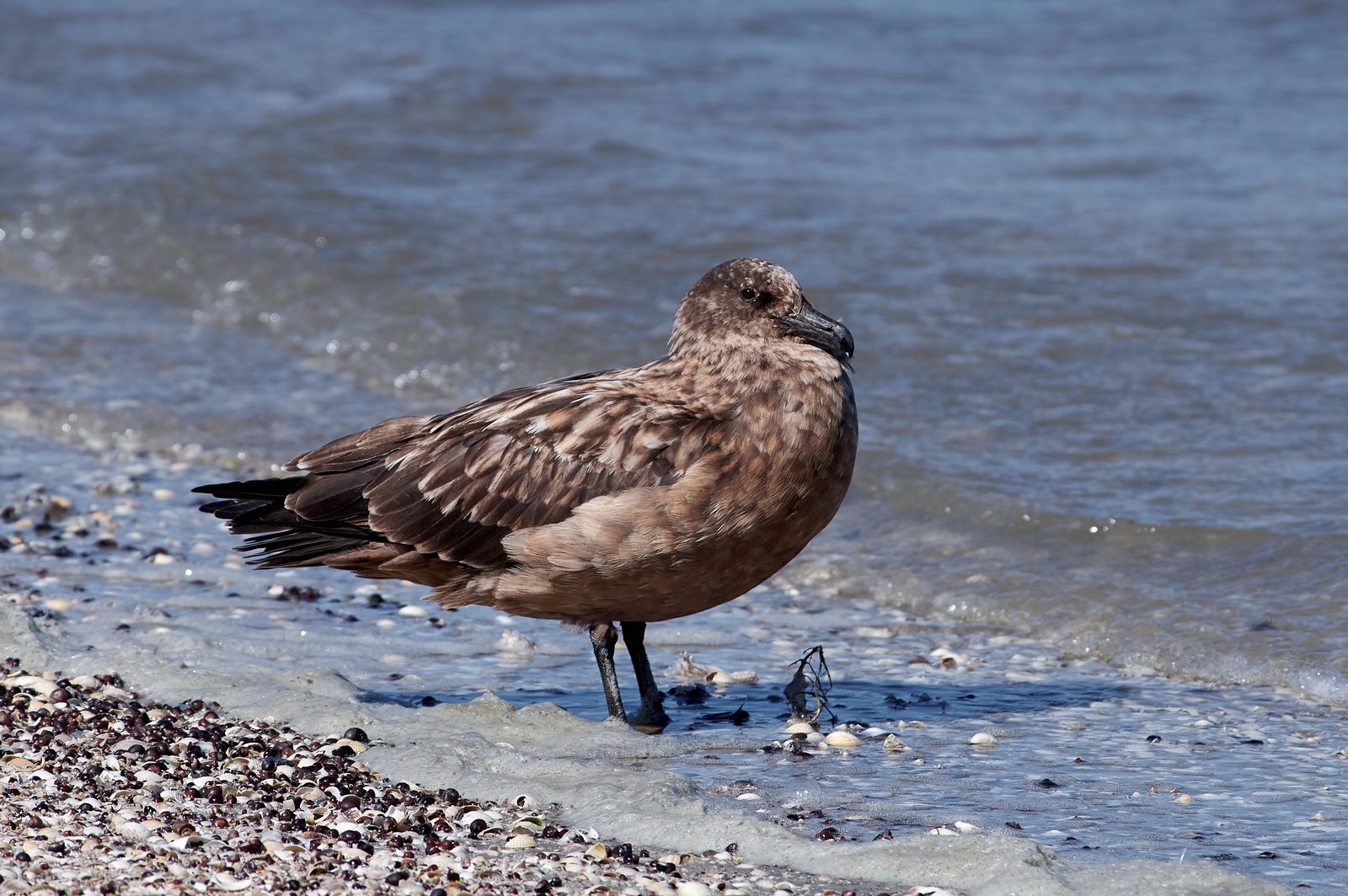
53–58 cm. A bulky, compact skua with broad wings, a short, wedge-shaped tail without projections and a heavy, black, gull-like bill. Warm brown, with golden and rufous streaks and spots on the mantle and scapulars; the cap is often slightly darker. Large, conspicuous white patches at the base of the primaries, both above and below. Juveniles are plainer, with warm rufous-brown underparts, less streaking and a smaller white wing patch. The flight is powerful, with slow beats.
Confusion species
Brown Skua Stercorarius antarcticus is larger and heavier, darker and colder brown, with less golden streaking and a heavier bill; juveniles in particular often cannot be identified without photographs. South Polar Skua Stercorarius maccormicki is smaller with a finer bill, greyer and without golden tones; pale birds show a pale head and body against dark wings. A dark juvenile Pomarine Jaeger Stercorarius pomarinus is slimmer and narrower-winged, with a smaller white wing flash and barred tail coverts.
Habitat
The open sea, mainly over the continental shelf and at trawlers, where it fights other seabirds for offal. It steals fish from gannets and gulls and also kills smaller seabirds.
Where the bird is most at home, classified by the vegetation units of southern Africa.

Range and movements
Only a handful of documented records, mainly at sea off Namibia and the west coast of South Africa. Because it closely resembles Brown Skua, the species is probably overlooked. It breeds in Iceland, the Faroes, Scotland, Norway and Svalbard and winters mainly off western Europe, West Africa and Brazil.
- Passage (Mar–Apr, Oct–Nov)
- dark = core range, pale = thinly spread
How and when to look
Check every large skua at trawlers on pelagic trips from Cape Town and Walvis Bay critically: warm, golden streaking on the mantle and a slightly slimmer build point to Great Skua. Good photographs of the mantle, head and underwing are essential; without evidence a record will not be accepted.
Conservation status
Not threatened, but the world population is small and largely concentrated in Scotland; in 2021 and 2022 avian influenza killed large numbers in the breeding colonies.
Scientific name
Stercorarius skua | (Brünnich, 1764)
Brünnich described the species in 1764 as Catharacta Skua; because it was later moved to another genus, the author and year stand in brackets. The genus Stercorarius was introduced in 1760 by Brisson. Stercorarius is Latin for 'of dung', from stercus 'dung': the food disgorged by seabirds when pursued by skuas was once taken for excrement. skua comes from Faroese skúgvur, the name for this bird; the island of Skúvoy is renowned for its colony. The specimen the first description was based on came from the Faroe Islands and Iceland.