All species › Cuckoos › Cuckoos › Green Malkoha
Green Malkoha | Ceuthmochares australis
Groene geelsnavelmalkoha | Malcoha Africano Oriental
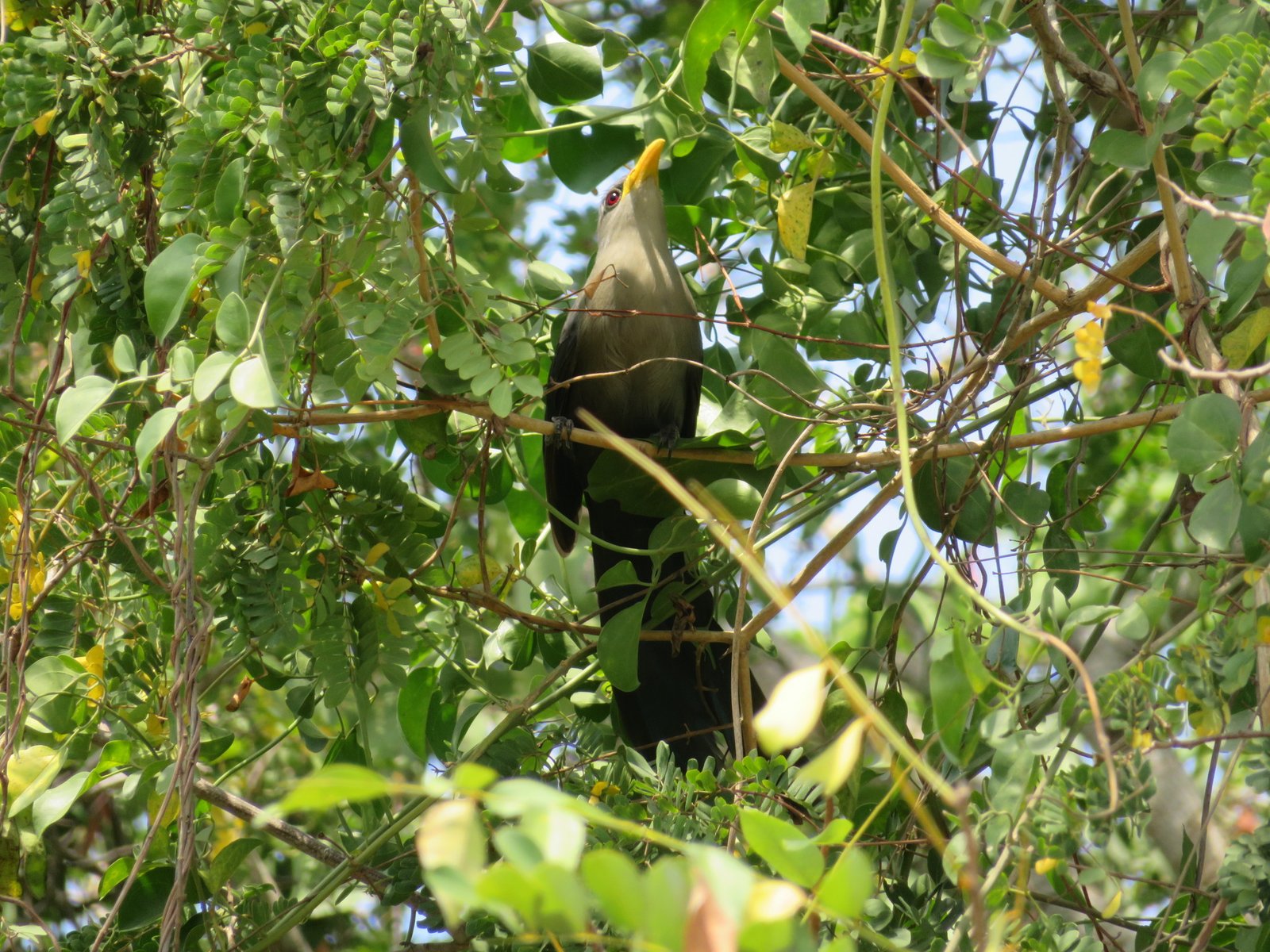
The Green Malkoha is a slender, long-tailed cuckoo with a thick, bright yellow bill that creeps like a mouse through dense foliage. Unlike most cuckoos of the region it is not a brood parasite: the pair builds its own nest and raises its own young. Usually only the ticking, accelerating call gives it away.
Voice
A series of dry clicks that speed up and run into a rattle, tik ... tik ... tik-tik-tiktiktrrrr, likened to a clock running down. Also a soft, plaintive whistled kyeew and a sharp click as a contact call. Calls all year but most in the breeding season, October to January.
Recording: Magnus Wadstein — CC BY-NC-SA 4.0 · converted to mono · xeno-canto
Identification
32–35 cm, over half of which is tail. The upperparts are dark olive-green with a green to blue-green gloss, the wings and the long, broad tail slightly darker and more strongly glossed. Head and underparts are grey, paler on throat and breast and darker on the belly. The bill is thick, curved and bright yellow, with a small yellow patch of bare skin before the eye; the iris is red. The sexes are alike. Juveniles are duller with a darker bill. It moves stealthily, clambering through creepers and dense canopy, and rarely crosses open ground.
Confusion species
Over most of its range no confusion is possible: no other dark, long-tailed forest bird has such a thick yellow bill. In the north-west of the region Blue Malkoha Ceuthmochares aereus occurs; it is darker slate-grey with a blue rather than green gloss and darker grey underparts. The ranges of the two may meet in Zambia.
Habitat
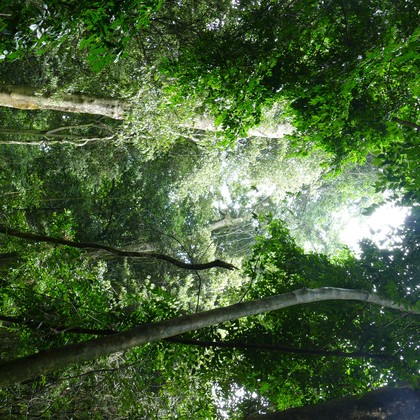
Dense evergreen lowland and coastal forest, riverine forest, forest edges rich in creepers and overgrown thickets, also dense forest patches down to parks. It forages in the mid-stratum and canopy for caterpillars, grasshoppers, beetles and other insects, plucked from leaves and twigs with the heavy bill. The nest is a shallow cup of twigs in a dense shrub or creeper.
Where the bird is most at home, classified by the vegetation units of southern Africa.

Range and movements
An eastern forest belt: the coastal and riverine forests of north-eastern KwaZulu-Natal and eastern Eswatini, then through Mozambique, eastern Zimbabwe (Chimanimani and the lower Zambezi Valley), Malawi and eastern Zambia. Beyond the region along eastern Africa north to Somalia.
- Resident
- Summer visitor (c. Oct–Mar)
- Winter visitor (c. Apr–Sep)
- Passage (Mar–Apr, Oct–Nov)
- dark = core range, pale = thinly spread
How and when to look
Walk slowly through coastal forest or dense riverine forest, for instance in Zululand or the lowland forests of Mozambique, and listen for the accelerating ticking. The bird often sits motionless in a tangle of creepers; wait for movement and look for the yellow bill, which is the first thing to catch the eye. It often forages with mixed bird parties.
Conservation status
Not threatened and widespread over a large range. In the south of its range, especially KwaZulu-Natal, it is vulnerable to clearing and fragmentation of coastal and riverine forest, but it persists in small, dense forest remnants.
Scientific name
Ceuthmochares australis | Sharpe, 1873
Sharpe described the species in 1873 and placed it straight away in the genus where it still stands. The genus Ceuthmochares was introduced in 1863 by Cabanis & Heine. Ceuthmochares comes from the Greek keuthmos, 'hiding place', and chairō, 'to rejoice' — 'delighting in hiding', for its secretive life in dense foliage. australis is Latin for 'southern' — for its range in southern Africa. The specimen the first description was based on came from KwaZulu-Natal, South Africa.