All species › Turacos › Turacos › Grey Go-Away-Bird
Grey Go-Away-Bird | Crinifer concolor
Vale toerako | Turaco Unicolor
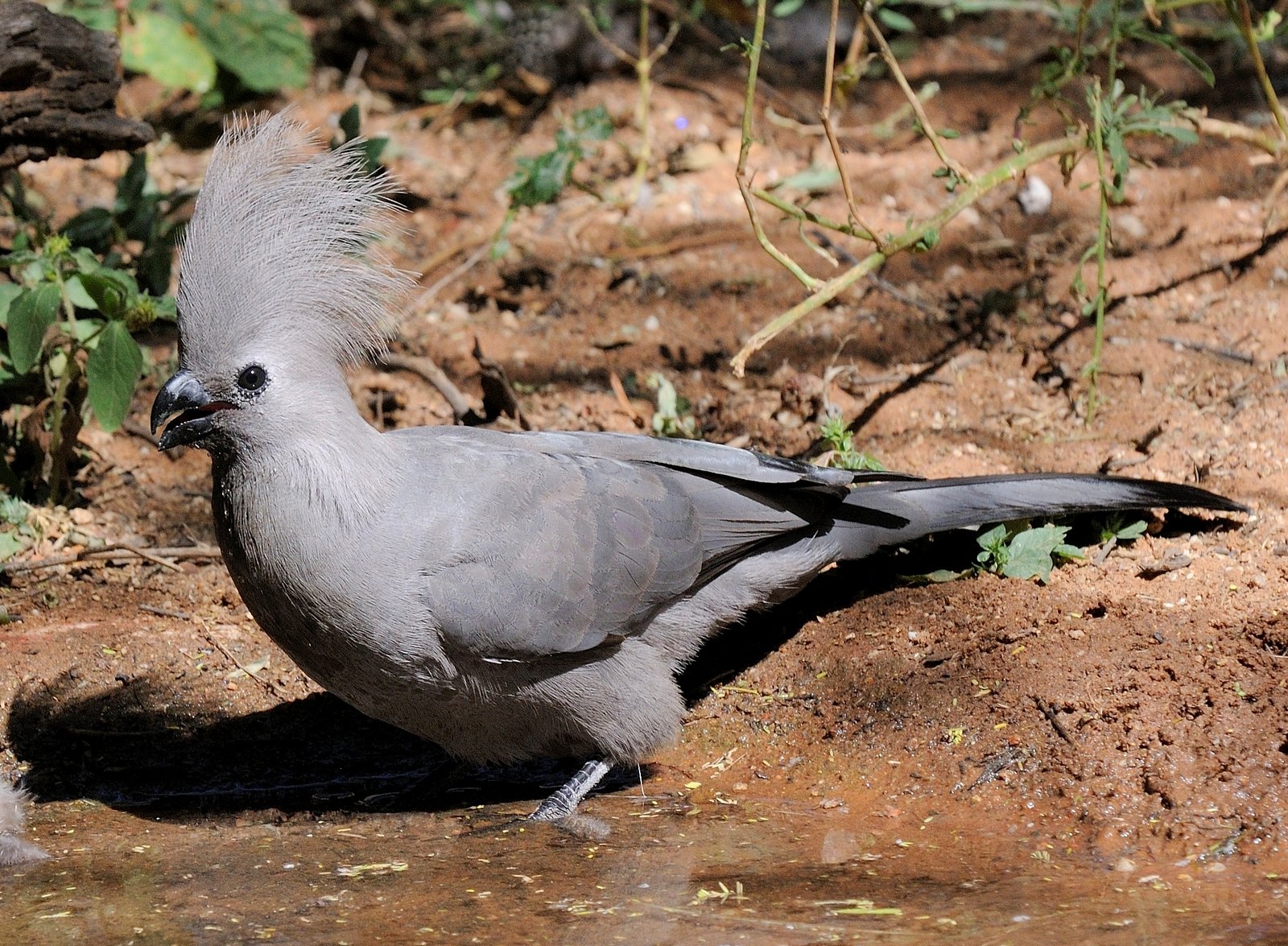
The Grey Go-Away-Bird is a plain grey, long-tailed bird of dry savanna with a shaggy crest, known for its nasal go-waaay call that gave it its name. Where it occurs it is often the first bird to raise the alarm.
Voice
A drawn-out, nasal, plaintive go-waaay or kweeh-h, often repeated, loud and with an irritated tone, especially at danger. Also a bleating croak between group members and a series of haa-haa-haa.
Recording: African Bioacoustics Community — CC BY-NC-SA 4.0 · shortened to the first 60 s, mono · xeno-canto
Identification
About 47 to 50 cm, more than half of it tail. Entirely ash-grey, slightly paler on the belly, with a long shaggy crest that can be raised or laid flat. The short thick bill and the legs are black, the eye dark. No red in the wing and no facial markings. Sexes alike; juveniles are browner with a shorter crest. It lives in pairs or groups, likes to perch high and conspicuous on a treetop and flies with shallow wingbeats and long glides.
Confusion species
In northern Zambia Bare-Faced Go-Away-Bird (Crinifer personatus) may occur, which has a bare black face and a white neck and upper breast; the ranges barely meet. Other turacos are green or blue with red primaries. At distance the long-tailed, crested silhouette sometimes suggests a mousebird, but those are much smaller.
Habitat
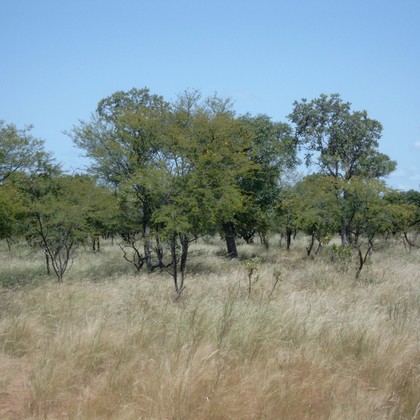
Dry open savanna, acacia thornveld, mopane and mixed woodland, often near water, also in gardens, parks and around villages. It eats fruit, leaves, flowers, buds and nectar, and to a lesser extent insects; it drinks regularly.
Where the bird is most at home, classified by the vegetation units of southern Africa.


Range and movements
Common over much of the region: northern and central Namibia, all of Botswana except the south-west, Zimbabwe, southern and western Zambia, southern Angola, southern Mozambique, southern Malawi, Eswatini and northern and eastern South Africa (Limpopo, Mpumalanga, Gauteng, North West and northern KwaZulu-Natal). Beyond the region to south-eastern DR Congo and south-western Tanzania.
- Resident
- Summer visitor (c. Oct–Mar)
- Winter visitor (c. Apr–Sep)
- Passage (Mar–Apr, Oct–Nov)
- dark = core range, pale = thinly spread
How and when to look
One of the easiest birds in almost any savanna park, from Kruger and Etosha to the Okavango. On hearing the plaintive go-waaay, check the top of the nearest tree: the bird often sits there in full view. Other birds and mammals respond to its alarm call, making it a useful informer on predators.
Conservation status
Not threatened, common and increasing in parts of its range as it adapts well to gardens and settlements with fruit trees. No significant threats are known.
Scientific name
Crinifer concolor | (Smith, 1833)
Smith described the species in 1833 as Corythaix concolor; because it was later moved to another genus, the author and year stand in brackets. The genus Crinifer was introduced in 1821 by Jarocki. Crinifer comes from the Latin crinis, 'hair', and -fer, 'bearing' — 'hair-bearer', for the shaggy crest. concolor is Latin for 'of one colour', from con- 'alike' and color 'colour', for the uniformly grey plumage. The specimen the first description was based on came from inland from Port Natal (Durban).